

Feb 10, 2026
How Stablecoin Banking Partnerships Are Shaping FinTech in 2026

By Fraxtional LLC

Stablecoins, digital currencies pegged to traditional assets such as the U.S. dollar, have progressed from niche crypto assets to critical components of global finance.
In 2025, stablecoin transaction volumes grew significantly, with more than 30% of all crypto activity involving stablecoins. As a result, banks and FinTechs are increasingly integrating these digital assets into their payment systems and treasury operations.
Stablecoin banking partnerships, i.e., collaborations between financial institutions and stablecoin ecosystems, are now central to modernizing payments. This reduces transaction costs and ensures compliance with emerging regulations.
This blog explores why these partnerships are becoming essential in 2026, the value they deliver to key players, and what investors and decision-makers should consider for future growth.
A Quick Glance
- Stablecoin partnerships are critical for banks and FinTechs to enable faster, more cost-effective cross-border payments.
- The GENIUS Act provides regulatory clarity, reducing risks and enhancing stablecoin integration.
- Banks prefer to partner with established stablecoin ecosystems rather than self-issuing, given regulatory and market advantages.
- Fractional leadership ensures stablecoin adoption is compliant, strategic, and risk-managed.
- Stablecoin partnerships explore new revenue opportunities through innovative financial products and services.
The Shift Toward Stablecoin Banking Partnerships

Stablecoins are no longer a fringe crypto trend. They're reshaping the financial infrastructure that sits at the heart of payments and liquidity management for banks, FinTechs, and investors.
Between 2023 and 2024, stablecoin transaction volumes rose from roughly $7.6 trillion to over $18 trillion, an increase of more than 140 % in a single year. This growth wasn't limited to crypto trading; stablecoins now facilitate billions of dollars in daily settlement activity across networks.
What's driving this shift?
1. Modern payment expectations:
Traditional cross‑border transfers still take 3–5 business days and involve multiple intermediaries. Stablecoins settle in minutes and operate 24/7, without holiday or weekend delays, making them a compelling alternative for high‑volume payment flows.
2. Real traction with institutions:
Nearly half (49 %) of surveyed financial institutions have already integrated stablecoins into payments or treasury workflows, with another 41 % in pilot or planning phases. Banks aren't waiting on the sidelines; they're testing and deploying.
3. Clearer regulation:
Recent U.S. legislation, such as the GENIUS Act, established the first comprehensive regulatory framework for payment stablecoins. This enables banks and financial firms to operate within defined guardrails and reduces compliance uncertainty.
For FinTech CEOs, sponsors, and investors, this means we've moved past the question of whether stablecoins matter. The question today is how banking partnerships will know their value, especially as legacy payment rails struggle to match the speed, transparency, and programmability that stablecoins offer.
Stablecoin banking partnerships are thus emerging not just as innovation pilots, but as critical infrastructure for future competitiveness in digital finance. Let's see the real definition of it.
What Stablecoin Banking Partnerships Really Mean

Stablecoin banking partnerships provide a practical model for banks and financial institutions to work directly with stablecoin ecosystems to offer real‑time, compliant digital-money services. This collaboration enables banks and FinTechs to use blockchain‑based digital cash without building and managing the underlying infrastructure themselves.
This is a major advantage as the industry approaches 2026.
A common question decision‑makers ask is: Should a bank issue its own stablecoin or partner with an established issuer? The answer generally favors partnerships for two key reasons:
- Regulatory and compliance complexity: Issuing a stablecoin requires meeting strict licensing, reserve, and reporting standards. In many jurisdictions, only regulated financial institutions can issue stablecoins directly.
- Network effects and adoption: Working with a recognized stablecoin network instantly gives access to liquidity, merchant integrations, and market familiarity, which can take years to build from scratch.
In simple terms, partnerships allow banks to capture market opportunities quickly and with less risk than creating their own stablecoin. This aligns with the global regulatory clarity, as frameworks increasingly encourage collaboration between traditional finance and digital asset issuers.
Who Are Stablecoin Partner Companies
Stablecoin partner companies provide the infrastructure, compliance tools, and rails needed for financial institutions to adopt digital cash smoothly. Some examples of these partners include:
- BVNK — Offers licensed, enterprise‑grade stablecoin payments infrastructure across 130+ jurisdictions, enabling compliant global payouts and treasury flows.
- Reap Technologies — Provides merchant and B2B payment systems that link traditional financial systems with stablecoin networks for faster and cheaper settlement.
- Thunes — A global payments network that enables cross‑border settlement into stablecoin wallets and traditional bank accounts, expanding global reach.
- Rain & Draft — Stablecoin‑linked payment cards and APIs that help institutions deliver digital money services to customers and partners.
These partners vary in specialization. Some focus on settlement rails, some on payment interfaces, and others on compliance and custody. But all help banks and FinTechs enter the stablecoin ecosystem without building everything internally.
How These Partnerships Work in Practice
In a stablecoin banking partnership, banks typically:
- Integrate stablecoin rails into existing systems so that users can move value on blockchains and traditional rails from a single platform.
- Use partner compliance frameworks to handle KYC, AML, licensing, and reserve attestations, reducing regulatory risk.
- Offer stablecoin‑enabled products — such as real‑time settlement services, tokenized treasury balances, or liquidity access, while maintaining deposit and custody control.
This model is appealing because it preserves trust and compliance. In many ways, it's the bridge between traditional financial infrastructure and next‑generation digital cash systems.
To successfully integrate stablecoin infrastructure, you need a strategic partner who understands both the technology and regulatory environment. Contact Fraxtional today to discuss how our fractional leadership can drive your stablecoin partnership forward with compliance and clarity.
Why Stablecoin Partnerships Matter to FinTech and Banks
Stablecoin banking partnerships are more than a technical integration. They're strategic value levers for banks, FinTechs, and related investors. Let's see why these alliances are quickly moving from optional pilots to core growth and competitive priorities.
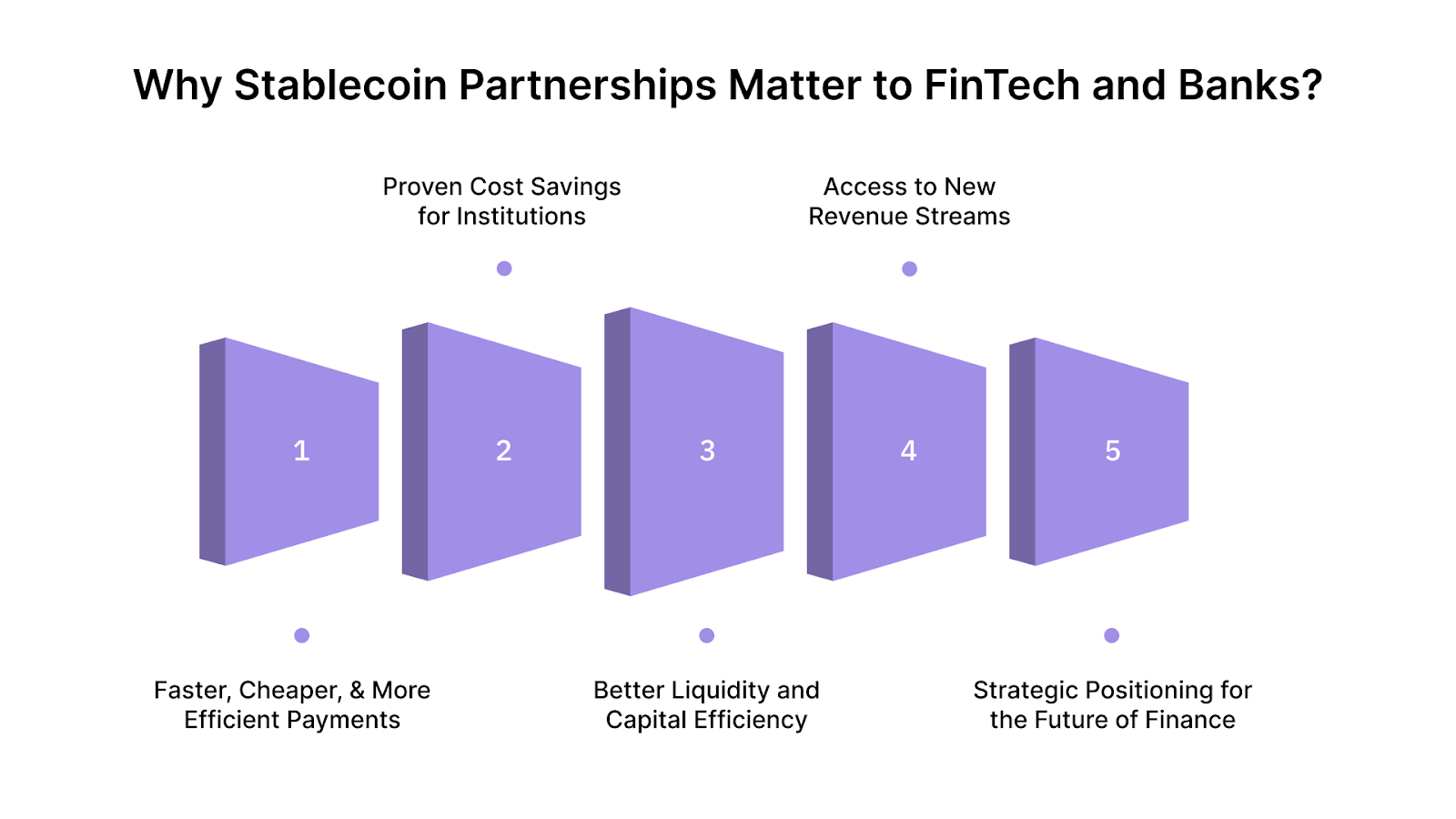
1) Faster, Cheaper, & More Efficient Payments
Traditional banking infrastructure wasn't built for 24/7 digital commerce. Cross‑border transfers can take several days and involve multiple intermediaries, each adding cost and latency.
By contrast, stablecoins settle on blockchain networks in minutes any time of day, any day of the year.
- Their design eliminates many slow correspondent-banking steps, significantly reducing settlement times and operational overhead.
- For global payments teams, this isn't hypothetical: stablecoin back‑ends are already processing billions in daily activity and live implementations are being scaled.
Stablecoins and tokenized cash infrastructures could reshape payment rails by improving efficiency and reducing friction in settlement processes that have changed little over the decades.
2) Proven Cost Savings for Institutions
When institutions pilot stablecoin integrations, measurable savings often follow. Approximately 41 % of organizations reported cost savings of 10 % or more, primarily from lower cross‑border payment fees and reduced operational burden.
For banks, this matters because:
- Intermediary fees and correspondent costs make up a substantial portion of international payment expenses.
- Stablecoins reduce the number of intermediaries and settlement steps, cutting overhead while preserving compliance standards.
These savings can be reinvested into innovation, customer experience, or improved pricing, all key differentiators in a competitive market.
3) Better Liquidity and Capital Efficiency
Stablecoin rails enable institutions to move value without locking up capital, unlike traditional banking corridors.
In current cross‑border systems, banks routinely pre‑fund nostro/vostro accounts in multiple jurisdictions to facilitate payments, sometimes tying up billions that could otherwise be deployed productively. Blockchain‑based settlement reduces the need for these capital reserves.
This liquidity efficiency appeals directly to treasury teams and CFOs seeking to optimize balance sheet utilization while accelerating turnaround times for corporate and institutional customers.
4) Access to New Revenue Streams
Stablecoin partnerships can unlock new business models, including:
- Tokenized cash management products for corporate clients.
- Real‑time settlement services for FinTech platforms.
- Digital asset custody offerings that integrate with traditional deposit services.
By designing products that integrate stablecoin rails with existing banking services, institutions can differentiate their offerings and capture value that previously didn't exist.
5) Strategic Positioning for the Future of Finance
Market momentum shows that stablecoins are no longer fringe financial instruments. They're becoming integrated into mainstream financial infrastructure. As markets mature, banks and FinTechs that adopt early partnerships gain positioning advantages:
- They build experience with digital rails ahead of regulatory standardization.
- They deepen relationships with large payment networks and tech partners.
- They create services that today's digital‑native customers increasingly expect.
Now you know the key benefits of stablecoin banking partnerships, but who actually benefits the most from it?
For investors and board‑level decision‑makers, the calculus isn't just “when can we adopt stablecoins?" It's "how do we architect partnerships that capture strategic value while managing regulatory and compliance risk?”
Suggested Read: Mastering Stablecoin Compliance: Key Strategies for Financial Institutions
Understanding the value of stablecoin partnerships is crucial, but choosing the right partner is even more vital. Let's look at the key strategic considerations before moving forward with these partnerships.
Strategic Partnership Evaluation for Stablecoin Banking (Beyond Basics)
Stablecoin banking partnerships aren't just about connecting rails. They're a strategic choice that can alter a firm's competitive footing, compliance exposure, and operational dynamics.
Instead of rehashing general compliance talk, let's focus on practical considerations that matter most in 2026 and beyond.
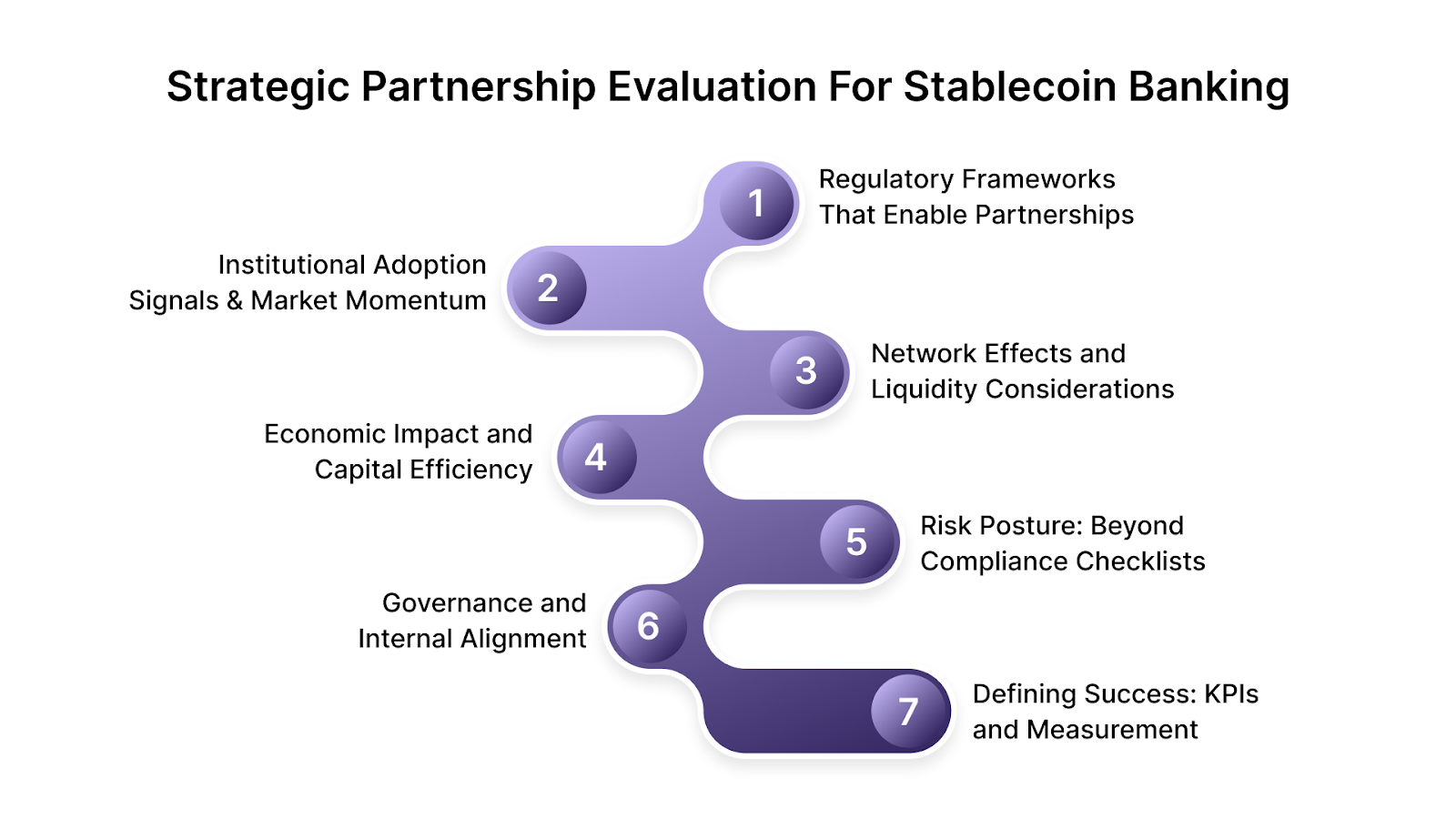
1. Regulatory Frameworks That Enable Partnerships
2025 was a turning point in stablecoin regulation:
- The U.S. GENIUS Act, enacted in July 2025, established the first comprehensive federal framework for payment stablecoins.
- This included requirements for reserve backing and transparency that financial institutions can rely on.
Partnerships now operate in a regulated ecosystem, not a regulatory vacuum. Firms must understand not only compliance hoops but also which parts of stablecoin operations the law actively supports. Especially issuance standards, reserve proofs, and custodian permissions.
Strategic implication:
Teams should prioritize partners whose regulatory compliance models align with evolving lawmaker expectations (e.g., audited monthly reserve attestations, robust governance, and compliant asset custody).
2. Institutional Adoption Signals & Market Momentum
Stablecoin integration is no longer experimental. Institutional interest has real scale and economic consequence:
- Stablecoins are used by financial institutions and corporates globally. About 13% have already deployed stablecoins, and over half of non‑users plan to adopt within 12 months.
- Sablecoin infrastructure could transform payment rails and settlement models, pushing institutions toward digital settlement sooner than many expected.
Strategic implication:
A partnership strategy that ignores broader adoption signals (including regulatory clarity and active institutional use) risks falling behind competitors that are already integrating stablecoin rails.
3. Network Effects and Liquidity Considerations
Partnerships differ dramatically in network access and liquidity depth depending on the stablecoin partner:
- Leading stablecoins like USDC and USDT command market share and have more mature liquidity networks, meaning partners with those assets often offer broader settlement reach.
- Companies like Thunes (which bridges traditional payments with stablecoin rails) demonstrate how institutional networks can extend reach beyond standalone stablecoin integrations.
Liquidity isn't just about settlement volume. It determines cross‑border throughput, pricing efficiency, and on‑chain/off‑chain integrations
Strategic implication:
Underestimating the role of underlying stablecoin liquidity and network connectivity can lead to bottlenecks once products scale, particularly for institutions expanding across regions.
4. Economic Impact and Capital Efficiency
Stablecoins are remodeling the economic calculus for payments, liquidity, and capital allocation:
- The total liability footprint of stablecoins in circulation surged past $300 billion in 2025. It's a scale that puts them on par with major U.S. money market funds.
- Citibank forecasts that this market could approach $1.9 trillion by 2030, highlighting long‑term economic potential.
Stablecoin partnerships enable firms to participate in this expanding ecosystem without front‑loading reserve commitments or building token-issuance engines internally.
Strategic implication:
Partnership models should be evaluated not only for operational fit but also for their ability to position firms to benefit from long‑run capital flows and access to liquidity.
5. Risk Posture: Beyond Compliance Checklists
A common but incomplete view of risk is treating it as a compliance tick‑box exercise. In practice, risk in stablecoin banking partnerships is multidimensional:
- Regulatory regime shifts—laws such as the GENIUS Act support innovation while also demanding high levels of transparency and auditability.
- Market concentration risks — heavy dominance by U.S. dollar stablecoins creates concentration challenges from both liquidity and regulatory perspectives.
- Future systemic effects — Stablecoins could influence broader financial structures, such as liquidity and interest rates, with implications for banking balance sheets.
Strategic implication:
Risk frameworks should go beyond compliance checklists to include systemic impact scenarios, concentration analysis, and modeling of future regulatory changes.
6. Governance and Internal Alignment
Finally, a key differentiator between successful and stalled partnerships is internal governance alignment:
Institutions that integrate stablecoin partnerships effectively often ensure cross‑functional ownership (treasury, compliance, tech, risk, product) early in the evaluation process.
This avoids late‑stage conflicts and prevents scenarios in which infrastructure goes live without operational readiness, a common failure point in digital finance integration.
7. Defining Success: KPIs and Measurement
Before launching a partnership, teams must define clear success metrics that align with business goals and regulatory expectations.
Here are some examples of meaningful KPIs:
These metrics should be tracked continuously, not just at launch. For banks and investors, good KPIs will translate into clearer ROI models and stronger governance documentation.
Evaluating and selecting the right stablecoin partner is critical to long-term success. Fraxtional's experienced leadership team can help you navigate risk, compliance, and technology considerations. Reach out to us today to discuss how we can customize the right strategy for your organization.
What's Next for Stablecoin Banking Partnerships in 2026

Stablecoin partnerships are no longer experimental but foundational to future-proofing banking operations.
Stablecoin banking partnerships are nearing a tipping point, shifting from pilot projects to core institutional infrastructure. The focus now is on real deployment, measurable impact, and alignment with evolving regulatory regimes.
- In 2026, strategic alignment with regulated stablecoin ecosystems will drive faster, more efficient cross-border settlements and deeper integration with core banking services.
- Banks that don't adopt these partnerships will fall behind, missing the opportunity to optimize liquidity, reduce operational costs, and unlock new revenue streams.
- For FinTechs, this shift means easier access to regulated liquidity and faster scaling opportunities, positioning them to lead in digital-first finance.
- The regulatory scene will continue to mature, with clearer guidelines that enable institutions to operate with confidence while balancing innovation with risk management.
- By focusing on modular partnerships that integrate with existing financial infrastructure, banks can capitalize on rapid advancements in blockchain-based financial services.
The emerging reality is clear: in 2026, stablecoin banking partnerships will be judged by tangible impact on cost reduction, liquidity freed up, compliance risk management, and the delivery of new offerings, not just by proofs of concept.
How Fraxtional Bridges the Gap in Stablecoin Banking Partnerships

Fraxtional operates where traditional banking meets next-gen stablecoin infrastructure, bringing regulatory clarity and strategic oversight to evolving financial models.
Our fractional C-suite leadership integrates seamlessly with stablecoin partners, ensuring that banks and FinTechs don't just adopt new technology, but strategically embed it into their operations.
We guide institutions through every phase:
- Mapping exposure across digital assets and global regulations.
- Aligning partnerships with evolving compliance frameworks.
- Embedding risk leadership into every operational layer.
- Translating blockchain and stablecoin dynamics into actionable insights for boards, investors, and regulators.
The result is a stablecoin adoption strategy that's not only compliant but also agile, scalable, and future-ready.
Turn your stablecoin partnerships into a competitive advantage today. Partner with Fraxtional to build a strategy that balances innovation with trust.
Conclusion
Stablecoin banking partnerships are transforming the financial scenario, but successful adoption requires more than just integrating new technology.
It requires strategic oversight and agile leadership.
While automation drives efficiency in operations and compliance processes, it's human expertise that ensures these systems remain credible and aligned with evolving regulations.
As fintechs and banks figure out this complex space, fractional leadership is critical to turning stablecoin partnerships into scalable advantages. The ones eager to stay ahead, combining technology with human judgment is essential for long-term success.
Fraxtional helps bridge this gap by offering fractional leadership that guides stablecoin integration with precision and accountability. We turn partnerships into growth drivers by ensuring compliance is more than a checkbox.
It's a strategic advantage that sets institutions up for a sustainable, compliant future. Try it out yourself today!
FAQs
Stablecoin partnerships introduce digital‑asset‑specific risks, such as AML/CFT gaps, sanctions exposure, and on‑chain transaction-monitoring requirements. This means banks must adapt their compliance frameworks beyond traditional banking controls to manage digital flows.
Stablecoin partnerships involve working with private issuers or networks to use digital rails, while tokenized deposits are bank‑issued digital representations of traditional deposits. The former focuses on programmable payments, the latter on digitalizing existing money.
Not entirely. Stablecoins improve speed and settlement efficiency but do not fully replace correspondent banking networks. Most institutions will maintain both systems while shifting higher‑value or time‑sensitive flows to stablecoin rails.
Yes. Some regulators and central bankers have warned that bank‑issued stablecoins could undermine financial stability and the traditional money-creation process, which is why many banks prefer partnership models to self‑issuance.
Yes. Under emerging frameworks such as the U.S. GENIUS Act, stablecoin partners must maintain 1:1 asset reserves that meet strict backing and transparency requirements, which changes how banks approach reserve reporting and auditing.
blogs
Don’t miss these



Let’s Get Started
Ready to Strengthen Your Compliance Program?
Take the next step towards expert compliance solutions. Connect with us today.