

Feb 10, 2026
Fractional Leadership for Scaleups: A Guide to Scaling Without Overhiring

By Fraxtional LLC

Summarize the blog with AI
Growth rarely breaks because of ambition. It breaks because leadership capacity doesn't scale at the same speed as the business. Headcount decisions are a big part of that problem.
Investors and partners increasingly expect clear ownership, operating discipline, and repeatable execution long before a company is ready to commit to permanent C-suite hires. That tension is why fractional leadership for scaleups has moved from a stopgap to a deliberate strategy.
Instead of over-hiring too early or waiting until execution starts to crack, scaleups are using fractional executives to add senior decision-making exactly where it's needed, when it's needed, and without locking in long-term overhead.
This isn't about saving money for its own sake. It's about protecting momentum while the organization is still forming. The purpose of this guide is to help scale-up founders and operators answer a practical question: how do you add real leadership capacity without slowing the business down with premature hires?
Quick Glance
- Growth breaks when leadership lags, not when talent is missing. Fractional leadership adds senior capacity before full-time roles are ready.
- Fractional leaders must make decisions, not advise. Without authority and accountability, the model fails.
- Overhiring costs momentum more than money. Early full-time hires often trigger resets that slow scaleups.
- Some roles matter earlier than others. Risk, operations, finance, and security leadership unlock scale fastest.
- Fraxtional helps scaleups discover leadership at the right time, building clarity and systems before permanent headcount is locked in.
What Fractional Leadership for Scaleups Actually Means

Fractional leadership is often misunderstood because it gets grouped with consulting or interim staffing. For scaleups, it's neither.
Fractional leadership means bringing in senior operators who own outcomes, not just provide advice, on a part-time or scoped basis. These leaders step into real decision-making roles, run operating rhythms, and are accountable for building systems that last beyond their engagement.
The difference shows up quickly in how the work is done.
- A true fractional leader is embedded in the business. They work with internal teams, make trade-offs, and take responsibility for progress. They're measured by what changes: clearer ownership, better execution, and stronger alignment between strategy and day-to-day work.
- For scaleups, this model fits because the need isn't constant executive presence. It's targeted leadership at specific moments. Building a function, installing governance, preparing for external scrutiny, or stabilizing execution during growth all benefit from senior experience without requiring a full-time role before the role's shape is clear.
Done well, fractional leadership isn't a compromise. It's a way to add depth and direction while keeping the organization flexible as it scales.
Once the model is clear, the next question is timing.
When Fractional Executives Are the Smartest Move

Fractional leadership works best when there's a clear gap between where the business is and what it needs next. That gap often shows up before teams feel “ready” to hire full-time executives.
By the time it's obvious, scaleups are usually already paying the price in slower execution or growing complexity.
Here are the most common signals that fractional executives make sense:
- You need a function built, not optimized
If a team or capability doesn't yet have structure, metrics, or clear ownership, fractional leaders can design and stand it up without locking in long-term headcount too early. - Founders are the default decision-makes
When major decisions repeatedly rest with the founders due to unclear ownership, growth is hindered. Fractional executives absorb that load and create clear decision rights. - Execution is inconsistent across teams
If goals are clear but delivery varies, the issue is usually operating cadence, not effort. Fractional leaders bring discipline around priorities, metrics, and follow-through. - External scrutiny is increasing
Upcoming investor diligence, bank partnerships, audits, or regulatory reviews often require senior oversight before a full-time hire is justified. - The company is entering a new phase of risk or complexity
New products, markets, or partnerships change the operating profile. Fractional leadership helps figure out that transition without prematurely committing to permanent roles.
In each case, the value comes from speed and precision. Fractional executives step in where leadership is needed most, deliver outcomes, and help the organization mature to the point where a full-time hire actually makes sense.
If founders are still the escalation point, or your growth is slowing execution, Fraxtional helps scaleups bring in fractional leadership to absorb decision-making and stabilize execution without committing to full-time hires too early. Contact us today!
Top 6 Fractional Roles That Help Scale Faster
For scaleups, the highest-leverage fractional roles appear when external expectations rise faster than internal structure. That's especially true in regulated growth, partner-led distribution, and enterprise sales.
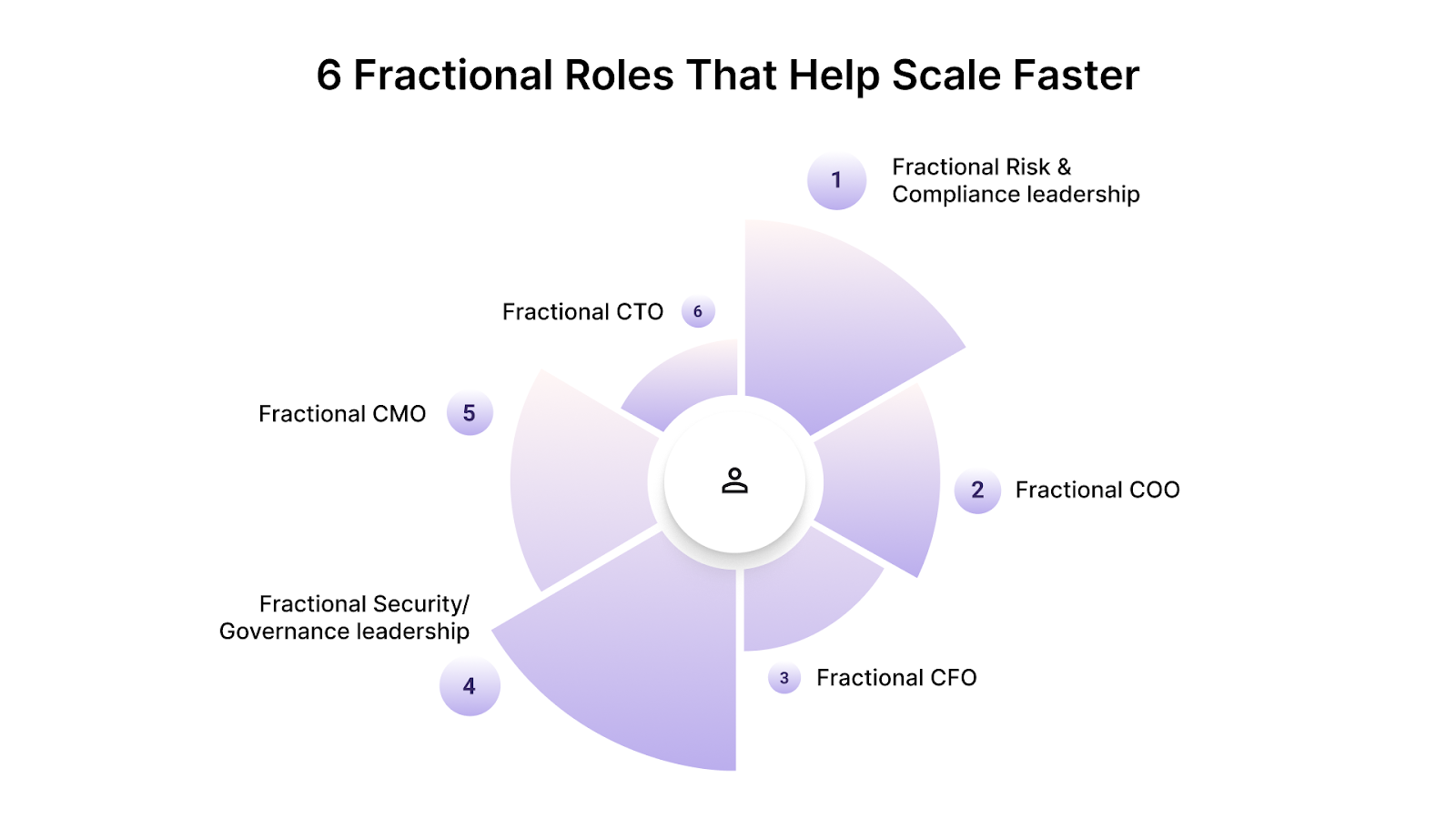
1. Fractional Risk & Compliance leadership
This role becomes urgent the moment your business model touches regulated rails (payments, banking partnerships, crypto, cross-border flows). U.S. requirements for many financial institutions explicitly tie AML program effectiveness to named program oversight, not just tools.
- For example, FinCEN's MSB guidance points companies to the requirement to establish a written AML program, and the underlying rule requires an “effective” program that's designed to prevent misuse.
- Fractional risk/compliance leadership adds pressure from sponsor banks and regulators: decision ownership, escalation logic, and defensible program governance.
What it unlocks fast: diligence readiness, fewer "who owns this?" gaps, faster approvals.
2. Fractional COO
Most scaleups don't stall because strategy is unclear. They stall because execution becomes inconsistent as headcount grows. This is the phase where decision rights get fuzzy, priorities multiply, and founders become the default escalation path.
A fractional COO is most valuable when the company needs an operating system installed quickly: cadence, ownership, KPI rhythms, and predictable delivery.
What it unlocks fast: fewer bottlenecks, clearer accountability, repeatable execution.
3. Fractional CFO
As soon as scaleups move from "growth at any cost" into “growth with control,” finance becomes a credibility function.
If you're fundraising, expanding partnerships, or preparing for stricter reporting, expectations around controls and management accountability increase.
- The SEC's guidance on management reporting around internal control over financial reporting reinforces that internal controls are a management responsibility and a disclosure focus for public-company reporting contexts.
- Even before IPO readiness, the same discipline shows up in investor diligence: forecasting reliability, clean reporting, and clear financial narratives.
What it unlocks fast: better runway control, stronger investor confidence, cleaner diligence.
4. Fractional Security/Governance leadership
Security becomes a growth constraint the moment enterprise customers, regulated partners, or board scrutiny enter the picture.
- The SEC's cybersecurity rules highlight that governance and risk management aren't just technical topics. They're matters of strategy and oversight that public companies must disclose, including governance practices.
- A fractional security or governance leader helps scaleups translate security posture into exec-ready decisions and readiness, without forcing a premature full-time hire.
What it unlocks fast: fewer deal blockers, stronger trust posture, faster audits/reviews.
5. Fractional CMO
Marketing leadership becomes critical as a scale-up moves from product-market fit to sustainable growth. The challenge is ensuring your brand scales, customer acquisition is efficient, and marketing decisions are tied directly to revenue impact.
Fractional CMOs step in to develop clear brand positioning, growth marketing strategies, and build a scalable marketing machine without overburdening the team or committing to permanent hires too soon.
What it unlocks fast: Scalable growth marketing strategies, clearer brand messaging, faster go-to-market cycles.
6. Fractional CTO
As technology decisions become more strategic, scaleups need leadership to ensure security, scalability, and innovation are aligned with business goals.
- Fractional CTOs bring senior leadership to oversee product direction, architecture decisions, and tech debt management while keeping pace with rapid growth.
- Get immediate value by building the right tech foundation, aligning teams, and ensuring the technology roadmap supports business growth. This avoids premature hires and ensures the right tech strategy at the right time.
What it unlocks fast: A solid tech foundation, better product scalability, faster innovation cycles.
These roles aren't about filling seats. They're about installing decision ownership and operating discipline before complexity hardens into permanent chaos.
Suggested Read: Fractional CRO vs CFO: Key Differences in Risk Management
Identifying the right role is only half the equation. Execution depends on how that leadership is structured.
The Operating Model that Makes Fractional Leadership Actually Work

Fractional leadership fails when it's treated like advice. It works when it's treated like ownership.
For scaleups, the difference comes down to how clearly decision rights, cadence, and accountability are defined from day one. Without that structure, fractional leaders become external voices instead of embedded operators, and impact stalls quickly.
A working model starts with clear ownership.
Fractional leaders shouldn't sit on the sidelines waiting to be consulted. They need explicit authority over a defined function, including the ability to make decisions, set priorities, and approve trade-offs. Scaleups that succeed with fractional leadership are explicit about what the role owns and what stays internal.
Next is operating cadence. Fractional leaders need a rhythm that matches the business's pace. That usually means:
- Regular leadership check-ins tied to outcomes, not updates
- Clear metrics that reflect progress and risk
- Defined escalation paths when decisions cut across teams
This structure matters because scaleups move fast. Without cadence, work drifts. With it, progress compounds.
Finally, there's handoff by design. Fractional leadership isn't meant to create dependency. The goal is to build systems, document decisions, and leave behind a function that's easier to run, whether by an internal team or a future full-time hire. Scaleups that plan for this from the start avoid disruption later.
When these elements are in place, fractional leadership no longer feels temporary. It becomes a deliberate way to add senior capability, stabilize execution, and keep the organization flexible as it grows.
Also Read: How Fractional Leadership Has Reshaped Private Equity Operations
A 30–60–90 Day Plan to Scale Without Permanent Headcount

Fractional leadership isn't effective when treated as an undefined addition to the team. It’s most valuable when structured around specific outcomes tied to real business signals. Scaleups operate in an environment where both decisions and talent gaps have a measurable impact.
For example, C-suite hiring cycles in the U.S. remain long, averaging about 5.3 months from search launch to hire. This is true even as mobility tightens, making full-time executive additions slow to materialize when urgency is highest. In a dynamic scale-up environment, that delay can slow execution at the worst possible time.
A 30–60–90-day approach compresses leadership impact while maintaining flexibility.
Days 0–30: Diagnose Real Constraints & Ownership Gaps
The first phase isn't about action. It's about clarity.
Fractional leaders focus on:
- Mapping where key decisions are currently made and where accountability is unclear
- Identifying bottlenecks that have the highest impact on growth or risk
- Setting clear success metrics for the next two phases
This phase matters because scaleups often don't know their true blockers until someone with a senior perspective interrogates the structure. A stronger leadership clarity correlates with better execution and motivation outcomes.
Days 31–60: Install Operating Structures Tied to Business Outcomes
Once barriers are clarified, fractional leaders shift to execution.
During this phase, they:
- Establish operating cadence (weekly metrics, decision logs, escalation paths)
- Normalize delivery and accountability across teams
- Reduce founder dependency for tactical decisions
This phase is where fractional leadership begins to unlock measurable improvements in execution agility.
Having a senior leader accountable for rhythm and structure helps standardize processes that would otherwise take multiple recruits to build. But here, they are built quickly and aligned with outcomes.
Days 61–90: Stabilize & Embed for Continuity
The final phase ensures progress lasts beyond the fractional engagement.
Now the fractional leader:
- Documents decisions, frameworks, and responsibilities
- Validates that systems hold up under real conditions
- Builds internal readiness for transition or full-time leadership
Across scaleups, one pattern is consistent: speed and focus beat generic leadership headcount expansion. Executive talent is expensive and slow to land, but fractional leaders with clear deliverables can install discipline, governance, and ownership much faster.
That makes this model not just efficient, but strategically necessary for growth phases where speed matters most.
Fraxtional works with scaleups to design and execute outcome-driven leadership engagements that build systems and prepare teams for the next phase of growth. Reach out to us today!
A 2-Minute Checklist for Scaleups to Run Before Hiring Full-Time Leadership

Before committing to a permanent executive hire, scaleups should pause and pressure-test whether full-time headcount is actually the right next move. In many cases, the signal to hire isn't urgency; it's readiness.
If the organization isn't structurally ready, a full-time hire often inherits ambiguity instead of momentum.
This quick checklist helps clarify that decision. Run through these questions honestly:
- Do we have a clearly defined problem this role is meant to solve?
If success can't be described in outcomes rather than responsibilities, the role is likely still forming. That's a strong signal to start fractional. - Are founders or early leaders still the default escalation path?
If major decisions still bottleneck at the top, adding a full-time executive without first clarifying ownership often increases complexity rather than reducing it. - Is the function stable, or does it still need to be built?
Full-time hires perform best when they're inheriting systems, not inventing them under pressure. If processes, metrics, or governance don't exist yet, fractional leadership is usually the better first step. - Would this role look the same 12 months from now?
If the answer is no, locking in permanent headcount today risks a mismatch tomorrow. Fractional leadership gives scaleups room to evolve before committing. - Is external scrutiny increasing faster than internal structure?
Upcoming investor diligence, audits, partnerships, or regulatory reviews often demand senior oversight before the business is ready for full-time expansion.
If you're answering "yes" to two or more of these, it's often a sign that the organization needs leadership capacity before headcount. Fractional leadership fills that gap, helping scaleups mature the role before making it permanent.
How Fraxtional Helps Scaleups Add Leadership Without Overhiring
Scaleups don't struggle because they lack ideas or ambition. They struggle when growth outpaces leadership capacity and decisions start piling up without clear ownership. Fraxtional operates in that gap, where execution needs senior judgment, but full-time headcount would be premature.
Fraxtional's help founders and operators turn growth pressure into structure by focusing on what matters most at this stage: decision clarity, operating cadence, and accountability.
Every engagement starts with precision:
- Identifying where leadership barriers are slowing execution
- Defining ownership and decision rights across critical functions
- Installing rhythms and systems that teams can run without constant escalation
- Preparing the organization for external scrutiny, whether from investors, banks, or partners
The result is a leadership model that scales with the business. Focused enough to move quickly. Senior enough to be credible. Flexible enough to evolve as the company matures.
Partner with Fraxtional to add senior leadership capacity that keeps pace with growth without locking in headcount before you're ready.
Conclusion
Scaling breaks when leadership capacity lags behind growth.
For scaleups, the challenge isn't whether talent exists. It's whether the right leadership is in place at the right moment. Overhiring too early hard-codes the wrong structure. Waiting too long leaves founders carrying decisions the organization should already own.
That's why fractional leadership for scaleups isn't a workaround. It's a timing strategy. Fractional leaders give scaleups senior judgment when complexity spikes, help build systems that survive growth, and create clarity before permanent roles are locked in.
Fraxtional brings this balance to practice by embedding accountable leadership exactly where scaleups need it most, long enough to create stability and flexible enough to evolve as the business matures. Try it out yourself today!
FAQs
In effective engagements, fractional leaders manage teams directly within a defined scope. They run meetings, set priorities, and own outcomes, rather than acting as external advisors.
ROI is typically measured by reduced founder involvement, shorter execution cycles, fewer reworks, and greater investor or partner readiness. The value shows up in speed and stability, not just cost savings.
Yes, and it’s often more effective in those environments. Scaleups in regulated sectors use fractional leaders to add senior judgment and governance without committing to permanent roles too early.
The biggest risks are unclear decision rights, vague success metrics, and treating the role as advisory. Without ownership and authority, even strong fractional leaders can’t deliver impact.
When done well, it improves clarity and reduces confusion. Teams benefit from faster decisions and clearer ownership, provided the fractional leader is visibly empowered by leadership.
blogs
Don’t miss these
.jpg)


Let’s Get Started
Ready to Strengthen Your Compliance Program?
Take the next step towards expert compliance solutions. Connect with us today.
Now Accepting:
BTC

ETH

USDC
USDP