

Jan 27, 2026
What Is a Data Governance Policy? A Practical Guide for Regulated Teams

By Fraxtional LLC

Summarize the blog with AI
Most teams only realize something is broken when a regulator, auditor, or sponsor bank asks a simple question, and nobody can answer it clearly. That moment usually traces back to a missing or weak data governance policy, not a tooling gap or staffing issue. When data ownership, access rules, and accountability are unclear, risk quietly builds across systems and vendors.
This concern is becoming more visible at the leadership level. 88% of data leaders expect data security and governance to become an even higher priority over the next 12 months, ahead of AI initiatives, signaling a shift from experimentation to control. For founders, compliance leaders, and bank partners, a defensible data governance policy has become a baseline expectation, not a maturity milestone.
In this guide, we break down how to design and operationalize a data governance policy, covering ownership models, regulatory alignment, and execution using tools such as identity and access management systems, data classification frameworks, audit logging platforms, and third-party risk controls.
Key Takeaways
- A data governance policy fails audits when policy requirements are not directly mapped to IAM, logging, and data platform controls.
- Regulators assess governance through execution evidence, such as access reviews, exception handling, and audit trails, not policy wording.
- Undefined data ownership is one of the fastest ways governance breaks down during sponsor bank and regulatory exams.
- Third-party access remains a primary governance risk when vendor data controls are not explicitly embedded in the policy.
- Data governance policies require scheduled review cycles to stay aligned with system changes, new data domains, and regulatory updates.
What Is a Data Governance Policy?

A data governance policy defines how data is owned, classified, accessed, protected, and audited across an organization. It establishes enforceable controls that regulators, auditors, and sponsor banks expect to see documented and operating in practice.
Types of Data Governance Policies
Each policy category addresses a specific risk surface in the data lifecycle, with clearly defined controls that regulators and auditors expect to see operating consistently.
- Data Ownership and Stewardship: Assigns accountable owners for each data domain with defined approval, escalation, and exception authority.
- Data Classification and Handling: Specifies sensitivity tiers, permitted uses, retention periods, and encryption requirements per data category.
- Access Control and Entitlement Management: Governs role-based access, provisioning workflows, periodic access reviews, and revocation triggers.
- Data Quality and Integrity Controls: Defines validation checks, reconciliation standards, issue remediation timelines, and reporting thresholds.
- Third-Party Data Governance: Sets requirements for vendor access, data sharing agreements, monitoring, and termination protocols.
- Audit and Monitoring Standards: Establishes logging, evidence retention, control testing cadence, and audit readiness expectations.
A data governance policy converts abstract data principles into enforceable controls that withstand regulatory exams, audits, and sponsor bank reviews. Without this structure, data risk remains unmanaged and undocumented.
Why an Effective Data Governance Policy Matters
An effective data governance policy reduces regulatory exposure, clarifies accountability, and prevents data misuse by converting regulatory expectations into enforceable operational controls across systems, teams, and third parties.
- Regulatory Examination Readiness: Demonstrates documented data ownership, access controls, retention rules, and audit trails required during regulator and sponsor bank reviews.
- Defined Accountability for Data Risk: Eliminates ambiguity by assigning named owners responsible for data accuracy, access approvals, exception handling, and issue remediation.
- Controlled Data Access at Scale: Prevents excessive permissions through role-based access, approval workflows, and periodic entitlement recertifications.
- Reduced Incident and Breach Exposure: Limits data leakage risk by enforcing classification-based encryption, storage, and transmission requirements.
- Consistent Third-Party Data Oversight: Applies uniform data handling standards to vendors, including access scope, monitoring, and termination controls.
Without an effective data governance policy, data risk remains fragmented across teams and systems. Strong governance creates defensible control structures that regulators expect to see in operation.
Step-by-Step Guide to Creating a Data Governance Policy
Creating a data governance policy requires structured input, documented accountability, and a clear path from documentation to enforcement. Each step builds toward a policy that regulators and auditors can validate in practice.
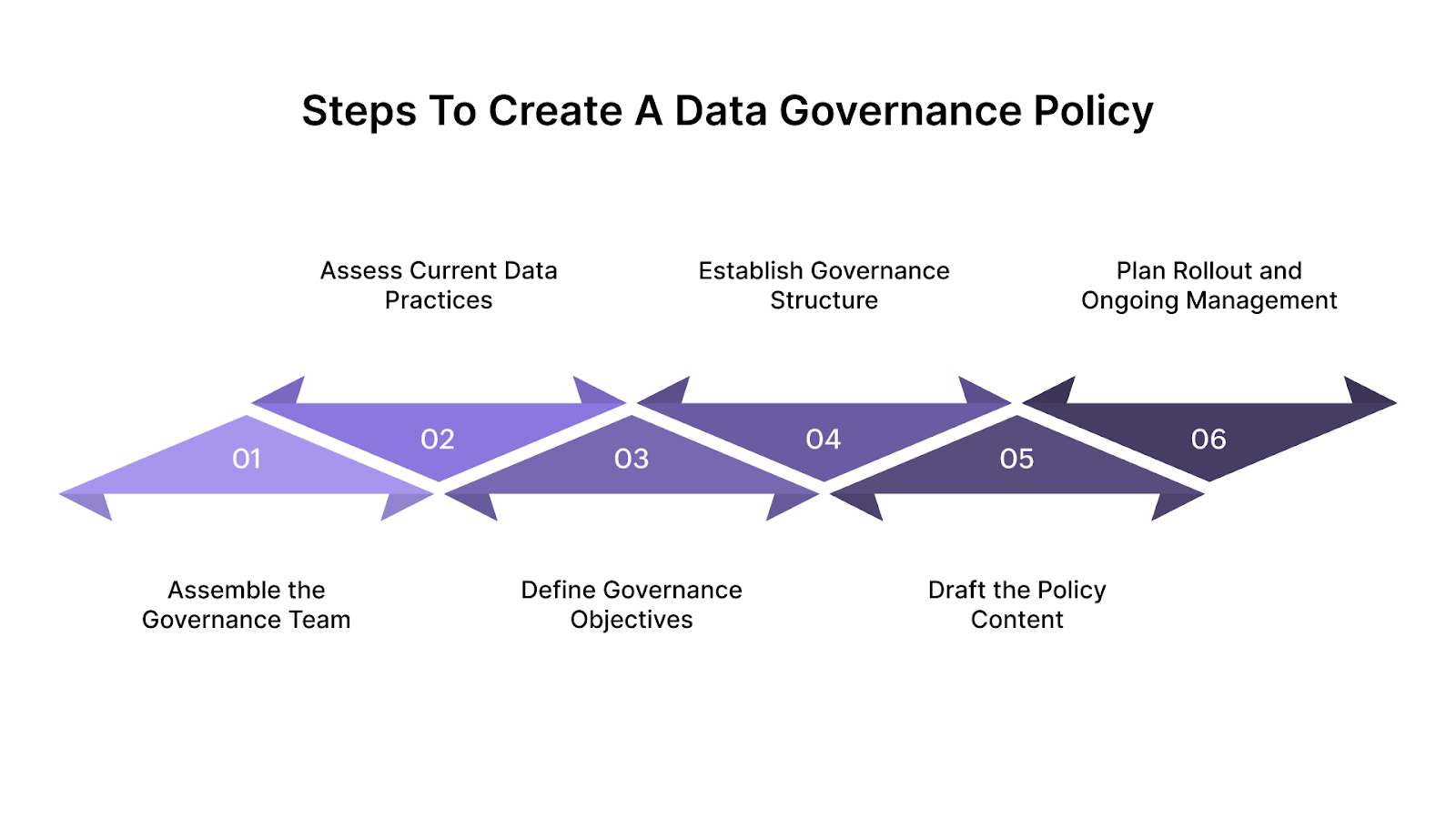
Step 1: Assemble the Governance Team
Policy credibility depends on participation from teams that create, manage, protect, and use data daily.
- Cross-Functional Representation: Include business owners, IT architects, security, legal, compliance, and data users with direct operational exposure.
- Executive Sponsorship: Assign a senior sponsor with authority to approve scope, resolve conflicts, and enforce adoption.
- Decision Authority Clarity: Document who drafts, reviews, approves, and escalates governance decisions.
Step 2: Assess Current Data Practices
A current-state assessment prevents policies from conflicting with real workflows or existing controls.
- Workflow Mapping: Document how data is collected, accessed, shared, stored, and retired across systems.
- Issue Identification: Review prior access incidents, audit findings, data quality issues, and vendor-related gaps.
- Domain Prioritization: Identify high-risk data domains such as customer, financial, or regulated datasets.
Step 3: Define Governance Objectives
Governance objectives anchor the policy to measurable risk and business outcomes.
- Outcome Alignment: Tie policy goals to access control, data accuracy, privacy obligations, and reporting reliability.
- Scope Definition: Specify which data types, systems, and third parties fall under governance coverage.
- Success Criteria: Define how adoption, compliance, and control operations will be measured.
Step 4: Establish Governance Structure
Governance structure converts policy language into enforceable responsibility.
- Role Definition: Assign data owners, stewards, custodians, and oversight bodies with documented authority.
- Approval and Escalation Paths: Define how access requests, exceptions, and violations move through the organization.
- Oversight Cadence: Set meeting frequency and reporting expectations for governance bodies.
Step 5: Draft the Policy Content
Policy content must be precise, readable, and aligned with how data is handled in practice.
- Clear Sectioning: Cover purpose, scope, roles, classification, access, retention, monitoring, and enforcement.
- Operational Language: Use concrete rules tied to systems, tools, and workflows rather than abstract principles.
- Formal Sign-Off: Obtain approval from legal, compliance, security, and executive leadership.
Step 6: Plan Rollout and Ongoing Management
Adoption depends on structured deployment and continuous oversight.
- Phased Deployment: Roll out controls by data domain or risk level to limit disruption.
- Training and Communication: Provide role-specific guidance tied to daily responsibilities.
- Review and Update Cycle: Schedule periodic reviews with documented version control and change rationale.
If you need support translating these steps into review-ready documentation and enforceable controls, Fraxtional helps teams build data governance policies that hold up in audits, sponsor bank reviews, and regulator exams without slowing execution. Get in touch with us!
Data Governance Policy Templates and Reference Frameworks

Data governance policy templates can accelerate drafting, but regulators and sponsor banks quickly identify policies that are not adapted to actual systems, data flows, and ownership structures.
- Industry Governance Frameworks: Frameworks such as DAMA-DMBOK help validate policy completeness, but require mapping to specific data domains, platforms, and access models to withstand review.
- Regulatory Guidance Sources: Standards such as GDPR and NIST inform required controls, but policies must document how those controls operate within the organization’s infrastructure.
- Professional Association Templates: Privacy and governance templates offer structure, but often lack evidence requirements, approval paths, and escalation mechanics tested during exams.
- Vendor-Provided Policy Examples: Vendor templates assist with formatting, but are frequently flagged when they reference controls, tools, or workflows not in use.
- Policy Management Tools: Centralized repositories and version control support maintenance, but do not replace documented ownership, access reviews, and audit evidence.
Templates reduce drafting risk, not regulatory risk. Policies must be explicitly aligned to real operations to withstand audits, sponsor bank reviews, and investor diligence.
Review your data governance controls through an internal audit lens to surface gaps early and maintain defensible oversight. The following guide explains How to Create an Effective Internal Audit Schedule that supports that objective.
Roles and Accountability in Data Governance Policy Design
A clear role definition is required for a data governance policy to operate as a control framework rather than a static document. Regulators and auditors expect documented ownership, approval authority, and escalation paths tied to specific roles.
A data governance policy fails without documented ownership and enforcement authority. Defined roles convert governance intent into defensible, auditable control execution.
How to Smoothly Implement a Data Governance Policy?

Implementation translates a data governance policy into operating controls enforced across systems, users, and vendors. Regulators assess execution evidence, not policy language, during exams and audits.
- Policy-to-Control Mapping: Convert each policy requirement into specific technical or procedural controls with documented owners and evidence artifacts.
- System-Level Enforcement: Configure IAM, data platforms, and logging tools to enforce access rules, classification standards, and retention schedules.
- Access Review Cadence: Execute periodic entitlement reviews with documented approvals, exceptions, and revocations tied to defined roles.
- Third-Party Enablement Controls: Apply onboarding checklists, access scoping, and monitoring requirements before granting vendor data access.
- Evidence and Audit Readiness: Maintain logs, approvals, review records, and exception tracking aligned to examination timelines.
A data governance policy is validated through consistent execution and evidence. Implementation failures surface quickly during audits and sponsor bank reviews.
Strengthen third-party oversight and risk accountability by extending governance beyond internal teams. This guide explains how Fractional CROs and Third-Party Risk: A Smarter Governance Model.
Regulatory Requirements Covered by a Data Governance Policy
A data governance policy operationalizes regulatory expectations by defining how regulated data is classified, accessed, retained, and audited. Regulators assess whether these requirements are documented, enforced, and evidenced across the data lifecycle.
- Data Access and Authorization Controls: Satisfies requirements for least-privilege access, role-based entitlements, and documented approval workflows.
- Data Retention and Destruction Rules: Aligns retention schedules and deletion standards with regulatory recordkeeping and data minimization obligations.
- Audit Trail and Logging Standards: Meets expectations for immutable logs, access histories, and evidence retention during regulatory examinations.
- Third-Party Data Oversight Requirements: Addresses vendor risk management, data sharing agreements, and ongoing monitoring obligations.
- Incident Response and Breach Reporting: Defines detection, escalation, documentation, and regulatory notification processes for data incidents.
- Data Accuracy and Integrity Expectations: Supports regulatory requirements for reliable reporting, reconciliation, and issue remediation.
A data governance policy acts as the control layer connecting regulatory obligations to daily data operations. Gaps in coverage surface quickly during exams, audits, and sponsor bank reviews.
Move from point-in-time reviews to ongoing oversight by embedding control monitoring into daily operations. This guide explains the benefits of continuous controls monitoring for your business.
Common Failure Points in Data Governance Policies

Data governance policies fail when control design, ownership, or execution gaps prevent consistent enforcement. Regulators identify these failures through access testing, evidence requests, and third-party reviews.
- Undefined Data Ownership: Missing named owners results in unapproved access, unresolved data issues, and failed accountability during exams.
- Policy Not Mapped to Systems: Governance requirements remain unenforced when IAM, data platforms, and logging tools are not configured to match policy controls.
- Inconsistent Access Reviews: Irregular or undocumented entitlement reviews lead to privilege creep and audit findings.
- Weak Third-Party Oversight: Vendors retain excessive or persistent access due to missing monitoring and termination controls.
- Insufficient Evidence Retention: Lack of logs, approvals, and review records prevents validation of control operation.
- Static Policies Without Review: Policies fall out of alignment with system changes, new data types, or regulatory updates.
Most data governance failures stem from execution gaps, not policy intent. Regulators focus on evidence of enforcement, not written standards alone.
How Fraxtional Supports Data Governance Policy Execution
Fraxtional supports data governance policy execution by translating regulatory expectations into review-ready documentation and operating controls. The focus remains on enforceability, audit acceptance, and alignment with how teams actually handle data.
- Policy Scope and Control Definition: Identifies required data governance policies based on regulatory exposure, business model, and growth stage, avoiding gaps and unnecessary documentation.
- Operationally Aligned Policy Drafting: Writes data governance policies mapped to existing systems, workflows, and roles, guaranteeing controls reflect real data handling practices.
- Clear Ownership and Escalation Design: Defines accountable data owners, approval authority, exception handling, and escalation paths expected during bank and regulator reviews.
- Audit and Bank Review Readiness: Structures policies with review-ready formatting, version control, and evidence expectations to withstand sponsor bank and auditor scrutiny.
- Ongoing Policy Maintenance Support: Supports policy updates as data usage, vendors, systems, or regulatory expectations change, reducing drift between documentation and practice.
Fraxtional helps convert data governance policies into defensible control frameworks. Execution remains aligned with regulatory expectations, audit standards, and business reality.
Conclusion
A data governance policy only holds value when it holds up under scrutiny. Regulators, auditors, and sponsor banks evaluate whether controls are defined, owned, and enforced across systems and third parties. Organizations that treat governance as a living control framework, not a static document, reduce review friction and limit avoidable data risk.
If your data governance policy needs to withstand audits, bank reviews, or investor diligence, Fraxtional helps translate regulatory expectations into enforceable, review-ready controls built around how your teams actually operate.
Schedule a policy review with Fraxtional to put defensible data governance in place.
FAQs
A data governance policy should be reviewed at least annually and after material system, vendor, or regulatory changes.
Yes. A data governance policy should define tiered controls based on data sensitivity, such as customer PII versus internal analytics data.
Regulators expect access logs, approval records, ownership assignments, review attestations, and documented exception handling.
A data governance policy should explicitly govern vendor access, data sharing scope, monitoring requirements, and access termination.
In regulated environments, a data governance policy is often expected before expanding analytics or AI use involving sensitive data.
blogs
Don’t miss these
.jpg)


Let’s Get Started
Ready to Strengthen Your Compliance Program?
Take the next step towards expert compliance solutions. Connect with us today.