

Mar 9, 2026
Vendor Due Diligence Checklist for Regulated Growth in 2026

By Fraxtional LLC

Summarize the blog with AI
Vendor risk rarely announces itself. It often arises during a surprise bank review, a stalled investor diligence call, or when a regulator asks how a third party gained access.
In fact, 97% of the top 100 U.S. banks faced a third-party data breach in 2024, showing just how hidden these risks can be. The real issue is not the vendor but the lack of early evidence that the risk was properly managed.
Many regulated businesses run into this gap. Even when contracts exist and vendors pass initial reviews, closer scrutiny often reveals missing documentation.
A strong vendor due diligence checklist helps close this gap by moving beyond surface-level checks and supporting reliable decisions based on what vendors actually do.
In this blog, you’ll learn how to create a vendor due diligence checklist that meets regulatory expectations, supports bank and investor reviews, and keeps third-party risk under control.
Key Takeaways:
- Vendor due diligence defines how third-party failures become your regulatory issue, shaping how banks, regulators, and investors judge control during audits, incidents, and reviews.
- Risk-based classification determines review depth by mapping access to data, systems, funds, and regulated workflows, which is what examiners test when validating oversight.
- A structured vendor due diligence checklist turns judgment into evidence by documenting what was reviewed, what risks were accepted, and how decisions were approved across the vendor lifecycle.
- Ongoing monitoring matters because vendor risk shifts with scope changes, fourth-party dependencies, and access expansion, long before contracts or renewals surface issues.
- Firms like Fraxtional help regulated companies build structured vendor risk frameworks, improve documentation standards, and prepare vendor programs for audits, sponsor bank reviews, and regulatory scrutiny.
What Is Vendor Due Diligence & Why Does It Matter?

Vendor due diligence is a structured process for reviewing the third parties you rely on to run your business, manage data, or support regulated activities. It helps you clearly understand how a vendor’s controls, day-to-day practices, and financial stability can affect your own risk.
In regulated environments, responsibility does not stop with your internal teams. Regulators, sponsor banks, and investors still hold you accountable for issues that begin with the vendors you choose to work with.
Because of this shared responsibility, vendor due diligence is crucial in protecting your business.
Here’s why it matters:
1. Helps Avoid Regulatory Surprises
When a vendor fails, regulators still come to you for answers. Vendor due diligence helps you spot regulatory gaps early and clearly document why a vendor meets your risk standards. This gives you solid records during examinations and lowers your exposure when issues come from third parties.
2. Builds Sponsor Bank Confidence
Sponsor banks want proof that you control vendor risk before they approve or continue a partnership. A structured due diligence process involves reviewing vendors based on access, impact, and controls. This builds trust and makes bank reviews smoother.
3. Reduces Hidden Operational Risk
Many vendors support critical operations, yet their resilience and governance are not always visible. Due diligence helps you review continuity plans, escalation processes, and overall operational stability before problems arise. This reduces disruptions that could affect regulated operations, critical workflows, and regulatory reporting.
4. Strengthens Investor Trust
Investors expect clarity on third-party dependencies and their management. Vendor due diligence provides a clear view of where risks exist and the steps you take to control them. This supports better decisions and builds confidence during diligence and ongoing oversight discussions.
However, vendor due diligence can fall short when ownership, approvals, and audit evidence are unclear. Fraxtional offers senior compliance leadership without the need for a full-time hire. Get in touch with us to see how we can help strengthen your vendor oversight.
When Should You Conduct Vendor Due Diligence?

Vendor due diligence should be conducted at specific points throughout the vendor lifecycle, especially whenever risk changes. These moments determine whether you identify third-party risks early and manage them effectively, or allow them to accumulate unnoticed.
While timing is important, a well-defined vendor due diligence checklist ensures the process remains thorough and consistent.
The Ultimate Vendor Due Diligence Checklist for Regulated Businesses

A vendor due diligence checklist helps you apply consistent scrutiny across all vendors while staying aligned with regulatory and sponsor bank expectations. It also serves as evidence that risks were identified, evaluated, and managed deliberately and in a structured manner.
The checklist below is organized around the key areas that regulators, banks, and investors expect you to review.
1. Company Identity, Structure, and Legitimacy
Start by confirming that the vendor is a legitimate, transparent, and properly structured business. This step forms the foundation for all other assessments.
Key activities:
- Verify legal name, jurisdiction of incorporation, registration status, and operating licenses.
- Review articles of incorporation, business licenses, and past business names to verify the company’s identity and avoid misrepresentation.
- Examine ownership structure, including parent companies, subsidiaries, and affiliates.
- Assess leadership and governance: board members, executives, and key decision-makers. Check for regulatory issues, conflicts of interest, or reputational concerns.
- Confirm physical headquarters and operating locations. Consider onsite verification for high-risk vendors.
- Obtain independent references from existing clients for additional credibility.
2. Financial Health and Vendor Stability
Assess the vendor’s financial condition to understand whether they can reliably support regulated operations over time. Regulators expect firms to consider how vendor instability could disrupt critical services, weaken controls, or impact compliance obligations.
Key activities:
- Review audited or reviewed financial statements to evaluate revenue stability, liquidity, cash flow, and debt exposure.
- Identify concentration risk, such as reliance on a small number of customers or funding sources.
- Assess whether financial stress could affect the vendor’s ability to maintain security controls, staffing levels, or service continuity.
- Check credit history, outstanding liabilities, and unresolved legal or tax issues that could signal elevated operational or regulatory risk.
- Review executive compensation and incentive structures to identify misaligned risk behavior.
3. Legal, Regulatory, and Compliance Standing
Verify that the vendor complies with all relevant laws, regulations, and industry standards. This protects your organization from shared liability and confirms that compliance is operational, not just documented.
Key activities:
- Identify applicable regulations based on the vendor’s services and location.
- Verify certifications, registrations, and licenses. Assess internal compliance, ownership, and policies.
- Screen vendor and key personnel against sanctions, enforcement databases, and PEP lists.
- Review legal history: lawsuits, regulatory actions, investigations, settlements.
- Conduct adverse media checks, review consumer complaints, and public feedback.
- Assess policies on compliance management, privacy, incident response, and change management.
4. Operational Risk and Resilience
Assess how well the vendor can maintain services under normal and adverse conditions. Strong operational resilience reduces the chance of disruptions affecting your customers or regulatory obligations.
Key activities:
- Review business continuity and disaster recovery plans. Confirm recovery objectives and regular testing.
- Examine Service Level Agreements (SLAs) to understand performance expectations, escalation paths, and remedies.
- Assess infrastructure, staffing, and scalability to support growth or demand spikes.
- Review vendor oversight of subcontractors or other third-party dependencies.
5. Cybersecurity and Information Security
Examine the vendor’s cybersecurity practices and data protection measures. This ensures sensitive information is secure and minimizes exposure to breaches or operational risks.
Key activities:
- Perform risk-tiered security assessment based on vendor access and data sensitivity.
- Review data-handling practices, including storage, processing, transmission, encryption, and access control.
- Examine past incidents, breaches, and corrective actions.
- Assess external exposure, including the attack surface, known vulnerabilities, and recurring security events.
- Review incident response procedures, notification timelines, and coordination expectations.
6. Insurance Coverage and Risk Acceptance Controls
Vendor insurance should be treated as a supporting control, not a substitute for due diligence. Policies must clearly define how management accepts residual risk, how coverage aligns with regulatory requirements, and how vendor-caused incidents would be escalated and reported.
Key activities:
- Find out whether vendor insurance limits match the potential regulatory and operational exposure
- Check who approves risk acceptance when coverage gaps exist
- See how insurance requirements are enforced contractually
- Review how claims, incidents, and vendor failures are tracked as part of compliance reporting
7. Fourth-Party and Dependency Risk
Fourth-party risk focuses on understanding who your vendors rely on. It is also about proving that dependencies are identified, evaluated, and governed at the same level as direct vendors when the impact is material.
Key activities:
- Identify all critical subcontractors and infrastructure providers that support regulated workflows
- Dependency mapping that shows how services, data, and operations flow across parties
- Concentration risks tied to single providers, regions, or technologies
- How vendors oversee their own third parties, including monitoring, incident response, and escalation expectations
- Which fourth-party risks require management approval or board visibility
Managing fourth-party risk and ensuring clear documentation requires strong ownership and internal controls. For practical guidance, see our guide on How a Fractional CCO Builds Better Internal Controls, which offers insights on approval workflows, evidence standards, and audit readiness.
How the Vendor Due Diligence Process Works: Step-by-Step
A clear vendor due diligence process helps you consistently review third parties without slowing decision-making. It ensures that risks are identified, assessed, and documented before a vendor supports regulated activities or critical operations.
To understand this in practice, here’s how the vendor due diligence process works:
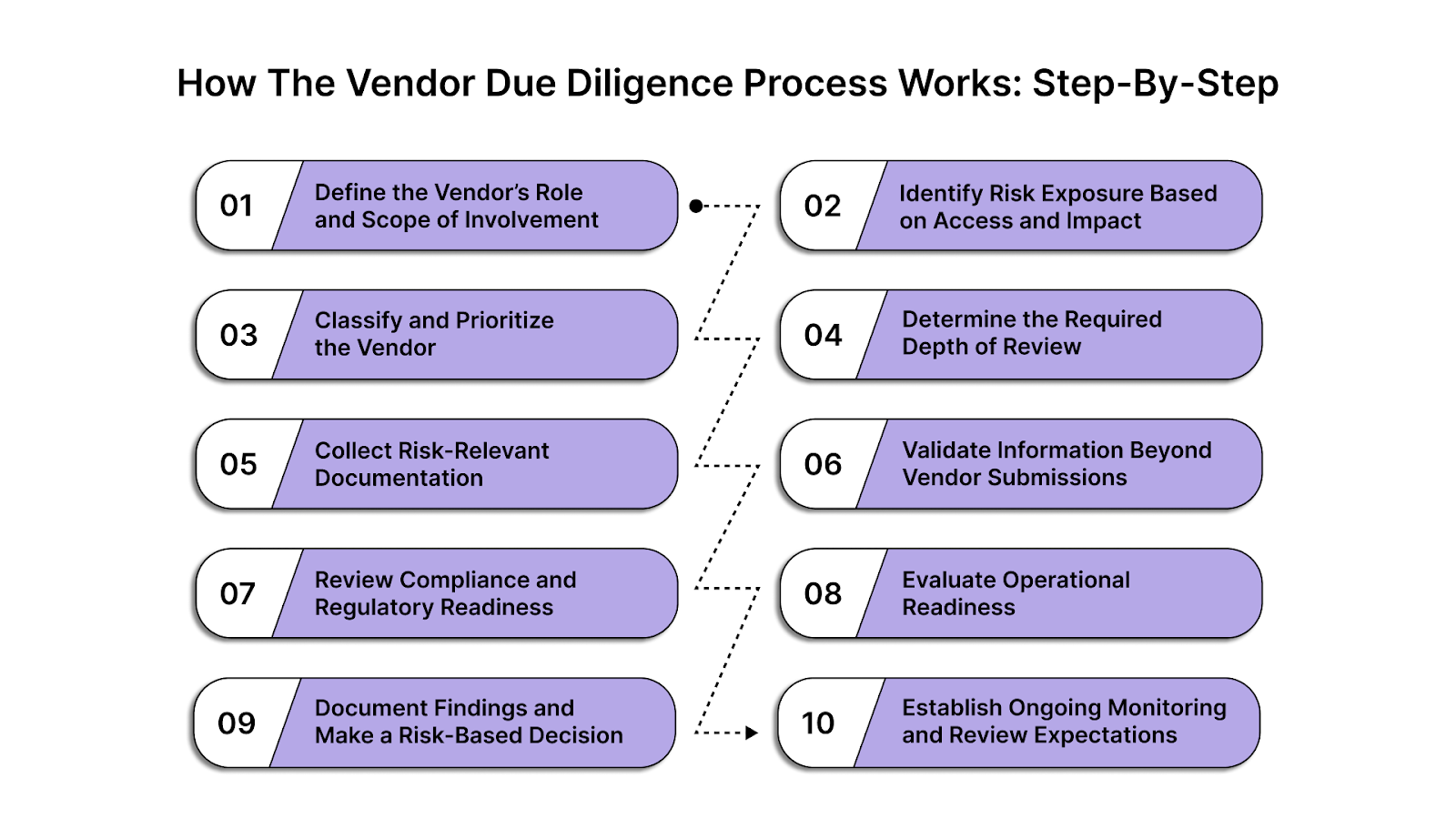
1. Define the Vendor’s Role and Scope of Involvement
Start by clearly defining what the vendor will support and how they fit into your operating model. You need to identify the services they provide, the business processes they touch, and whether they support regulated activity.
2. Identify Risk Exposure Based on Access and Impact
Next, you should look at what the vendor can access and influence. This includes data types, systems, customer information, funds, and critical workflows. When you understand access and impact, you can see how a vendor failure could affect compliance, operations, or reporting.
3. Classify and Prioritize the Vendor
Place the vendor into a risk tier based on their role and exposure. Vendors that support core operations or handle sensitive data get higher priority than those with limited or indirect involvement.
4. Determine the Required Depth of Review
You then decide how detailed the review needs to be for this type of vendor. Higher-risk vendors require deeper checks across compliance, security, financial stability, and operations. Lower-risk vendors can be reviewed with a lighter, more focused approach while still maintaining a reliable process.
5. Collect Risk-Relevant Documentation
Request documentation that directly supports the areas you are reviewing. This can include compliance policies, security materials, operational procedures, governance details, and financial information.
6. Validate Information Beyond Vendor Submissions
You shouldn't rely only on what the vendor provides. Where possible, review other reliable sources, such as independent audit reports, certifications, and third-party assessments. This extra validation confirms accuracy and reduces reliance on self-reported claims.
7. Review Compliance and Regulatory Readiness
Assess whether the vendor meets the regulatory requirements for your business. This includes checking licensing status, compliance frameworks, internal controls, and, where applicable, training practices.
8. Evaluate Operational Readiness
You should review whether the vendor can meet its obligations over time. Operational readiness shows whether the vendor has the systems, people, and continuity planning to support you.
9. Document Findings and Make a Risk-Based Decision
Pull everything into a clear, structured record, including identified risks, mitigating controls, and open issues. Document whether the vendor is approved, conditionally approved, or declined, along with the rationale. This record is critical for audits, exams, and internal reviews.
10. Establish Ongoing Monitoring and Review Expectations
Vendor risk changes over time. Define review frequency, tracked performance, compliance metrics, and reassessment triggers. Ongoing monitoring ensures risk stays aligned as vendor scope and exposure change.
If you’re refining how vendor risk is identified and prioritized, understanding structured risk evaluation models can help. Explore practical frameworks in this Top Risk Assessment Methodologies and Practices Guide.
What are the Reliable Sources for Finding Vendor Due Diligence Data?

Collecting accurate and reliable data is a crucial part of any vendor due diligence process. By using multiple sources, you can verify vendor claims, unfold hidden risks, and gain a clearer understanding of a vendor’s operational, financial, and compliance posture.
The following is a list of common sources for vendor due diligence data:
- Public Databases and Registries: Verify legal registration, licenses, and certifications through government or professional registries to independently confirm vendor legitimacy and compliance.
- Third-Party Audits and Compliance Certifications: Review SOC 2 reports, ISO certifications, and independent audits to validate controls and support exam traceability.
- Vendor Risk Questionnaires and Surveys: Use structured questionnaires to collect consistent data on security, compliance, operations, and governance. Treat responses as input only and always validate with independent sources.
- Financial Statements and Credit Assessments: Collect procedures, risk frameworks, compliance policies, and contracts. Store them in a traceable repository to show what was reviewed, approved, and monitored.
- Vendor-Provided Documents, Policies, and Procedures: Collect operational procedures, risk frameworks, compliance policies, and contracts. Maintain them in a traceable repository to show auditors what was reviewed, approved, and monitored.
- Internal Records and Historical Experience: Use past audits, incident logs, contracts, and performance data to identify patterns and maintain audit-ready continuity and accountability.
After collecting and validating these sources, having senior oversight and structured processes becomes critical to ensure your vendor due diligence program is reliable and audit-ready. Fraxtional provides fractional compliance leadership designed for regulated growth, offering expertise and guidance without adding full-time headcount.
How to Select a Compliant Vendor After Due Diligence?

Selecting a vendor after due diligence is a risky decision. Your goal is to choose vendors whose controls, stability, and day-to-day practices match your regulatory obligations and risk tolerance.
Here’s how to choose a compliant vendor after due diligence:
- Evaluate Findings Against Predefined Risk Criteria: Review due diligence results against your upfront criteria and base decisions on evidence.
- Assess Control Effectiveness: Focus on whether controls actually work in practice and align with the vendor’s role, not just on policies or certificates.
- Distinguish Between Manageable and Structural Risks: Separate fixable gaps from deeper issues, addressing some through remediation while letting structural problems strongly influence decisions.
- Apply Conditional Approval Where Appropriate: Grant conditional approval only when risks are manageable and clearly define remediation steps, timelines, and reporting expectations.
- Align Contracts With Due Diligence Findings: Ensure contracts reflect the due diligence results, including audit rights, reporting requirements, remediation commitments, and termination triggers.
Once the evaluation criteria are in place, the next step is understanding how the right partner supports this due diligence process in practice.
How Fraxtional Supports Vendor Due Diligence Execution?
Vendor due diligence can become challenging when expectations rise, but processes remain informal, or documentation is inconsistent, making it difficult to explain decisions during reviews.
Fraxtional provides experienced fractional compliance and risk leaders who help regulated companies strengthen vendor oversight as part of their broader compliance and risk programs.
- Risk-Based Vendor Scoping and Classification: Fraxtional helps teams prioritize vendors based on operational impact, data access, and regulatory exposure, ensuring oversight aligns with actual risk.
- Vendor Due Diligence Framework Development: Frameworks are designed within policy and procedure services to define which information should be reviewed, documented, and monitored to meet regulatory and sponsor bank expectations.
- Documentation and Decision Support: Fraxtional establishes standards to clearly show what was reviewed, how risks were assessed, and why approvals, escalations, or remediations were made.
- Ongoing Oversight and Reassessment: Vendor oversight is embedded into ongoing risk programs to ensure reviews are updated as access, scope, incidents, or dependencies change over time.
- Fractional Compliance and Risk Leadership: Fraxtional provides fractional CCO, CRO, MLRO, and compliance leaders to guide approvals, escalations, and regulatory engagements without the need for full-time executives.
Fraxtional helps regulated companies move from due diligence intent to defensible execution. Vendor oversight practices are built to withstand audits, sponsor bank reviews, and regulatory scrutiny. Connect with Fraxtional today!
Final Thoughts
Vendor due diligence often fails when decisions cannot be clearly explained during audits, bank reviews, or investor checks. A structured checklist closes this gap by bringing risk classification, evidence gathering, and oversight into one reliable process.
For regulated teams preparing for audits, sponsor bank reviews, or critical growth milestones, Fraxtional helps create practical, review-ready vendor risk programs. It collaborates with internal teams to design vendor management frameworks, strengthen documentation standards, and embed ongoing oversight practices that align with regulatory expectations.
If vendor risk is drawing increased attention from regulators, banks, or investors, promptly consult with an Expert or Compliance Leader to review and strengthen your vendor due diligence process so it meets real-world review requirements, avoiding reliance on last-minute fixes.
FAQs
The level of due diligence should match the vendor’s risk. Review vendors based on what they access, the services they support, and the impact their failure could have on regulatory obligations. Vendors handling regulated activities, sensitive data, or core operations need deeper reviews.
Security incidents, financial stress, leadership changes, regulatory actions, or major service disruptions should trigger immediate reassessment, as these may alter the vendor’s risk profile.
Sponsor banks expect risk-tiered vendors, clear documentation of reviews, and tracked resolution of issues, focusing on defensible decisions over the volume of collected information.
A refusal is itself a risk signal. If a vendor cannot support reasonable review requests, you should reconsider whether the relationship aligns with your regulatory obligations and risk tolerance before moving forward.
Yes, contracts should reflect what your due diligence reveals. This includes audit rights, reporting obligations, notification timelines, and remediation requirements helps keep controls enforceable after onboarding.
blogs
Don’t miss these
.jpg)


Let’s Get Started
Ready to Strengthen Your Compliance Program?
Take the next step towards expert compliance solutions. Connect with us today.