

Jan 8, 2026
Drata vs Human Compliance Leadership

By Fraxtional LLC

Summarize the blog with AI
Fintech and crypto companies are operating in an increasingly complex regulatory scenario. In the United States, firms face layered obligations from federal agencies and states; globally, regions like the UK, EU, and Canada are raising the bar on licensing, AML/transaction monitoring, and data security.
Among fintech firms, around 80% are increasing their compliance budgets in 2024. And yet, more than 60% of fintech companies reported paying at least $250,000 in fines in a single year due to compliance deficiencies. For startups and growth-stage firms, these numbers translate into real pressures.
For banks and sponsor banks, the question becomes: how do you partner with fintechs whose compliance maturity you can trust? And for private-equity investors, you're asking: what's the compliance risk in a portfolio fintech, crypto, or payments business? And is software alone enough?
This article equips you with a clear framework to decide. We'll compare Drata vs human compliance leadership across various aspects so you can choose the model that aligns with your objectives, budget, and regulatory profile.
Key Takeaways:
- Drata helps teams automate evidence collection and stay audit-ready, but it cannot replace regulatory judgment or leadership.
- Human compliance leadership brings strategy, risk oversight, and direct regulatory experience that software alone cannot provide.
- Fintech, crypto, and sponsor banks face higher regulatory pressure, and choosing between software and leadership is more critical as they scale.
- Early-stage teams often start with automation, while growing companies blend software with fractional C-suite leadership.
- The right choice depends on your sector, risk maturity, and the type of oversight regulators and sponsor banks expect.
What Exactly is Drata and What it Offers

For many fintech and crypto teams, Drata is often the first compliance platform they evaluate when preparing for audits or building internal controls. Its core value lies in automation.
Instead of collecting evidence manually or tracking controls in spreadsheets, Drata streamlines the operational workload that slows teams down.
Drata focuses on three areas most early-stage companies struggle with:
1. Automated Evidence Collection and Control Monitoring
Fintech and crypto firms often need to prove that their controls work across engineering, data, HR, and operations. Drata automates this process by pulling evidence from cloud providers, code repositories, and internal systems. It reduces manual documentation and keeps teams audit-ready.
This matters when you must move fast. If you're launching new products, integrating with a sponsor bank, or scaling to new states, manual evidence tracking quickly becomes unmanageable.
2. SOC 2, ISO 27001, and Audit-Ready Reporting
Drata is well known for SOC 2 automation. The platform guides teams through readiness steps, helps maintain controls, and supports audit workflows. For companies seeking fast validation for investors or bank partners, this speed becomes a competitive advantage.
However, this focus is also the limit. Drata does not replace sector-specific requirements like money transmitter licensing, AML program development, or MLRO-led reviews. These areas require human judgment and regulatory experience, which automation cannot replicate.
3. Integrations and Workflow Efficiency
Drata's integrations reduce friction across departments. Security teams can link infrastructure tools. HR teams can automate onboarding and offboarding evidence. Compliance officers get dashboards to see where gaps exist.
For lean teams, this efficiency saves hours every week. It also reduces the administrative burden when preparing for audits, which is why many early-stage companies compare audit-ready compliance Drata vs fractional leadership models to understand where the balance should be.
However, despite its strengths, Drata is not built to handle financial services-specific risks. These gaps become clearer as teams scale.
- Regulatory nuance
Automated workflows cannot interpret complex AML or payments regulations or adjust policies to align with sponsor bank expectations. - Human oversight
Platforms like Drata offer automation, but not to regulatory officers with experience managing enforcement actions or guiding a fintech through bank partnership reviews. - Sector requirements
Elements like suspicious activity oversight, money transmitter licensing, and fintech-specific audits require human-led decision-making and experience. This is where comparisons such as regulatory officer Drata vs human-led leadership arise. - Sponsor bank relationships
No automation platform can build or maintain relationships with bank partners. Banks often require direct access to human compliance leadership.
For these reasons, many companies treat Drata as a foundation but still evaluate compliance role outsourcing vs Drata or a Drata vs outsourced CCO approach as they grow.
What is Human-Led Compliance Leadership and What it Offers

Software can automate tasks, but it cannot replace the strategic judgment, regulatory interpretation, and real-world experience needed to guide a financial business through audits, licensing, or bank partnerships. Human compliance leadership brings depth that automation tools cannot reach.
For most fintechs, crypto firms, banks, and private-equity-backed companies, this leadership becomes essential the moment risk grows beyond basic control monitoring.
1. Strategic Oversight and Regulatory Judgment
A human compliance leader provides something Drata cannot: decision-making grounded in experience. This includes interpreting ambiguous rules, adjusting controls to match evolving risk, and advising founders or investors when regulators tighten expectations.
- Rewrite policies to satisfy a sponsor bank's exact requirements.
- Anticipate regulatory questions before an audit starts.
- Spot gaps that automation tools cannot detect, such as flawed onboarding flows or unusual transaction risks.
This judgment is critical in sectors where regulators expect human oversight, not just automated controls.
Suggested Read: What a Fractional CCO Does & Why It Matters for Your Business?
2. Sector-Specific Expertise
Financial products are not uniform. A neobank faces different risks than a payments processor. A crypto exchange faces different risks than a lender. Human leaders understand these differences and can tailor controls, monitoring, and escalation processes to match them.
This is where companies often compare Drata vs fintech-specific compliance services or Drata vs human-led models. Software may support general frameworks, but it cannot redesign programs for:
- Money transmitter licensing
- Cryptocurrency-related AML obligations
- Card program compliance
- Bank partnership requirements
These responsibilities require human evaluation and industry context.
3. Regulatory Relationships and Sponsor Bank Engagement
Automation tools cannot represent a company during sponsor bank reviews, audits, or due diligence. Human compliance leadership can. Banks expect direct access to a compliance officer who can explain risk decisions, answer questions, and own the program.
A platform cannot build that trust. A human leader can:
- Prepare your company for the sponsor bank onboarding
- Communicate risk decisions to bankers
- Respond to review comments in real time
This is often the deciding factor when teams compare Drata vs outsourced CCO or Drata vs CAMLRO-as-a-service for growth-stage regulatory needs.
4. End-to-End Policy Development and Audit Readiness
While Drata can help track controls, it cannot create or revise policies to match regulatory expectations. Human leaders build these documents with precision, ensuring every policy reflects your operational reality, not a generic template.
Human-led programs strengthen:
- AML and transaction monitoring oversight
- Suspicious activity escalation
- Vendor risk management
- Operational risk controls
- Ongoing governance frameworks
These tasks require situational context. Automation supports them, but it cannot lead them.
5. Flexibility Through Fractional or Outsourced Models
Not every company needs a full-time CCO. This is why fractional and outsourced leadership models exist. They give teams experienced oversight without the cost of a full-time executive.
This model is becoming more common for firms comparing compliance role outsourcing vs Drata or audit-ready compliance Drata vs fractional approaches. It helps startups move fast while maintaining credibility with banks, auditors, and regulators.
Side-by-Side Comparison: Drata vs Human Compliance Leadership
Choosing between Drata and human compliance leadership is not a matter of one being “better” than the other. The right choice depends on your product, regulatory exposure, growth stage, and your sponsor bank's or investors' expectations.
Below is a clean, structured comparison to help you decide.
Most teams quickly realize that automation and leadership solve different parts of the compliance problem. Drata reduces busywork. Human experts reduce risk.
If your team is weighing automation against human oversight, Fraxtional's compliance leaders can help you understand what you truly need for your next stage. Connect with us to review your requirements and choose the model that fits your risk profile.
When a Hybrid Approach or Fractional Leadership Makes Sense

A recent survey found 93% of fintechs say meeting compliance requirements is increasingly complex. Many fintechs and banks recognize that a mix of automation and human leadership works best, mainly as growth introduces greater regulatory complexity.
Here are the key scenarios where hybrid or fractional models shine:
1. Early-Stage Fintechs Preparing for First Audits
For Seed or Series A companies, automation like Drata handles busy-work: evidence collection, control monitoring, and audit readiness.
But when you need to build an AML program, draft niche policies, or respond to bank due diligence, human leadership kicks in.
2. Growth-Stage Companies Expanding Products or States
Scaling into new states, launching new products, or hitting sponsor-bank triggers raises risk. Automation continues to help maintain consistent controls.
But you also need a compliance authority that can adjust policies and guide decisions when rules change. A fractional leader fits that gap.
3. Crypto Firms Under Heightened Scrutiny
Crypto firms operate in a fast-evolving regulatory zone. Automation can flag anomalies and maintain logs, but it cannot replace expert judgment on wallet risk, licensing, or sponsor-bank partnerships.
4. Sponsor Bank Partnerships & Ongoing Reviews
Sponsor banks will not accept software alone as your compliance governance. They expect a named person who understands risk, can explain controls, and sits in the boat with you.
A hybrid model, software plus human leadership, allows you to maintain documentation (via automation) and accountability (via your compliance lead).
5. Private Equity Portfolio Monitoring
PE firms need a clear picture of compliance risk across portfolio companies. Automation can surface control gaps and metrics, but human leadership is required to assess whether those gaps create material risk.
Fractional leadership offers cost-effective oversight without building full executive teams.
Also Read: How Fractional Leadership Transforms Corporate Governance
Implementation Checklist for Founders, Compliance Officers, and Sponsor Banks

Choosing between Drata, human leadership, or a hybrid model is easier when you break the process into concrete steps. Structured implementation is critical. This checklist gives each decision-maker group a practical way to assess readiness, risk, and resource fit.
1. For Founders & CEOs
Early decisions shape long-term risk posture. Use this checklist to align compliance with growth.
- Define the problem first.
Are you preparing for SOC 2? Seeking a sponsor bank? Entering new states? Your goal determines whether you need automation, leadership, or both. - Assess internal ownership.
If no one owns compliance decisions today, software will not solve the gap. - Map regulatory exposure.
Payments, lending, crypto, and money transmission each require human review. - Identify where Drata fits.
Automation works well for control tracking and audit readiness. - Identify where it doesn't.
Bank relationships, licensing strategy, and AML decisions need leadership.
This is where comparisons like compliance role outsourcing vs Drata become relevant.
2. For Compliance Officers & Risk Managers
Your job is to maintain clarity and control as complexity increases.
- Review current control coverage.
Are gaps operational (automation-friendly) or judgment-based (leadership-dependent)? - Check audit readiness.
Are you preparing for SOC 2, ISO 27001, a bank review, or all three? - Evaluate workload.
If manual evidence collection consumes more than 20–30% of your time, Drata adds value. - Test risk maturity.
If policies are outdated, generic, or misaligned with operations, leadership is required. - Growth plan.
As the footprint expands, hybrid models often outperform software-only solutions.
3. For Sponsor Banks
Banks need confidence that a fintech partner understands risk, not just compliance tasks.
- Verify the presence of a human lead.
Banks cannot interface with software. They need a responsible person. - Assess the program's adaptability.
Does the fintech update its controls when guidance changes, or only when automation flags an issue? - Review governance clarity.
Are roles and escalation paths defined? Is there ongoing oversight? - Validate documentation quality.
Drata helps maintain evidence, but human leaders must interpret it and respond during reviews. - Check responsiveness.
Sponsor banks often prefer hybrid setups because responses to findings, remediation plans, and quarterly reviews require real human input.
Suggested Read: SOC 2 Compliance Checklist: Step-by-Step Guide to Pass Audit
Common Mistakes and How to Avoid Them
Even experienced teams misjudge where automation ends and human oversight begins. The cost of these mistakes can escalate quickly. Avoiding these pitfalls helps you stay ahead of risk and reduces the chance of avoidable findings during audits or sponsor bank reviews.
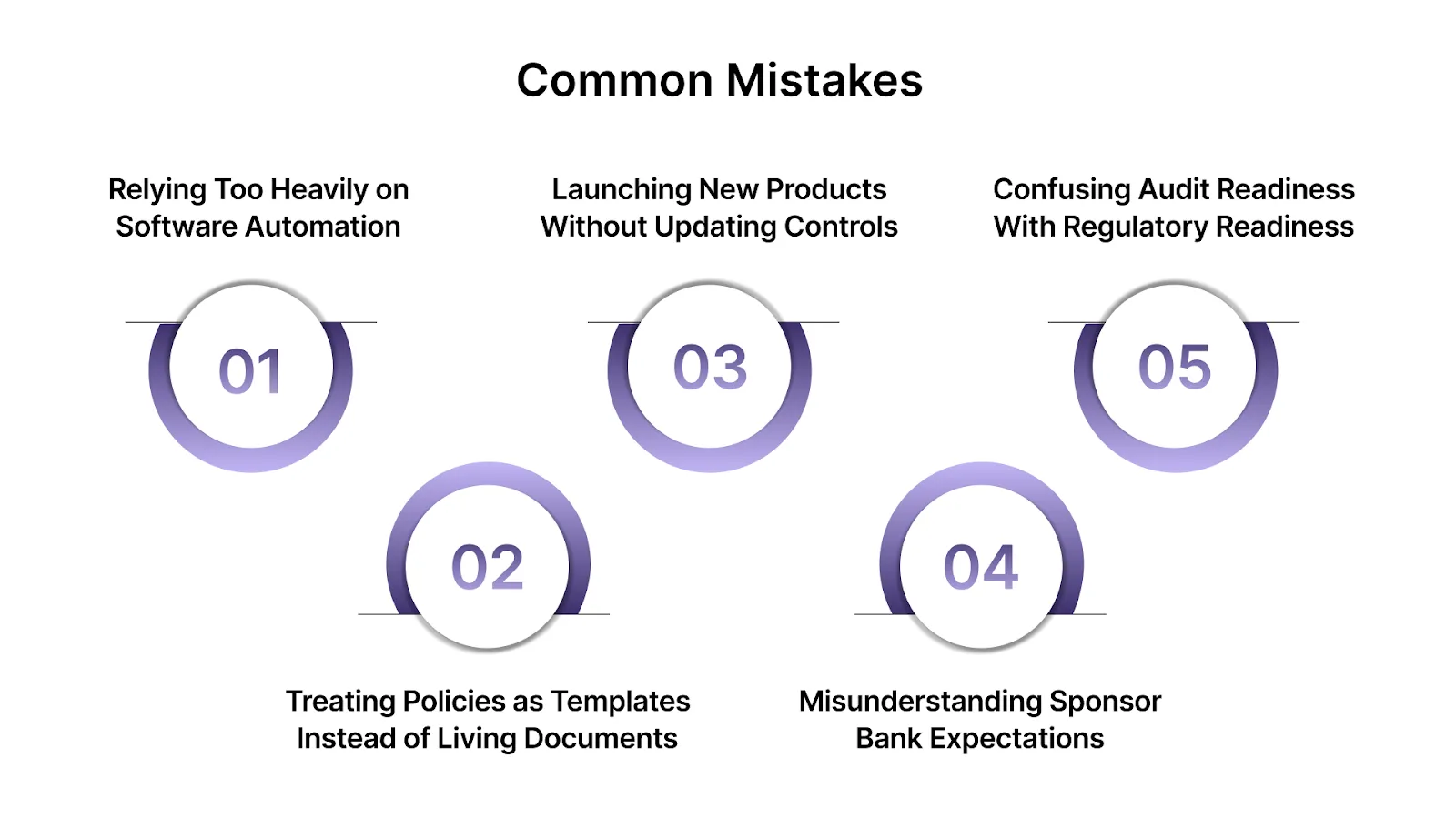
1. Relying Too Heavily on Software Automation
Drata helps with workflows, but it cannot replace a regulatory officer. Teams often assume automation provides full compliance coverage, leading to overlooked risks in AML, onboarding, payments, or crypto activities.
- How to avoid it:
Use Drata for efficiency, not decision-making. Pair automation with a compliance lead who understands your business model and regulatory exposure.
2. Treating Policies as Templates Instead of Living Documents
Generic templates do not satisfy sponsor banks or regulators. Policies must match real operations. If they don't, gaps appear during SOC 2 audits, licensing reviews, or bank partner assessments.
- How to avoid it:
Have a human leader rewrite policies to align with actual processes and risks. Automation can help track controls, but not define them.
3. Launching New Products Without Updating Controls
New product features often introduce overlooked risks. Fraud patterns shift. Vendor exposure changes. Automation tools will not automatically detect these gaps.
- How to avoid it:
Update risk assessments and controls before launch. Growth-stage firms frequently adopt hybrid setups once they realize automation doesn’t scale judgment.
4. Misunderstanding Sponsor Bank Expectations
Sponsor banks require clarity, accountability, and a real compliance owner. Software cannot attend meetings, interpret feedback, or commit to remediation.
- How to avoid it:
Assign a human lead who can manage bank communication and their own findings. Automation then supports evidence and documentation.
5. Confusing Audit Readiness With Regulatory Readiness
SOC 2 or ISO 27001 audits do not equal full regulatory compliance. This misconception pushes companies to compare audit-ready compliance, Drata vs fractional leadership, as they discover hidden gaps beyond the audit scope.
- How to avoid it:
Treat audits as one piece of compliance, not the whole picture. Human leaders fill the gaps that automation cannot assess.
Avoiding these mistakes requires judgment, not just tools. This is where a partner like Fraxtional, which bridges automation with leadership, becomes essential.
Where Fraxtional Fits in a Drata-Driven Compliance Environment

Most fintech and crypto teams reach a point where automation is no longer enough. A gap arises when evidence must be translated into decisions, strategy, and defensible oversight. This is where Fraxtional bridges the divide between automated operations and human regulatory leadership.
Fraxtional's fractional Chief Compliance and Risk Officers work with platforms like Drata, not instead of them. Automation handles the mechanics. Fraxtional handles the judgment. The result is a compliance program that operates efficiently without losing credibility with regulators, auditors, or sponsor banks.
Every engagement starts by grounding compliance in reality rather than templates:
- Mapping regulatory exposure across products, states, and licensing paths.
- Aligning Drata's controls with absolute obligations, not just framework checklists.
- Embedding leadership oversight into governance routines and escalation paths.
- Translating Drata-generated outputs into clear narratives for boards, auditors, and sponsor banks.
This combination matters because most regulatory expectations require a responsible leader who understands the risk environment. Software alone cannot own those outcomes.
Fraxtional's model strengthens what Drata already does well. Together, they give fintechs the two qualities regulators and banks look for first: precision and accountability.
Partner with Fraxtional to build a compliance foundation that moves with your product, scales with your risk, and holds up when regulators, auditors, and sponsor banks look closest.
Conclusion
Automation can demonstrate compliance, but only leadership can stand behind it.
Drata keeps controls organized and evidence complete, but it cannot defend a decision, interpret a gray area, or sit across from a sponsor bank explaining how risks are managed. Regulators, investors, and auditors still expect accountable ownership, not just automated workflows.
That's why the strongest compliance programs are neither software-only nor leadership-only. They blend both.
Automation keeps the engine running.
Human oversight keeps it credible.
For fintechs, crypto firms, and banks that need to move fast without losing control, fractional leadership fills the space that software cannot reach. It brings judgment, context, and accountability to the systems already in place.
Fraxtional turns that balance into an advantage by pairing the efficiency of platforms like Drata with the clarity and oversight that regulators look for first.
FAQs
No. Drata automates evidence collection and control monitoring, but regulators and sponsor banks require a human leader to interpret rules, their own decisions, and respond during reviews. Software supports compliance, but it cannot assume accountability.
Teams usually shift when they face sponsor bank reviews, pursue money transmitter licenses, launch higher-risk products, or expand into multiple states. These milestones require judgment that automation cannot provide.
Not on its own. Crypto programs require CAMLRO oversight, specialized AML controls, and ongoing risk evaluation. Drata helps with documentation, but crypto-specific decisions need a human compliance lead.
Fractional leaders map absolute obligations to Drata's controls, update policies, guide risk decisions, and represent the company during audits or bank reviews. Drata handles workflow; leaders ensure outputs match the company’s actual risk posture.
Sponsor banks value automation, but they require a designated compliance officer who can explain controls, answer questions, and own remediation. Software alone is never accepted as a full compliance governance solution.
Common gaps include incomplete AML oversight, outdated policies, unclear escalation paths, and missed regulatory updates. These gaps appear during audits or reviews because they require interpretation, not automation.
blogs
Don’t miss these



Let’s Get Started
Ready to Strengthen Your Compliance Program?
Take the next step towards expert compliance solutions. Connect with us today.
Now Accepting:
BTC

ETH

USDC
USDP