

Feb 23, 2026
Independent Audit as a Strategic Signal in 2026

By Fraxtional LLC

Summarize the blog with AI
You’ve probably been in a room where a board member quietly asks: “Are we truly ready for what the next audit will hit on?” That question goes beyond compliance checkboxes and points to an uncomfortable truth executives rarely admit: independent audits reveal hidden risks buried in everyday operations.
A missed control, weak process, or unseen compliance gap can quickly derail fundraising, stall bank partnerships, or invite heightened regulatory scrutiny. In fact, in 2024, the Public Company Accounting Oversight Board (PCAOB) found audit deficiencies in 39% of U.S. audits it inspected, a clear indicator that even seasoned auditors often miss critical weaknesses without an accurate, independent review.
For founders, compliance leaders, sponsor banks, crypto firms, and investors like you, facing that reality head-on is essential. In this blog, we will explore what independent audits really do, why they matter to your growth plans, and how to understand them strategically.
Key Takeaways
- Independent audits act as a strategic signal of governance and risk maturity for regulators, sponsor banks, and investors in 2026.
- Audit expectations increase with stakeholder reliance and regulatory exposure, not just company size or revenue stage.
- Independent audits carry significantly more external credibility than internal audits or advisory reviews, often serving as gating requirements for partnerships and capital.
- Poor audit scoping, weak execution, or misinterpreted findings can delay deals, elevate regulatory scrutiny, and expose hidden risks.
- Fraxtional risk and compliance leadership enables continuous audit readiness, helping high-growth firms align audit outcomes with strategy without slowing execution.
Why Independent Audits Matter for High-Growth Companies

When you’re scaling fast, launching products, courting banks, or raising capital, the last thing you want is a blind spot lurking in your controls that a partner, regulator, or investor identifies at the worst possible time.
Across fintech, crypto, and banking, expectations around third-party assurance are rising because internal reviews alone no longer satisfy stakeholders who must manage risk and trust.
Independent audits matter because key decision-makers increasingly rely on them to:
- Sponsor Banks: Validate your risk controls before onboarding or deepening partnerships.
- Regulators: Confirm your compliance program meets changing supervisory standards.
- Private Equity Investors: Assess maturity and identify hidden risk before capital deployment.
What happens when you delay or skip them:
- Delayed partnerships with banks that won’t proceed without external assurance.
- Failed diligence outcomes in investor reviews.
- Regulatory escalations that distract your team and drain resources.
Each of these isn’t abstract; they show up in real commercial conversations, board meetings, and fundraisers. Independent third-party assurance helps you anticipate concerns before they become setbacks instead of surprises down the road.
Also Read: Top Risk Assessment Methodologies and Practices Guide
Understanding why independent audits matter naturally leads to a deeper question: what an independent audit actually means from a decision-maker’s perspective.
What Independent Audits Examine and Verify

When every stakeholder from sponsor banks to PE investors asks, “How can we trust what we’re seeing?” the answer isn’t just a report, it’s the independent precision behind it that matters most.
An independent audit is a formal examination of a company’s financial statements, controls, and reporting by a third-party auditor with no financial or operational ties to the business. This auditor provides objective assurance that the information presented is accurate, reliable, and free from bias.
Independence is crucial: auditors must be free from influence in fact and perception so their conclusions cannot reasonably be questioned by those who rely on them.
What Independent Audits Cover
In a financial audit, auditors verify whether your financial statements fairly present your financial position in accordance with Generally Accepted Accounting Principles (GAAP). They:
- Test whether balances and transactions are accurate.
- Confirm proper classification of assets and liabilities.
- Ensure disclosures comply with reporting standards.
The result is a formal audit opinion that stakeholders can trust.
For sponsor banks, regulators, and investors, independence matters far more than a big firm logo; they care about realistic assurance and transparent findings that hold up under scrutiny.
5 Core Roles Independent Audits Play in Risk & Compliance
Independent audits aren’t just formalities; they shape how regulators, banks, investors, and leadership see your business’s risk posture. When done well, they identify risks others miss and build trust where it matters most.
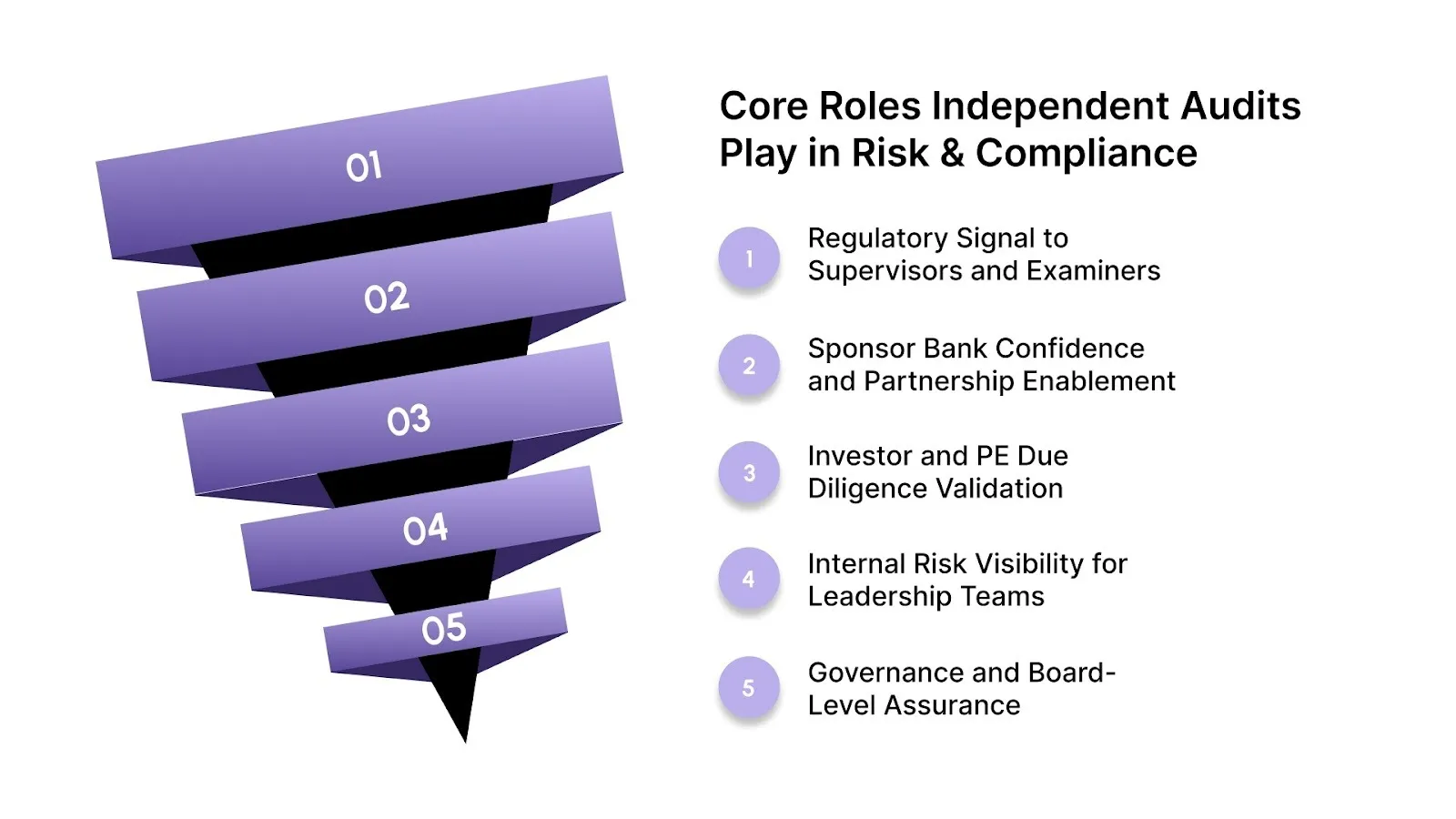
1. Regulatory Signal to Supervisors and Examiners
Regulators don’t just check boxes; they look for signals that your controls actually work. Independent audits become early indicators of risk and compliance strength.
In practice, regulators use audits to:
- Validate control effectiveness before exams or enforcement actions.
- Assess compliance maturity against frameworks like SOX, AML/CFT, or state financial rules.
- Reduce follow-up scrutiny when prior audits show consistent control performance.
Regular independent audits can shift regulators from reactive questioning to collaborative review, saving time, uncertainty, and potential enforcement escalation.
2. Sponsor Bank Confidence and Partnership Enablement
Banks don’t sign deals just because of a pitch; they need evidence that you manage risk. Independent audits are one of the most credible signals they can rely on.
How audits support bank relationships:
- Demonstrate objective evidence of control effectiveness before onboarding.
- Provide third-party assurance that internal processes meet bank standards.
- Highlight red flags early (e.g., incomplete vendor controls or weak risk monitoring) that banks care about.
Sponsor banks increasingly require audit outcomes before committing to fintech partnerships, because audits help them satisfy their own compliance obligations.
If audit findings are starting to influence regulator conversations, sponsor bank confidence, or investor diligence, the risk is no longer theoretical. Fraxtional risk and compliance leadership helps you interpret audit signals early and act before they slow partnerships or capital decisions. Reach out to us today!
3. Investor and PE Due Diligence Validation
For investors, an independent audit is more than proof of compliance; it’s a lens into the quality of governance and risk preparedness.
How investors view audits:
- Decision-grade vs “check-the-box” audits: Investors distinguish between superficial reports and deep assurance that identifies actual risk.
- Audit outcomes shape valuation and timelines because they impact perceived execution risk.
A clean independent audit can accelerate diligence phases, deepen investor confidence, and improve negotiating understanding, especially in competitive rounds.
4. Internal Risk Visibility for Leadership Teams
Sometimes the biggest risks aren’t unknown; they’re unseen until someone outside your daily rhythms highlights them. That’s where independent audits become strategic.
What audits identify for leaders:
- Control gaps leadership may overlook during growth or change.
- Translate audit findings into operational priorities that strengthen resilience.
- Avoid blind spots during rapid scaling or product launches.
Good independent audits help you see bigger risks before they become headline problems, enabling proactive decisions.
5. Governance and Board-Level Assurance
Boards and audit committees don’t just want reports; they want confidence that leadership is managing risk well. Independent audits are essential tools for that assurance.
How boards use audits:
- Assess risk oversight effectiveness at the governance level.
- Set reporting expectations that align with fiduciary duties and enterprise risk management (ERM) appetite.
- Support fiduciary responsibilities with evidence that controls and disclosures are tested by a neutral party.
Independent audits reshape how external stakeholders and internal leaders alike perceive risk, readiness, and reliability, making them indispensable for high-growth companies that must balance compliance with strategic ambition.
Also Read: Top ERM Frameworks to Strengthen Risk Management in 2026
To fully understand their impact, it helps to see how independent audits differ from internal audits and advisory reviews.
Independent Audit vs Internal Audit vs Advisory Reviews

Independent audits, internal audits, and advisory reviews all play roles in risk and compliance, but they differ in independence, credibility, depth, and how stakeholders rely on them.
Once an independent audit becomes necessary, how companies approach it often determines whether it adds value or creates friction.
Common Mistakes Companies Make with Independent Audits
Even smart, well-intentioned teams often stumble when preparing for or executing independent audits, not because they lack effort, but because they treat audits as another item on a checklist instead of a strategic risk signaling process.
Below are common pitfalls you might encounter, with practical fixes that focus on outcomes, not blame.
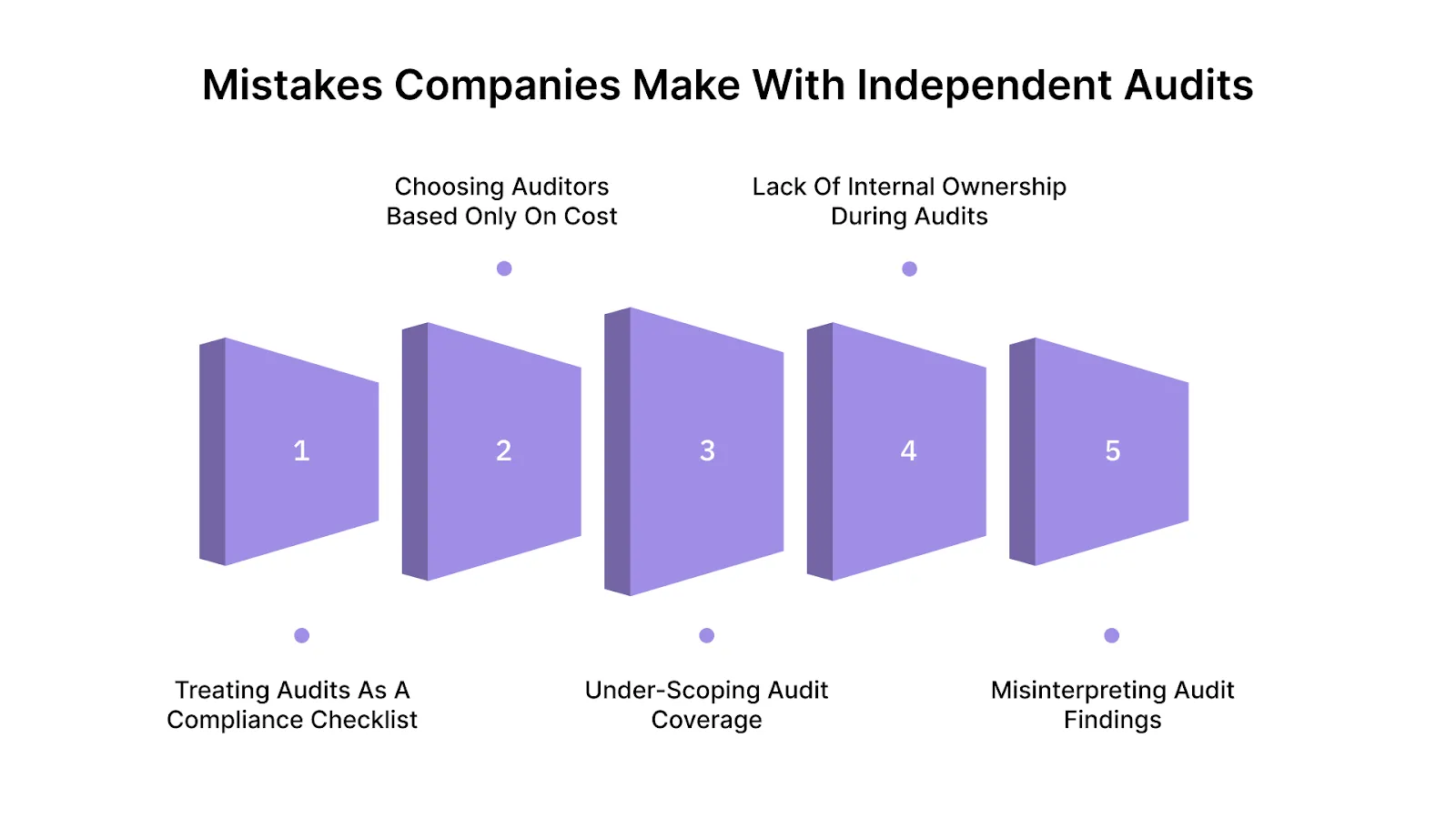
1. Treating Audits as a Compliance Checklist
- What Happens: You prepare documentation only to satisfy minimum requirements, missing deeper control weaknesses.
- Consequence: Stakeholders still lack confidence in your processes, and audit results don’t change decisions.
- Fix: Approach audits as risk evaluation exercises, dig into control effectiveness and why it matters to regulators or investors, rather than just accumulating documents.
2. Choosing Auditors Based Only on Cost
- What Happens: Selecting the lowest-cost auditor can reduce perceived precision and compromise stakeholder trust.
- Consequence: Banks and investors may discount the audit outcomes or insist on repeat external verification.
- Fix: Evaluate auditor expertise in your industry and the depth of their procedures, not just fees.
3. Under-Scoping Audit Coverage
- What Happens: The audit covers only a subset of critical areas or risks.
- Consequence: Unexamined areas may hide control gaps that surface later during diligence or exams.
- Fix: Collaborate early on scope definition with auditors and key internal functions to ensure high-risk domains are included.
4. Lack of Internal Ownership During Audits
- What Happens: Teams treat audits as “external” events, so internal SMEs aren’t engaged.
- Consequence: Auditors encounter vague answers, longer fieldwork, and superficial testing.
- Fix: Assign clear internal owners for audit evidence, control narratives, and responses to findings.
5. Misinterpreting Audit Findings
- What Happens: Management sees audit comments as “audit problems” rather than signals about process weakness or risk exposure.
- Consequence: Fixes become cosmetic instead of strategically reducing risk, leading to repeated issues next cycle.
- Fix: Debrief with auditors to understand root causes and model corrective action plans that improve risk posture over time.
When audit preparation begins to compete with growth priorities, teams often lose speed or clarity. Fraxtional leadership helps you stay audit-ready while keeping operators focused on scaling the business. Partner with Fraxtional to align audit readiness with execution instead of disruption.
Avoiding these mistakes starts with preparing for an independent audit in a way that supports growth rather than slows it down.
How to Prepare for an Independent Audit Without Slowing Growth

Here’s a step-by-step guide that helps you stay on track without losing momentum:
1. Pre-Audit Readiness Steps - Lay the Groundwork
- Understand the Audit Scope and Objectives: Clarify what the audit will cover, including financial, operational, and compliance, so teams aren’t guessing what comes next.
- Review Past Reports or Mock Audits: A quick self-assessment can flag gaps and reduce surprises once auditors arrive.
- Set Clear Timelines: Define milestones from document prep to fieldwork and reporting, ensuring teams know what’s due and when.
2. Documentation and Control Ownership - Be Organized, Be Ready
- Gather Key Documentation Early: Financial records, control narratives, contracts, risk assessments, and reconciliations should be organized, labeled, and easy to retrieve.
- Assign Control Owners: Make sure every critical control has a responsible individual who knows how it works and where supporting evidence lives.
3. Align Leadership, Compliance, and Operations - Get Everyone on the Same Page
- Hold Alignment Meetings: Bring compliance, finance, and operations together to unify understanding of scope, risks, and evidence requirements.
- Communicate Expectations: Share audit objectives and responsibilities across teams so everyone works toward the same outcomes and avoids redundant work.
4. Setting Realistic Audit Scopes - Be Clear and Practical
- Define Scope with Auditors Early: Agree on boundaries, key focus areas, and risk priorities so work aligns with what stakeholders actually care about.
- Balance Depth Against Disruption: Prioritize high-risk domains to ensure meaningful assurance without overwhelming your team or slowing operations.
Also Read: The Ultimate Guide to UBO Compliance for Investors in 2026
Preparation sets the foundation, but sustained audit readiness often depends on experienced risk and compliance leadership.
How Fraxtional's Risk & Compliance Leadership Supports Audit Readiness

Independent audits succeed not just because of evidence and checklists, but because experienced leadership shapes the narrative, clarifies risk, and aligns assurance with strategic objectives.
That’s where Fraxtional’s risk & compliance leadership model comes in. It integrates strategic compliance leaders directly into your organization to bridge the gaps between management, auditors, regulators, and sponsor banks.
Here’s how Fraxtional makes audit readiness more than a procedural exercise:
- Strategic Leadership, Not Execution Alone: Fraxtional places seasoned compliance and risk executives inside your team to clarify control objectives, interpret audit evidence, and guide strategic risk decisions, aligning audit outcomes with business goals rather than treating audits as isolated events.
- Integrated Communication with Stakeholders: Fraxtional leaders act as a bridge, translating priorities between your management, external auditors, regulators, and sponsor banks, ensuring everyone speaks the same risk language and reducing friction during audit phases.
- Contextualized Audit Support: With deep domain experience in fintech, crypto, and banking, Fraxtional helps define realistic audit scopes, prepare evidence in stakeholder-expected formats, and anticipate questions auditors or regulators commonly raise.
- Continuous Readiness Through Compliance Integration: Beyond episodic readiness, Fraxtional shapes ongoing control, ownership, documentation discipline, and regulatory alignment so audit preparedness becomes part of your operational rhythm, not a last-minute scramble.
Also Read: What Is an Interim Executive? Roles, Value, and When to Use One
By positioning compliance leadership as a business enabler, Fraxtional strengthens controls and credibility, helping teams prepare for audits with confidence, align risk insights to strategy, and build trust as they scale.
Final Thoughts
An independent audit is no longer a back-office formality; it’s a signal. It tells regulators, sponsor banks, and investors how seriously you take risk, governance, and control discipline. When used well, it doesn’t just surface gaps; it shapes better decisions, tighter oversight, and stronger credibility at moments when scrutiny is highest.
This is where Fraxtional adds real value. Through risk and compliance leadership, Fraxtional helps high-growth fintechs, banks, crypto firms, and investors prepare for independent audits with intent, aligning audit outcomes with business objectives, stakeholder expectations, and long-term scale.
If you’re preparing for an independent audit or facing increased scrutiny, speak with Fraxtional to understand how fractional risk and compliance leadership can strengthen audit readiness and stakeholder confidence before it becomes a bottleneck.
FAQs
The timeline depends on scope, readiness, and complexity. Most independent audits take anywhere from a few weeks to several months. Companies with clear control of ownership, organized documentation, and aligned leadership typically complete audits faster with fewer follow-ups and less disruption to daily operations.
While auditors conduct testing, internal responsibility usually sits with senior management, compliance leadership, or finance. Without clear ownership, audits slow down, evidence becomes fragmented, and findings increase. Strong internal coordination often matters more than team size during audit execution.
Yes, and that’s often the point. Independent audits frequently surface control weaknesses, documentation gaps, or process inconsistencies that feel “normal” internally but appear risky to external stakeholders. Identifying these early allows leadership to address issues before regulators, banks, or investors raise them.
Independent audits aren’t about company age; they’re about risk exposure. Startups handling regulated activities, customer funds, or sensitive data may face higher expectations earlier. When external parties rely on your controls, independent assurance becomes relevant regardless of headcount or revenue.
Frequency depends on regulatory expectations, stakeholder requirements, and business changes. Many companies conduct audits annually, while others repeat them after major events like new product launches, regulatory changes, or market expansion. The goal is to maintain credibility, not to repeat audits unnecessarily.
blogs
Don’t miss these



Let’s Get Started
Ready to Strengthen Your Compliance Program?
Take the next step towards expert compliance solutions. Connect with us today.
Now Accepting:
BTC

ETH

USDC
USDP