

Dec 8, 2025
The Rise of Fractional C-Suite Executives in Crypto

By Fraxtional LLC

Summarize the blog with AI
Instead of unraveling slowly, Crypto just snaps.
A protocol is fine until a vulnerability drains liquidity.
A token chart is stable until a single unlock breaks confidence.
A project runs smoothly until regulators decide otherwise.
And when things move this fast, the gap between a good outcome and a disaster usually comes down to one thing: whether someone in the room has handled this level of pressure before.
The reality is that most crypto teams are brilliant at building products, not running companies. They can ship code at impossible speed, but treasury stewardship, exchange scrutiny, compliance expectations, investor reporting, and community stability require experience the average Web3 team doesn’t have yet.
This is where the fractional C-suite has become crypto’s quiet advantage.
Instead of waiting months for a permanent hire, founders are bringing in operators who’ve already managed token launches, liquidity shocks, security incidents, and regulatory escalations.
They step into volatile situations the moment they’re needed, steady the company, and bring discipline to a space where the pace rarely slows down.
Key Takeaways
- Crypto companies are turning to fractional C-suite leaders because full-time executive hiring can’t keep up with market volatility.
- Fractional CFOs, COOs, CISOs, and compliance heads step in fast and take charge of treasury, risk, operations, and regulatory exposure.
- They help teams steady the business during listings, audits, fund raises, hacks, or rapid user surges.
- The model delivers senior leadership at a lower cost, without slowing product or exchange timelines.
- Crypto founders use fractional executives to keep control, maintain credibility, and avoid operational gaps during high-pressure phases.
Why Crypto Needs a Different Kind of Executive
Crypto, unlike traditional markets, moves in bursts, fast, loud, and unforgiving. One protocol upgrade, one liquidity shock, one regulatory notice, and the entire operating plan has to change overnight.
This isn’t an environment where slow hiring cycles or “wait-and-watch” leadership works.
Crypto companies need operators who can carry weight the moment they walk in.
Here’s why the industry needs a different breed of executive altogether:
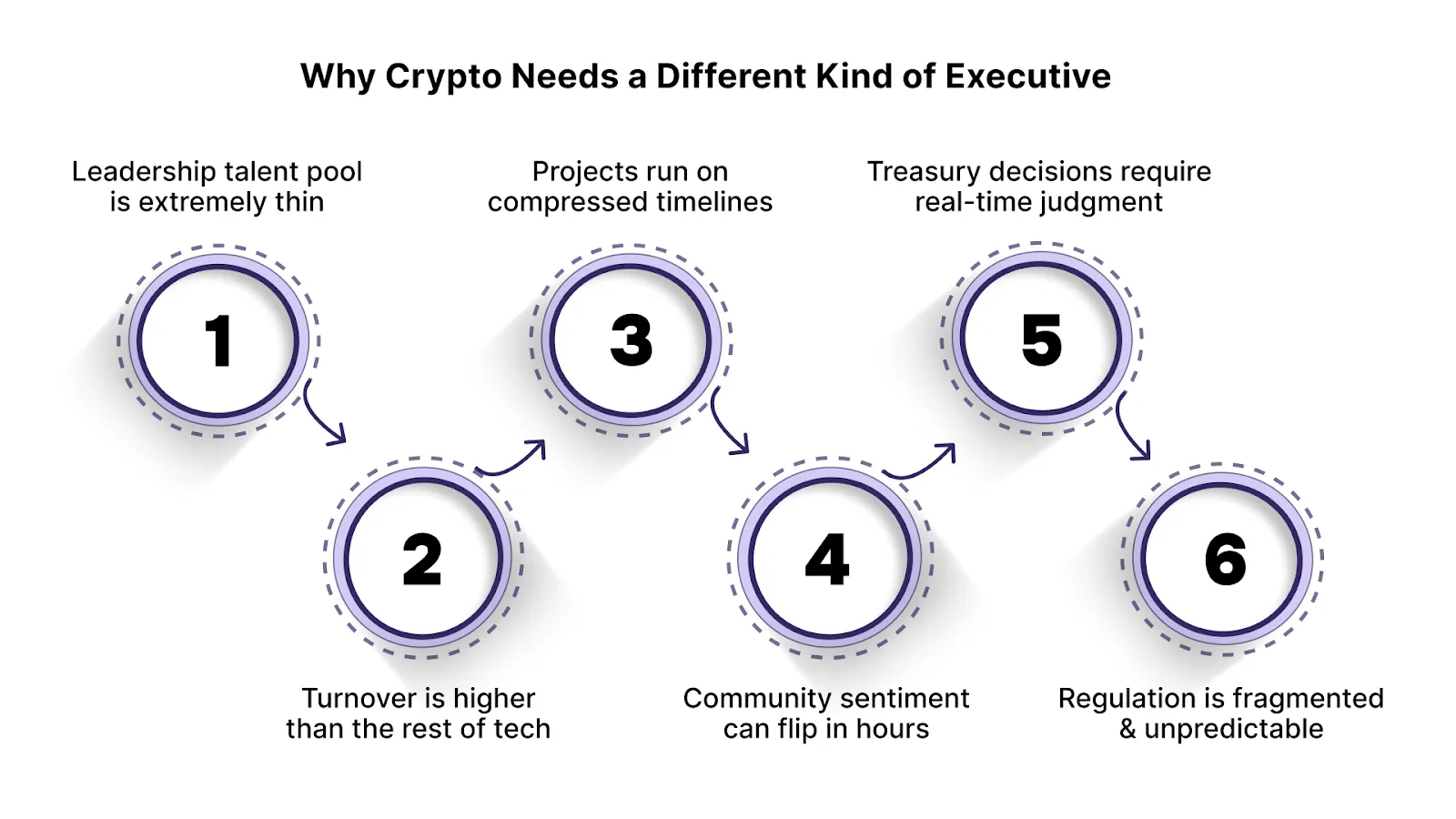
1. The leadership talent pool is extremely thin.
There aren’t many executives who understand exchanges, token mechanics, chain analytics, treasury structures, and compliance across multiple jurisdictions.
Those who do understand it are already stretched across several projects — or priced far beyond a startup’s early budget.
2. Turnover is higher than the rest of tech.
Bull cycles attract talent.
Bear cycles wipe teams out.
Founders often end up rebuilding leadership every 12–18 months, which slows everything from product timelines to investor confidence.
3. Projects run on compressed timelines.
A new chain integration, liquidity partnership, token rollout, or compliance deadline can shift from “next quarter” to “this week” with no warning.
Full-time executive hiring simply can’t keep pace with industry velocity.
4. Community sentiment can flip in hours.
A tweet, a hack, a market dip, and suddenly, user support, legal, risk, and comms all need senior direction.
Crypto lives under a microscope. One misstep gets amplified fast.
5. Treasury decisions require real-time judgment.
Most executives in traditional finance never deal with:
- token volatility
- on-chain liquidity
- smart contract risk
- stablecoin exposure
Crypto treasuries move minute to minute, and they affect payroll, liquidity, and investor trust.
6. Regulation is fragmented and unpredictable.
Different states, different countries, different interpretations of the same rule.
Crypto companies face inquiries, filings, and reviews that shift without notice.
Executives need experience navigating environments where “guidance” can change mid-project.
The result:
Crypto needs leaders who’ve lived through volatility, understand the technical and regulatory stakes, and can make decisions before problems snowball. Because in crypto, the failure points usually show up long before anyone realizes the leadership gap is the root cause
The Jobs That Break First in Crypto, and the Fractional Execs Who Stop the Bleeding
Crypto companies rarely fall apart because of one big mistake. They crack at pressure points that appear without warning, and those cracks widen fast.
This table breaks down where things typically fail, who steps in, and why fractional leadership works in each scenario.
Fractional executives work because they’ve lived through almost all the stress points and know how to steady the system before the damage compounds. Because when something cracks, liquidity, security, compliance, sentiment, it escalates fast.
When to Bring in Fractional Leadership (Before Trouble Hits)

Most crypto teams bring in senior help after something catches fire, a failed listing, a treasury scare, an exploit, or a community backlash.
But by the time the damage shows up on-chain or on Twitter, it’s already expensive.
The strongest founders use fractional C-suite operators as a preventive layer, not a rescue team.
Here are the moments when bringing in fractional leadership early protects the entire project:
1. Before a Token Launch
A token launch exposes everything at once: liquidity planning, emissions, vesting, market-maker coordination, and community expectations.
Fractional CFOs and CROs lock down the mechanics early, so founders aren’t patching tokenomics in the middle of volatility.
2. Before Raising Capital
Investors now expect maturity: treasury discipline, risk visibility, compliance posture, security controls, and clean reporting.
Fractional execs shape the fundamentals before the data room opens, making the raise smoother and strengthening valuation.
3. Before Exchange Listings
Listings move fast, but the due diligence behind them is brutal.
Fractional CCOs and CROs help teams prepare disclosures, risk frameworks, and compliance packages so listings don’t get delayed over preventable gaps.
4. Before Entering New Jurisdictions
Licensing requirements shift daily across regions.
Fractional compliance leaders decode eligibility, prepare filings, and streamline onboarding so expansions don’t stall under regulatory confusion.
5. Before Onboarding Institutional Partners
Funds, custodians, and market-makers now run institutional-grade checks.
Fractional operators build governance and reporting standards that pass those checks without last-minute scrambling.
6. Before Security Audits
Audits don’t fix problems; they expose them.
Fractional CISOs prepare infra, access controls, and emergency-response pathways so audits become an advantage, not an embarrassment.
7. Before Scaling Headcount
Most crypto teams grow faster than their operating rhythm.
Fractional COOs put structure in place, decision cadence, KPI systems, and cross-team alignment, before chaos becomes culture.
8. Before Treasury Diversification
Treasury strategy is the heartbeat of survival.
Fractional CFOs and treasurers manage diversification, hedging, and liquidity buffers before market swings erase months of progress.
9. Before Governance Buckles Under Growth
Decentralized projects often outgrow their governance models faster than they expect.
Fractional governance leads help teams redesign voting, committees, and reporting structures early, before community trust slips.
Most crypto collapses happen because early pressure points were ignored until they snowballed. Bringing in fractional leadership before those moments is how projects stay stable, fundable, bankable, and trusted.
When operators with real experience shape decisions early, the project moves with confidence instead of reacting in panic. Prevention becomes a strategy, not luck.
This is where selecting the right fractional leader becomes just as important as the timing.
How to Choose a Fractional Executive for a Crypto Project

The right fractional leader needs a skill set shaped by volatility, public scrutiny, fragmented regulation, and the speed of Web3 execution, because not every seasoned operator can survive crypto.
Here’s the no-fluff checklist that separates crypto-ready executives from everyone else:
- On-chain operational experience: They must understand wallets, custody, bridges, transaction flows, gas mechanics, validator dynamics, and the realities of on-chain risk.
- Exchange + token listing familiarity: If they’ve never handled listing DDQs, liquidity commitments, or market-maker coordination, they’re not ready.
- Crisis management in public: Crypto doesn’t give companies the luxury of “internal-only incidents.” Your fractional leader must know how to communicate during hacks, liquidity dips, or sentiment swings.
- Multi-jurisdictional compliance awareness: MiCA, MAS, FCA, FinCEN, VASP rules, U.S. state-by-state requirements, crypto operates across incompatible regulatory maps. Your exec must know how to keep the project bankable globally.
- Scaling teams around volatility: A qualified fractional exec should have led teams through unpredictable cycles without burning out the organization.
- Comfortable with DAO or hybrid governance models: Top-down leadership won’t work here. They need to navigate community voting, contributors, working groups, and hybrid structures with political awareness.
- Proven track record with similar crypto projects: They must have lived through the same fires your project will face, not just read about them.
But where do you find leaders who can handle this level of volatility, scrutiny, and operational pressure?
Cause Crypto doesn’t need generic operators, instead it needs people who understand the terrain.
This is where Fraxtional fits in.
How Fraxtional Fits Into the Crypto Ecosystem

Most fractional leaders come from traditional industries.
They understand structure, but not speed.
They understand governance, but not on-chain risk.
They understand reporting, but not community-driven sentiment swings.
Crypto companies need operators who can work inside markets that move in minutes and do it with the discipline expected by regulators, exchanges, partners, and institutional investors.
Fraxtional fills that gap by supplying fractional executives who are built for crypto’s unique pressures, not retrofitted into them.
Here’s where they create the strongest lift:
- Strengthening AML/KYC Programs for Fiat Bridges
On/off-ramp compliance is one of the biggest failure points in crypto.
Fraxtional provides leaders who can build controls that survive bank scrutiny, exchange audits, and jurisdictional fragmentation.
- Governance During Token Launches
Most token launches fail from governance mistakes, not hype.
Fraxtional’s operators help design vesting structures, risk controls, disclosure readiness, and market-maker coordination that won’t blow up under pressure.
- Risk Reporting That Institutional Investors Trust
Treasury oversight, liquidity exposure, counterparty health, investors need clarity, not chaos.
Fraxtional executives generate the reporting rigor that enables fundraising, partnerships, and exchange visibility.
- Controls and Structure After Security Incidents
When an exploit hits, speed matters, but so does precision.
Fraxtional brings leaders who can lock down systems, coordinate audits, tighten access governance, and manage communications professionally.
- Leadership During Hyper-Scaling Phases
Crypto teams often grow from 10 to 40 overnight.
Fraxtional’s COOs, CFOs, and risk leaders create operating discipline without slowing innovation.
If your project needs operators who can step in the moment pressure spikes, leaders who understand both crypto speed and regulator-grade expectations, Fraxtional can support you. Let's Talk!
Conclusion
Crypto companies usually fail because key decisions happen under pressure, and the team isn’t equipped for the moment. Markets move, liquidity shifts, regulators step in, security breaks, the community reacts, all much faster than traditional hiring cycles can support.
That’s why fractional leadership has become such a practical tool in the space.
It gives teams access to people who’ve seen these situations before and know how to steady things without slowing momentum. They bring clarity during launches, discipline during market swings, and structure when growth exposes gaps.
Fraxtional’s value comes from that same simplicity.
With operators who understand the demands of crypto, the pace, the public nature of mistakes, the fragmented rules, and the pressure around treasury, listings, and security. They step in quickly, take responsibility for the areas that carry the most risk, and help teams move forward with confidence.
FAQs
They take responsibility for high-stakes areas like treasury, listings, risk, compliance, security, or operations. Unlike consultants, they work inside the project, run the function day-to-day, and help the team make decisions during volatile moments.
Most teams bring them in before major events, token launches, exchange listings, fundraising rounds, audits, or large community announcements. They’re also used when treasury management, compliance, or security becomes too complex for existing staff.
Interim leaders hold a temporary seat. Advisors guide from the outside.
Fractional leaders do neither. They operate as part of the senior team, own KPIs, manage risk, and make decisions, just on a flexible, part-time basis.
CRO, CFO, CCO, CISO, COO, Treasurer, and Head of Governance are the most common. These roles are typically the first to crack when markets move fast or regulatory pressure increases.
Ye, especially when founders need senior judgment but don’t have the budget or hiring timeline for a full-time executive. Fractional leaders help shape the structure early, which prevents costly mistakes later.
blogs
Don’t miss these
.jpg)


Let’s Get Started
Ready to Strengthen Your Compliance Program?
Take the next step towards expert compliance solutions. Connect with us today.