

Dec 8, 2025
How Fractional Leadership Has Reshaped Private Equity Operations in 2026

By Fraxtional LLC

Summarize the blog with AI
Private equity deals are moving faster than the leadership pipelines meant to support them.
Portfolio companies shift direction overnight, new markets, new systems, new board expectations, yet the executives needed to steer those transitions aren’t always in place when the clock starts ticking.
That gap has become one of the biggest value leaks in PE operations.
A full-time COO takes months to hire. A CFO who understands carve-outs isn’t always available. A transformation lead with actual integration experience is even harder to find. Meanwhile, the portfolio company is already expected to execute against its 100-day plan. This is where fractional executive advisors have quietly become the industry’s most reliable lever.
They slot into pressure points the moment a deal closes, bringing operational discipline, board-ready reporting, and measurable uplift without slowing the investment timeline.
For PE firms, fractional leadership is a way to protect returns, accelerate value creation, and keep momentum intact when the deal pace outstrips the hiring cycle.
Let’s break down how fractional executives fit into private equity, the roles that create the highest lift, and why this model is becoming a competitive advantage across PE-backed companies.
Key Takeaways
- Fractional executives give PE firms immediate leadership during post-close pressure and 100-day execution.
- They bridge gaps between the deal model and real operations, taking ownership of functions that can’t wait for full-time hires.
- Reporting, governance, and operational discipline mature faster with fractional operators who’ve run PE-backed companies before.
- Execution risk drops significantly during carve-outs, integrations, and restructures.
- Fraxtional delivers PE-ready operators who step in fast and keep value creation on track.
What Fractional Executive Advisors Do in Private Equity

Fractional executives in PE-backed companies aren’t external consultants, and they aren’t temporary caretakers. They operate as embedded senior operators who carry responsibility for execution, reporting, and value creation during windows where speed matters more than structure.
Here’s the core of the model and how it works inside investment environments:
A leadership model designed for deal speed
Fractional executives step into roles that can’t wait for a traditional search, such as COO, CFO, CRO, CTO, Head of Integration, and transformation leads.
They stabilize operations, shape reporting, and keep the pace of the 100-day plan intact while long-term hiring runs in parallel.
Not consulting, not interim, embedded operators
Consultants deliver workstreams. Interim leaders hold the seat temporarily.
Fractional executives do neither. They take ownership of outcomes tied to the investment thesis:
– operational redesign
– cash visibility
– integration steps
– quality of earnings clean-up
– governance and reporting cadence
They work as part of senior management, not alongside it.
Engagement structures that fit PE timelines
Depending on the transaction and portfolio maturity, fractional advisors join through:
- Part-time C-suite engagements (COO, CFO, CRO)
- Retainer-based operational leadership (weekly rhythms, board preparation, KPI tracking)
- Outcome-based mandates focused on value creation (integration, margin expansion, restructuring)
They stay only as long as the transformation requires, scaling up or down without affecting headcount.
Roles that fit naturally into PE-backed companies
Private equity firms typically use fractional executives for functions tied directly to risk, speed, or value creation:
- Fractional COO to fix operational bottlenecks
- Fractional CFO to clean financials, build reporting, and support bolt-ons
- Fractional CRO to stabilize revenue engines and pipeline quality
- Fractional CHRO to reset org structures and compensation models
- Fractional Compliance/Risk Leaders for regulated portfolios
- Fractional Transformation/Integration Leads for post-acquisition execution
These leaders bring enterprise-grade experience without slowing the pace that PE mandates.
A fractional management team when pressure peaks
Some PE firms use multiple fractional roles at once, creating a compact executive team that manages operations until the company is ready for permanent leadership.
This model works especially well during:
- Lightning-fast carve-outs
- Distressed assets that need triage
- Multi-market rollouts
- Founder transitions
- Integration of bolt-on acquisitions
It’s leadership that moves at the speed of private equity, without compromising accountability.
Why Private Equity Firms Are Leaning Toward Fractional Leadership

Private equity doesn’t reward hesitation.
Portfolio companies move through compressed timelines, carve-outs, integrations, restructures, and expansion pushes, all under the pressure of quarterly reporting and value-creation milestones.
Fractional leadership has become a natural fit because it solves the problems that appear between the deal model and the operating reality.
Here’s why PE firms are using it more aggressively:
1. Value creation can’t wait for a full-time search
A C-suite search often takes 4–7 months. A 100-day plan doesn’t.
Fractional executives step in immediately so key workstreams don’t stall:
- reporting clean-up
- margin initiatives
- SG&A resets
- working capital fixes
- operational realignment
They create momentum before the first permanent hire even reaches final interviews.
2. Better control during the messy middle of ownership
Most PE-backed companies hit turbulence right after the deal closes: gaps in leadership, thin processes, unclear reporting, and systems that don’t match growth expectations.
Fractional leaders help stabilize those gaps by:
- owning weekly management routines
- resetting KPIs to match the investment thesis
- tightening controls without slowing operations
- building the governance cadence PE expects
They’re a bridge between investment strategy and on-ground execution.
3. Immediate operational clarity when diligence doesn’t tell the full story
Even the strongest diligence misses something, hidden inefficiencies, overreported margins, weak compliance, or operational blind spots.
Fractional operators help uncover the real picture in weeks, not quarters.
They create the clarity needed to:
- Refine the thesis
- Adjust the value-creation roadmap
- Prioritize which fires to put out first
This protects the IRR when the business looks different from the deck suggested.
4. Flexibility that matches the funding cycle
PE-backed companies don’t need the same leadership profile at every stage.
Early ownership may require restructuring strength.
Mid-cycle may need a growth operator.
Pre-exit may need a governance-heavy leader.
Fractional leadership adjusts on demand, without carrying long-term compensation burdens.
5. Access to operators who’ve already scaled similar assets
The best fractional executives have run multiple PE-backed companies before.
They understand:
- lender reporting
- board cadence
- bolt-on integration
- cost discipline
- liquidity pressure
- investor communication
This keeps management aligned with what PE expects instead of learning through mistakes.
6. A stronger governance layer without increasing headcount
Most PE firms want institutional-grade governance but don’t want to inflate G&A.
Fractional executives introduce discipline and structure:
- financial controls
- risk processes
- compliance oversight
- HR governance
- cyber and operational controls
All without adding permanent seats.
7. Lower execution risk during transformation
Restructuring, integration, and operational redesign are high-stakes moments. Fractional leaders reduce the risk by bringing experience from similar scenarios. They’ve done it before, which minimizes avoidable mistakes and accelerates measurable wins.
In short: PE firms choose fractional leadership because it compresses time, reduces execution risk, and puts experienced operators inside the business exactly when they’re needed, not after the damage is done.
What Good Looks Like: How to Evaluate a Fractional Executive for PE
Private equity demands a different kind of operator.
Short deadlines, aggressive value targets, and board-level scrutiny mean only a small group of fractional executives can actually deliver in this environment.
Here’s how to evaluate whether a fractional executive is PE-ready:
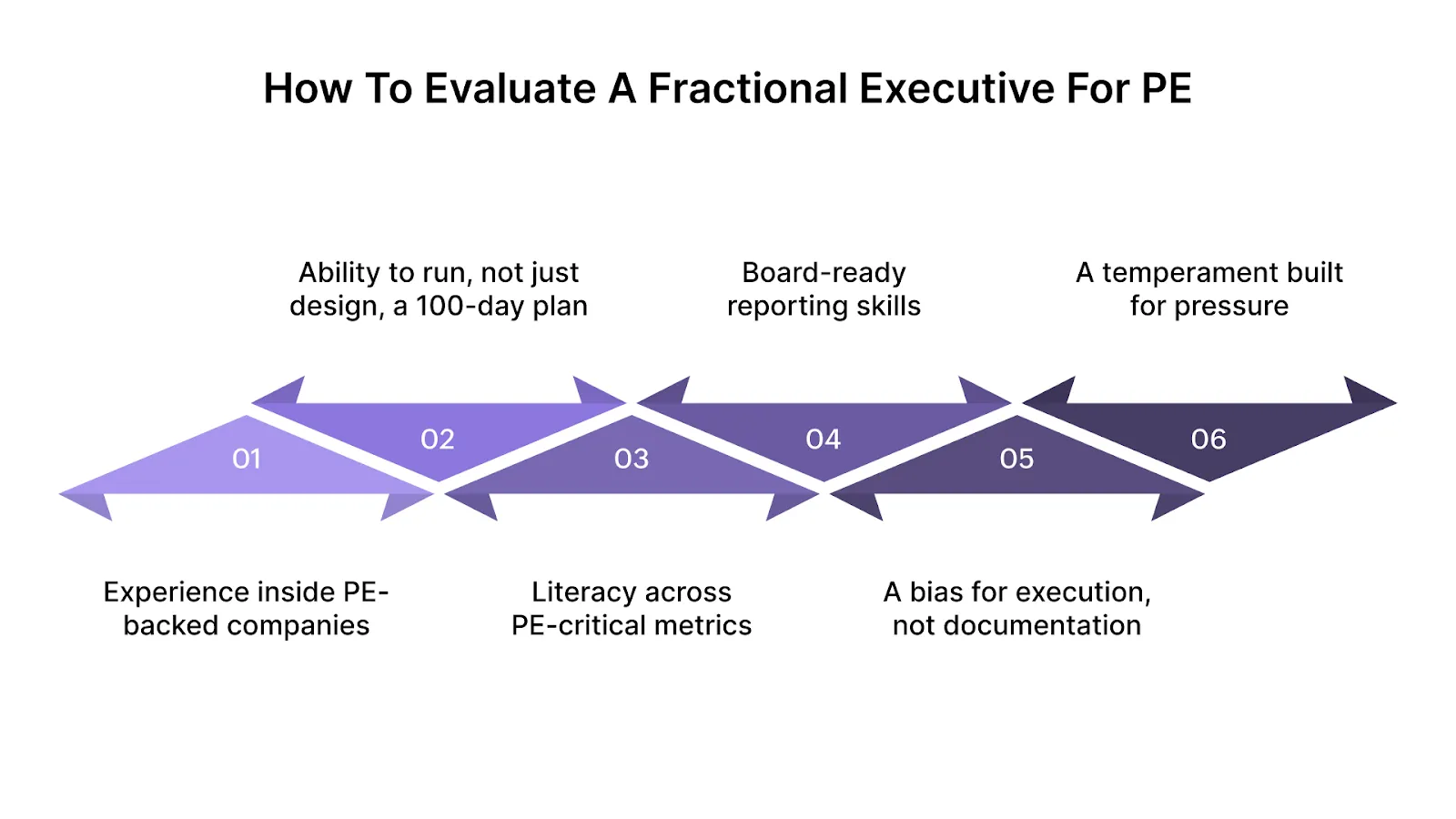
1. Proven experience inside PE-backed companies
PE is its own operating universe.
You want someone who has already:
- delivered on a 100-day plan
- managed board cadence
- navigated lender reporting
- handled carve-outs or integrations
If they’ve never sat in a PE-backed seat, you’ll spend months teaching instead of executing.
2. Ability to run, not just design, a 100-day plan
A PE-grade operator must be able to:
- break the plan into weekly rhythms
- assign ownership
- monitor KPIs
- remove bottlenecks fast
If they can’t convert strategy into day-to-day execution, they won’t survive your first board meeting.
3. Literacy across PE-critical metrics
A strong fractional executive should already speak the language of value creation:
- EBITDA uplift
- cash conversion cycles
- net revenue retention
- CAC/LTV
- margin drivers
- ROIC
- working-capital levers
If they can’t tie decisions to these numbers, they can’t drive PE outcomes.
4. Board-ready reporting skills
PE firms expect clarity, brevity, and defensibility.
Look for someone who can:
- Build a clean reporting pack
- present without hedging
- Link KPIs to the investment thesis
- communicate risk without triggering panic
This is where average operators fall short and true PE operators stand out.
5. A bias for execution, not documentation
Consultants document.
Fractional PE operators fix.
You’re looking for someone who will:
- walk the floor
- audit processes personally
- challenge assumptions
- unblock teams
- deliver outcomes, not decks
Execution > presentation.
6. A temperament built for pressure
PE portfolios often experience turbulence, messy handoffs, deadlines, integrations, and restructures.
A strong fractional operator stays steady, keeps teams aligned, and keeps decisions moving.
If they need “structure before impact,” they’ll slow the company down.
Once you know what a strong fractional operator looks like, the next question is simple: where do you find leaders who can actually deliver at PE speed?
Fraxtional was built to answer that exact need.
How Fraxtional Supports Private Equity Firms

PE-backed companies need two things at once: speed and control. Most leadership models give you one or the other. Fraxtional was designed to deliver both disciplined operators who can tighten governance while keeping growth plans on schedule.
Here’s how Fraxtional directly solves the challenges outlined in this article:
1. Operators Who Understand PE From Day One
Fraxtional doesn’t send generalists. Their bench is built from executives who’ve already run PE-backed businesses, handled lender reporting, survived carve-outs, and managed board cadence.
No learning curve. No onboarding drag. Just operators who know how PE works.
2. Leadership Capacity the Moment a Deal Closes
Whether it’s a vacant COO seat, an incomplete finance function, or a missing integration lead, Fraxtional fills those roles immediately.
And keep the 100-day plan moving while the search for permanent leadership runs in parallel.
3. Reporting and Governance PE Can Trust
PE-owned companies live and die by reporting discipline. Fraxtional’s executives build the structure:
- weekly operator rhythms
- KPI dashboards aligned to the thesis
- controls and governance that withstand investor scrutiny
It’s the layer portfolio companies often lack, delivered instantly.
4. Execution Support During High-Pressure Phases
Fraxtional specializes in moments where execution risk is highest:
- carve-outs
- integrations
- restructures
- bolt-on M&A
- margin expansion sprints
By bringing in operators who have done this before, Fraxtional helps you reduce missteps and accelerate tangible wins.
5. Flexible Engagements That Fit Fund Cycles
PE firms don’t need the same leadership profile in year 1 as they do in year 3.
Fraxtional scales leadership up or down across:
- early stabilization
- growth scaling
- pre-exit governance tightening
This gives firms institutional-grade leadership without a permanent G&A load.
Bring in the operator your portfolio needs. Connect with Fraxtional and get leadership that can execute from day one.
Conclusion
Private equity is slowed down by gaps in execution. Deals close faster, expectations tighten sooner, and portfolio companies are pushed into transformation long before full-time leadership is in place.
Fractional executives have become the practical answer to that reality. They give PE firms operators who can restore control, build reporting discipline, and accelerate value creation without waiting months for a permanent hire. The model works because it matches the pace of investment, not the pace of recruiting.
As portfolios become more complex and timelines compress even further, fractional leadership is no longer a workaround. It’s a competitive edge.
If your portfolio needs operators who can deliver impact from day one, Fraxtional is built for exactly that.
FAQs
A fractional executive steps into a senior role, COO, CFO, CRO, CHRO, or transformation lead, to run execution-heavy work during periods when the portfolio company can’t wait for a full-time hire. They stabilize operations, build reporting discipline, and drive value-creation milestones tied to the investment thesis.
Consultants advise and deliver workstreams. Interim leaders hold the seat temporarily.
Fractional executives take ownership of execution — running management routines, refining KPIs, leading integrations, and delivering outcomes tied directly to the 100-day plan. They operate as part of the senior team, not outside it.
PE firms usually deploy fractional operators when a deal closes and execution needs to begin immediately, before full-time leaders are hired. They’re also used during carve-outs, integrations, distressed situations, rapid expansion phases, or when reporting needs to mature quickly for lenders and the board.
The highest-impact roles are fractional COO, CFO, CRO, CHRO, CTO, and transformation/integration leads. These operators improve reporting quality, tighten controls, accelerate operational redesign, and guide teams through milestone-heavy periods.
It works across both. Smaller companies use fractional operators to fill capability gaps quickly. Larger platforms use them during integrations, cross-portfolio initiatives, bolt-ons, or when they need domain-specific operators without adding permanent G&A.
blogs
Don’t miss these
.jpg)


Let’s Get Started
Ready to Strengthen Your Compliance Program?
Take the next step towards expert compliance solutions. Connect with us today.