

Dec 8, 2025
Leadership in AML: Traits, Training, and Tactics for Modern Compliance Teams

By Fraxtional LLC

Summarize the blog with AI
When a fintech’s alert queue overflows, documentation looks inconsistent, or escalations stall, the true risk isn’t operational; it’s leadership. Without strong AML governance, models evolve without review, analysts make decisions without clear authority, and risk exposures compound quietly until regulators impose penalties.
In 2025 alone, U.S. regulators issued a $3 billion penalty for systemic AML failures, including appointing a full-time, government-approved compliance monitor to oversee remediation. For investors, that isn’t just a red flag; it’s a capital risk that can derail valuations, acquisitions, or sponsor-bank relationships instantly.
Strong AML leadership protects investor capital by reducing regulatory exposure, operational drag, and the risk of enforcement actions. Weak leadership does the opposite: breaks workflows, slows revenue, jeopardizes partnerships, and triggers costly remediations.
If you’re evaluating a financial institution or fintech, AML leadership quality is one of the top indicators of long-term stability.
At a Glance:
- Regulatory Reality: U.S. regulators issued $3B in AML penalties in 2025, proving leadership failures, not tools, drive most enforcement actions.
- Leadership vs Management: AML leaders own governance, risk appetite, escalation rules, and regulatory engagement; unlike managers, who handle daily casework.
- Core Leadership Traits: Strong AML leadership requires strategic risk judgment, data awareness, ethical decision-making, and consistent escalation discipline.
- Training Priority: Future AML leaders must master scenario-based judgment, regulatory communication, model oversight, and defensible documentation.
- Fraxtional Impact: Fraxtional provides senior AML leadership (CCO/MLRO-level) that stabilizes programs, fixes governance gaps, and accelerates exam readiness.
What Leadership in AML Really Means for Modern Compliance Teams

Leadership in Anti–Money Laundering has a precise, regulator-defined meaning: it’s the accountability structure that determines whether an institution can consistently prevent, detect, and escalate financial crime risks.
Supervisors repeatedly identify weak governance, unclear ownership, and inconsistent decision-making as core causes of AML failures, not insufficient tools. This makes leadership a control function, not a soft skill.
For investors, this translates directly into valuation protection.
Strong AML leadership demonstrates:
- Clear ownership of monitoring, investigations, reporting, and model oversight.
- Consistent documentation that shows how decisions were made and reviewed.
- Defined escalation paths that prevent delays or missed red flags.
- Cross-functional alignment with product, operations, fraud, and legal.
- Independent review and QA to meet supervisory expectations for control strength.
Understanding these expectations helps investors distinguish between operational activity and true AML governance capability.
AML Manager vs AML Leader: Key Differences You Need to Know
An AML manager handles daily operations like alert triage, investigations, and filings. An AML leader sets strategy, owns governance, and is accountable for the program’s strength during regulatory scrutiny.
The difference matters: in the HSBC case, the bank paid $1.9 billion after U.S. authorities found leadership failures and weak oversight enabled cartel-linked laundering, far beyond operational errors. This shows regulators assess not just casework efficiency but the quality of AML governance, decision-making, and leadership accountability.
Below is a concise comparison showing the practical differences you should expect between an AML manager and an AML leader.
Also Read: Why You Need Chief Anti-Money Laundering Officer Services
Since leadership itself is treated as a control in AML examinations, it’s critical to understand the traits that determine whether that control is considered strong or weak.
Essential AML Leadership Traits Every Compliance Head Must Develop
Supervisors often cite unclear ownership, inconsistent decisions, and weak escalation paths as key factors behind enforcement actions. As a result, AML leaders need traits that support sound judgment, reliable processes, and consistent oversight.
These traits influence daily work; how risk is assessed, how red flags are escalated, and how teams act when decisions aren’t straightforward.
Below are the traits that matter most and why they make a difference:
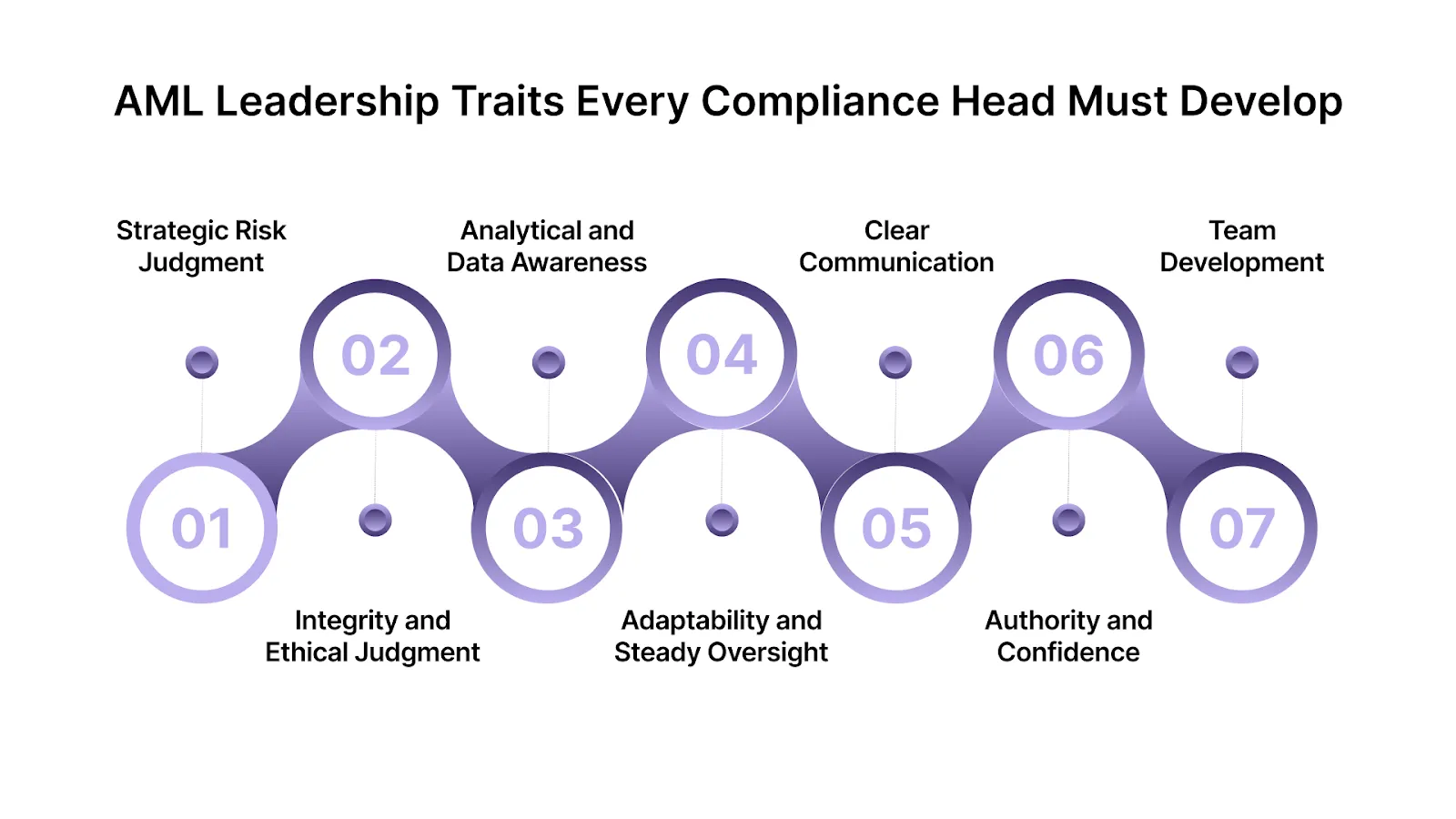
1. Strategic Risk Judgment
Leaders must understand how customer behavior, new products, and emerging patterns translate into exposure. They use this judgment to set priorities, allocate resources, and decide when an issue requires escalation.
How it helps: It keeps the program focused on material risks instead of spreading effort across low-impact work.
Also Read: Understanding the Risk-Based Approach for Better Risk Management
2. Integrity and Ethical Judgment
Supervisory bodies frequently cite weak “tone from the top” as a root cause of AML failures. Leaders must show that decisions are driven by regulatory expectations and internal standards, not commercial pressure.
How it helps: It reinforces accountability and reduces the chance of overlooked red flags or inconsistent decisions.
3. Analytical and Data Awareness
AML work depends on pattern recognition, data quality, and reliable interpretation of monitoring outputs. Leaders must understand how information flows through the program and how to question unusual results.
How it helps: It improves decision accuracy, strengthens investigations, and supports better use of monitoring systems.
4. Adaptability and Steady Oversight
New rules, typologies, and methods of financial crime appear regularly. Leaders must respond without creating confusion or disruption within the team.
How it helps: It prevents operational drift and keeps staff confident during periods of change.
5. Clear Communication
AML decisions involve product teams, operations, fraud units, external partners, and occasionally regulators. Leaders must explain expectations clearly so responsibilities are understood across groups.
How it helps: It reduces delays, avoids misunderstandings, and supports consistent application of controls.
6. Authority and Confidence
AML leaders must speak clearly with senior management, request resources, escalate issues, and stand by decisions that may not be popular but are necessary.
How it helps: It ensures the program receives the attention, staffing, and systems needed to run effectively.
7. Team Development
A reliable AML program depends on analysts who can make sound decisions under pressure. Leaders must build skill, judgment, and confidence across the team, not just manage tasks.
How it helps: It supports continuity, reduces turnover, and prepares future leaders who can maintain standards.
These traits matter, but they only create impact when leaders apply them in daily decisions and routines.
Practical Leadership Behaviors for Heads of AML and Compliance

Effective AML leadership shows up in clear expectations, steady decisions, and consistent oversight that teams can trust. The FCA’s £29 million fine against Starling Bank highlighted how weak leadership, unclear responsibilities, and poor communication can lead to systemic failures.
Strong leaders set priorities, define ownership, maintain solid escalation paths, collaborate early, and use data to keep the AML program stable and regulator-ready.
Key practical leadership behaviors for heads of AML and compliance include:
Clear AML Prioritization
Strong AML leaders clearly identify which risks, products, and customer segments require the most oversight. They create a risk-aligned focus that helps teams understand why certain cases receive priority and how workload decisions are made.
Defined Ownership Across Functions
They establish unmistakable ownership for monitoring, investigations, QA, and reporting. Every alert, case, and deadline has a named accountable leader, eliminating duplication and ambiguity.
Commitment to Team Development: Effective leaders invest in targeted development, ensuring analysts receive training based on real gaps, whether in SAR quality, typology recognition, or documentation standards.
Early Partnership With Business Teams: These leaders work proactively with product, operations, legal, and fraud teams. They ensure AML is involved early in new features or processes, reducing the chance of last-minute compliance failures.
Data-Driven Decision Culture: Strong AML leaders rely on metrics like alert aging, QA trends, repeat escalations, and cycle times. This is to detect weak points in the program before they become issues.
Reliable Escalation Structures: They maintain clearly defined escalation pathways with expectations around triggers, timelines, and required context so significant issues move quickly and accurately.
Independent and Objective Judgment: These leaders demonstrate the willingness to make regulatory-aligned decisions. This is even when those decisions slow revenue, require additional controls, or surface operational friction.
Structured and Controlled Change Management: They introduce policy updates, monitoring adjustments, and system changes through structured testing, clear documentation, and well-communicated rollouts, thereby avoiding operational confusion.
Suggested Read: Why Every Fintech Needs a Chief Compliance Officer Today
To keep the program steady in the long term, companies must invest in developing the people who will lead next.
AML Leadership Training: How to Build Your Future Leaders

Examiners look beyond your current head of AML; they assess whether you have people who can step in, make sound calls, and uphold standards without hesitation. Without a pipeline, every audit, model change, or escalation bottleneck becomes a risk.
Below are the components that matter most:
- Set role-specific expectations: Train future leaders on the specific decisions they will own, including threshold approvals, SAR reasonability reviews, model-change sign-offs, and governance documentation. They should understand precisely what regulators will expect them to justify.
- Scenario-based judgment: Use simulations with borderline cases, incomplete data, delayed escalations, or commercial pressure. Assess how leaders explain their reasoning and record their decision trail.
- Leadership communication: Teach leaders how to brief executives with a clear and concise risk position. They must be able to defend AML requirements when challenged and communicate controls without disrupting operations.
- Targeted mentorship: Pair emerging leaders with senior AML professionals and assign them real responsibilities such as policy drafting, QA reviews, and audit responses. This helps them develop applied judgment rather than theoretical knowledge.
- Ongoing technical refreshers: Require regular updates on typologies, regulatory shifts, and risk assessment standards. Leaders should be able to identify when the program begins drifting from expectations.
- Technology and data fluency: Train leaders to interpret monitoring dashboards, anomaly patterns, and model behavior. They must recognize when alert trends or scoring changes indicate system drift.
- Feedback-driven development: Use structured evaluations that draw from QA findings, escalation patterns, and documentation audits. Include mock regulatory interviews to identify leadership gaps and shape the next stage of training.
Strengthening future AML leaders takes time, structure, and senior oversight, especially when regulatory expectations keep rising. If your team needs guidance, mentorship, or depth of leadership to support this development, Fraxtional can step in with experienced AML executives who accelerate readiness.
Even with strong training, certain leadership gaps show up repeatedly in AML programs and create risk if they are not addressed early.
Common Leadership Gaps in AML Teams and How to Fix Them
Most recurring AML failures trace back to leadership weaknesses rather than technology limitations. For investors, these gaps are early indicators of governance risk, operational instability, audit vulnerability, and potential future enforcement actions.
Below are the leadership gaps most frequently observed in AML programs, and what they reveal about the strength or immaturity of a company’s compliance function.
When these gaps start impacting decisions or exam readiness, bringing in experienced support becomes essential.
Strengthen AML Leadership with Fraxtional’s Compliance Expertise

When your AML program lacks senior oversight, blurred responsibilities, or unclear decision pathways, compliance risks escalate. That’s where Fraxtional steps in: they provide experienced AML leadership and on-demand advisory support. We help teams restore control, align with regulatory expectations, and ensure every transaction, escalation, and filing is defended.
Here’s how Fraxtional strengthens AML leadership in practice:
1. AML Reporting Compliance Consulting
Fraxtional strengthens the reporting layer of your AML program by building clear, defensible workflows for monitoring outputs, escalations, and incidents. The focus is on creating reporting processes that leadership can rely on during audits or partner-bank reviews.
What it includes:
- Custom AML reporting frameworks
- Transaction-monitoring calibration and rule refinement
- Clear escalation and incident-management processes
- Audit-ready documentation standards
How it helps:
Your reporting structure becomes consistent, well-documented, and ready for examiner or partner-bank review.
2. Anti-Money Laundering (AML) Services for FinTech and Crypto
This service builds or upgrades your complete AML program, including monitoring rules, workflows, documentation, and training. It’s designed for fast-growing teams that need structure, clarity, and scalability as regulatory expectations increase.
What it includes:
- Complete AML program development
- Monitoring and alert workflows
- Escalation paths and decision frameworks
- Training, onboarding, and documentation updates
How it helps:
You get a structured AML program that leadership can manage confidently as the business expands.
3. AML Compliance Consulting and Advisory Services
Fraxtional provides fractional AML leadership to organizations that need senior oversight without a full-time executive. They support governance, decision-making, and examiner-facing responsibilities, giving your program immediate leadership depth.
What it includes:
- Fractional or interim AML executive leadership
- Ongoing oversight of monitoring, screening, and reporting
- Program design, risk assessment, and governance updates
- Scalable support as the business grows or adds new products
How it helps:
You gain immediate leadership depth, stronger oversight, and credible decision-making at the executive level; exactly when your AML program needs it most.
Conclusion
AML programs rarely fail because teams aren’t working hard enough; they fail when leadership doesn’t have the structure, bandwidth, or oversight needed to keep decisions consistent and controls tight. The programs that stay steady are the ones with leaders who anticipate pressure, maintain clear accountability, and build people ready to take on more responsibility.
If your team is feeling the strain, growing backlogs, unclear decisions, and rising scrutiny, experienced support becomes essential. Fraxtional provides senior AML leadership that can stabilize your program, reinforce governance, and guide high-stakes decisions with confidence.
If you’re ready to strengthen your AML leadership bench, connect with us now and equip your program with the expertise it needs.
FAQs
It refers to the governance, decision-making authority, and oversight structure that determines how effectively an institution prevents, detects, and escalates financial crime risks. Regulators treat AML leadership as a core control, not a soft skill.
Managers oversee daily operations like alert handling and filings. Leaders own the AML framework, governance standards, escalation rules, and regulator-facing responsibilities. Their decisions shape program strength and audit outcomes.
Most AML failures stem from unclear ownership, weak escalation discipline, and inconsistent decisions. Strong leadership directly influences documentation quality, issue response times, and the reliability of controls.
They need role-specific judgment, scenario-based decision-making, regulatory communication, model and monitoring oversight, and the ability to document rationale in a way that stands up to exam scrutiny.
When backlogs grow, governance gaps appear, exam readiness declines, or the program is scaling faster than internal leadership coverage. Fractional leadership provides immediate senior oversight without long hiring cycles.
blogs
Don’t miss these
.jpg)


Let’s Get Started
Ready to Strengthen Your Compliance Program?
Take the next step towards expert compliance solutions. Connect with us today.