

Dec 8, 2025
The Ultimate Guide to UBO Compliance for Investors in 2026

By Fraxtional LLC

Summarize the blog with AI
Have you ever wondered who truly benefits from the investments you make or who controls the companies in which you invest? Understanding Ultimate Beneficial Ownership (UBO) is crucial to answering these questions, yet it remains elusive for many investors.
As regulatory requirements grow and financial transparency becomes more critical, identifying and reporting UBOs is increasingly essential. Investors and businesses are under increasing pressure to comply with regulations while reducing the risks of financial crimes.
In this blog, we’ll explore the basics of UBO, why it’s essential for compliance and risk management, and how to ensure your investments and business structures meet the necessary legal requirements.
Key Takeaways:
- UBO checks identify individuals who control or benefit from a company, ensuring compliance with anti-money laundering (AML) and counter-terrorism financing (CTF) laws.
- Complex ownership structures and varying regulations across jurisdictions make UBO identification challenging, requiring detailed tracing and verification.
- UBO verification helps mitigate legal, financial, and reputational risks, providing clarity for investments and partnerships.
- Technology, like automated tracing and continuous monitoring, simplifies the UBO compliance process and enhances risk management.
- Global regulations, including the U.S. Corporate Transparency Act and UK transparency requirements, enforce UBO reporting to maintain financial transparency and accountability.
What is Ultimate Beneficial Ownership (UBO)?

Ultimate Beneficial Ownership (UBO) refers to the person or persons who ultimately own or control a company or arrangement. The Financial Action Task Force (FATF) defines a UBO as the natural person(s) who have effective control, typically owning more than 25% of a company’s shares or voting rights.
Identifying a UBO can be challenging, especially when ownership is obscured through structures such as shell companies or trusts. These often span multiple jurisdictions, each with its own rules on disclosure and transparency.
Now that you understand what UBO is, let’s explore why it’s essential to check UBOs for compliance.
Also Read: Three Stages of Money Laundering and How to Spot Them
Why UBO Verification is a Critical Step for Regulatory Compliance?

Conducting UBO checks is crucial for ensuring compliance, mitigating risks, and safeguarding investments. These checks provide insight into the actual ownership and control behind an entity, which helps reduce potential threats.
Here’s why UBO checks matter:
- Regulatory Compliance: Proper identification and verification of UBOs ensure compliance with anti‑money laundering (AML) and counter-terrorism financing (CTF) laws.
- Risk Management: UBO checks help detect potential risks, such as shell companies or high-risk jurisdictions, that could impact investments or business dealings.
- Reputational Protection: Failure to identify UBOs can damage your reputation with clients, regulators, and stakeholders, leading to lost trust and business opportunities.
- Due Diligence Confidence: UBO checks enhance due diligence efforts by providing clarity on who ultimately controls a business, supporting investment and partnership decisions.
- Audit Readiness and Assurance: Incorporating UBO checks into your compliance framework ensures that you are prepared for independent audits and regulatory reporting, including SOC2 compliance.
With a clear understanding of UBO checks, it’s now time to review the key legislation that enforces compliance.
Also Read: SOC 2 Compliance for Financial Institutions 2025: A Complete Guide
UBO Legislation Across Different Jurisdictions

UBO regulations are designed to ensure transparency by requiring businesses to identify and report individuals who ultimately control or benefit from an entity. These regulations vary across regions, and compliance with them is critical.
Below, we look at the key legal frameworks in the U.S., the UK, and globally.
- United States: The Corporate Transparency Act (CTA)
The CTA requires “reporting companies” to submit beneficial ownership information to the Financial Crimes Enforcement Network (FinCEN). This applies to corporations, LLCs, and similar entities in the U.S., with some exceptions. Reports must include the name, date of birth, address, and identification number of the UBO. Non‑compliance can result in both civil and criminal penalties.
- United Kingdom: Registers and Transparency Requirements
In the UK, companies are required to disclose individuals who hold significant control over a business. The Financial Action Task Force (FATF) recommends that countries maintain public records of beneficial ownership to enhance transparency and promote accountability.
- Global Standards: FATF Recommendations
FATF’s Recommendation 24 requires authorities to keep accurate and current records of the beneficial owners of legal entities. This includes trusts and other arrangements, as outlined in Recommendation 25. These recommendations guide global standards for transparency and compliance.
Failure to comply can expose businesses to legal actions, reputational damage, and financial losses. For investors and private equity firms, understanding these regulations is crucial to conducting effective due diligence and maintaining transparency in their dealings.
Ready to improve your compliance strategy? Explore Fraxtional’s expert leadership solutions today.
A Step-by-Step Guide to UBO Identification
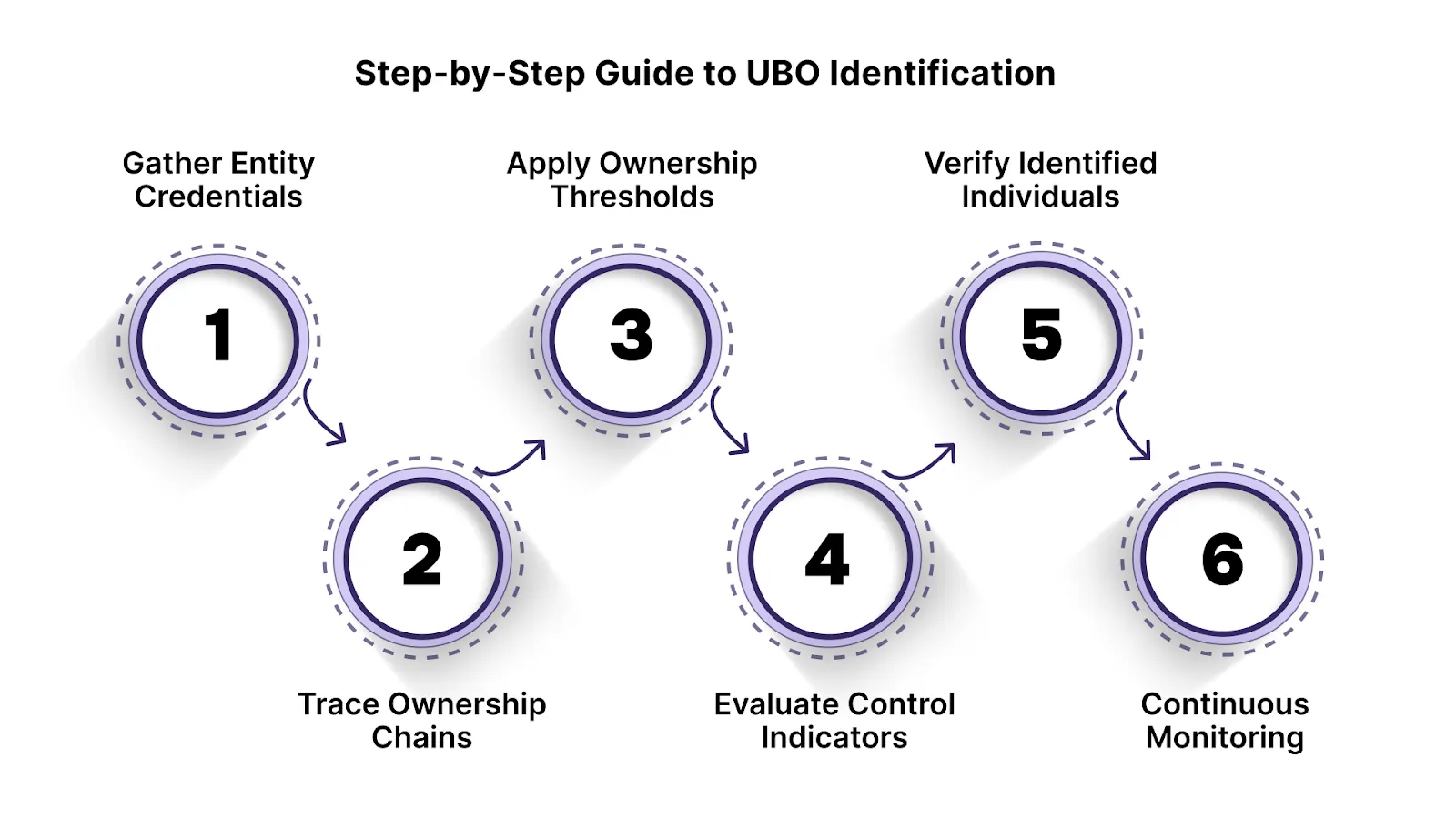
Identifying UBOs requires a thorough process of tracing ownership, especially in complex structures. This helps ensure transparency and compliance with regulatory standards.
Below are the key steps used by businesses and institutions to identify UBOs:
- Gather Entity Credentials: Start by collecting company registration numbers, shareholder records, and directorship details to establish the ownership structure.
- Trace Ownership Chains: Follow ownership through layers, identifying both natural persons and legal entities that control or influence the company.
- Apply Ownership Thresholds: UBOs are typically individuals who hold 10-25% or more of a company’s shares or voting rights, depending on the jurisdictional requirements.
- Evaluate Control Indicators: Look for other indicators of control, such as management authority, decision-making power, or the right to dividends, as these can help identify influential individuals who may be involved in the control structure.
- Verify Identified Individuals: Confirm the identity of identified UBOs, checking their address, sanctions status, PEP (Politically Exposed Person) status, and screening for adverse media.
- Continuous Monitoring: UBOs can change due to corporate restructuring, mergers and acquisitions. Regular updates and validation of UBO information are necessary for ongoing compliance.
As you begin identifying UBOs, you may encounter challenges that can complicate the process.
Also Read: The Risk Assessment Process in Fintech: A Step-by-Step Overview
Common Challenges in Identifying UBOs
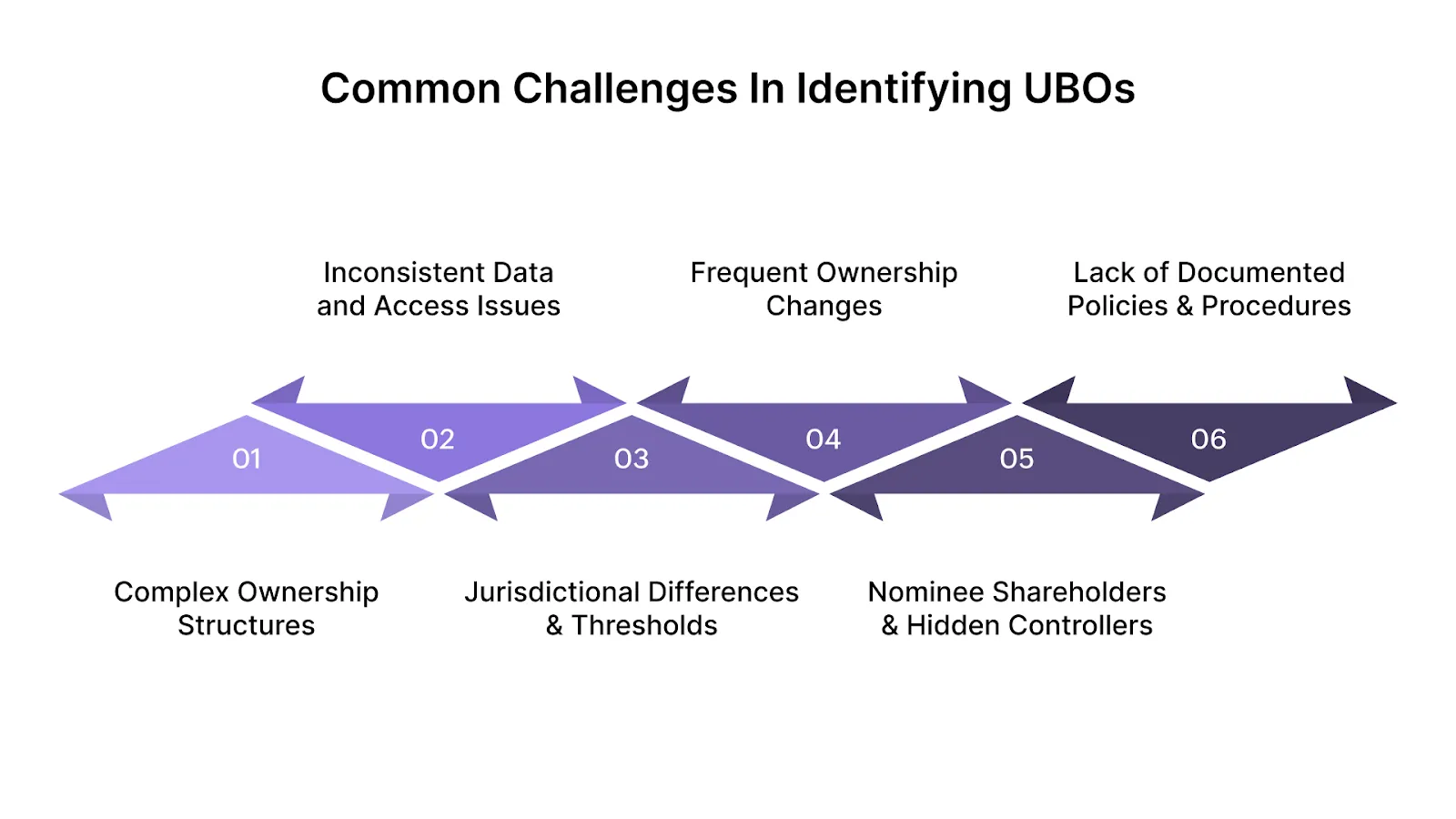
Identifying and verifying UBOs can be challenging, particularly when ownership structures are complex and span multiple jurisdictions. Below are common obstacles faced during UBO identification:
- Complex Ownership Structures: Ownership can be concealed behind multiple layers of companies, trusts, and shell entities, making it challenging to determine the proper ownership.
- Inconsistent Data and Access Issues: Public registers may be incomplete or outdated, and data access can vary significantly between jurisdictions.
- Jurisdictional Differences and Thresholds: UBO definitions and reporting requirements differ across countries, making it harder to apply uniform standards to international business activities.
- Frequent Ownership Changes: Mergers, acquisitions, and restructuring can result in changes to UBOs, requiring ongoing monitoring and verification.
- Nominee Shareholders and Hidden Controllers: Nominee shareholders may be listed in official documents, masking the true UBOs behind the entity.
- Lack of Documented Policies and Procedures: Without established internal procedures, businesses may struggle to maintain consistent and accurate UBO identification processes.
For businesses facing such challenges with complex ownership structures, chief AML officer consulting services can assist in managing UBO compliance, ensuring thorough and up-to-date due diligence.
Technology is also increasingly helping to simplify the process of UBO verification and ensuring that businesses stay compliant with regulations.
How Technology Makes UBO Compliance Easier

By automating and enhancing compliance efforts, technology provides businesses with powerful tools to manage UBO risks. Here are some key technological features supporting UBO compliance:
- Automated Ownership Tracing: Advanced solutions use machine-learning models and integrated global databases to map ownership chains and identify hidden beneficial owners.
- Continuous Controls Monitoring: Platforms can monitor and alert users to any changes in UBO status, sanctions listings, or emerging control links, improving risk management.
- Document Verification and Identity Tools: Digital identity tools, such as biometric checks and OCR (optical character recognition), help verify the identity of UBOs quickly and accurately.
- Centralised Compliance Repository: A single platform that stores UBO records, audit trails, and reports ensures businesses can access and manage UBO data in one place.
- Integration with Risk Management Workflows: By linking UBO tools with other risk management systems, businesses can view ownership risks within the broader context of compliance and exposure.
Proper systems not only enhance governance but also simplify the management of UBO information across multiple jurisdictions.
Developing clear policy and procedure frameworks and integrating technology into your compliance can help businesses address these challenges, ensuring consistent and effective UBO identification practices across jurisdictions.
Conclusion
UBO compliance plays a crucial role in safeguarding investors and businesses against undisclosed risks, regulatory penalties, and reputational damage. Clear identification of ultimate beneficial owners supports transparency, reduces exposure to illicit ownership structures, and strengthens trust in transactions and partnerships.
If you’d like to enhance your UBO compliance framework, establish solid policies, or prepare for audits and reporting obligations, contact us today to schedule a consultation.
FAQs
Any company or legal entity that is formed or registered to do business in certain jurisdictions, such as the U.S., under the Corporate Transparency Act (CTA), must file a BOI report. This typically includes businesses that meet specific thresholds for ownership or control, unless they are exempt under certain conditions.
No, the CEO is not necessarily the UBO. The UBO refers to the individual(s) who ultimately control or benefit from the business, typically through ownership of shares or voting rights. While a CEO may be a UBO, this role alone does not guarantee that the CEO holds ultimate beneficial ownership of the company.
In a Private Limited company, the UBO is typically the individual or individuals who hold a significant ownership stake, usually over 25% of shares or voting rights. This can include individuals who exert control over the company’s operations or benefit from its profits, even if their ownership is indirect.
Businesses, including corporations, limited liability companies (LLCs), and certain trusts, are required to file for beneficial ownership. The requirements vary by jurisdiction, but generally, entities must disclose the individuals who control or benefit from them, especially if the entity is involved in financial transactions or business operations that require regulatory oversight.
Failure to report the UBO can result in penalties, including fines or other legal consequences, depending on the jurisdiction. Additionally, non-compliance may damage the company’s reputation and hinder its ability to engage in certain business activities or secure investments.
blogs
Don’t miss these
.jpg)


Let’s Get Started
Ready to Strengthen Your Compliance Program?
Take the next step towards expert compliance solutions. Connect with us today.