

Jan 27, 2026
Information Security Policies: Importance, Elements, and Key Questions

By Fraxtional LLC

Summarize the blog with AI
Information security policies are rarely questioned during routine operations. They come under scrutiny during audits, sponsor bank reviews, and regulatory examinations, when reviewers assess whether security governance is documented, owned, and enforceable.
This is why information security policies function as formal governance instruments rather than internal guidance. Banks, auditors, and regulators expect these policies to define security objectives, assign responsibility, and document how confidentiality, integrity, and availability are governed across systems and third parties.
When policies do not reflect how access is granted, data is handled, or incidents are escalated, review processes slow down. The issue is usually misalignment between policy language and operational reality.
This article explains what information security policies are, how external reviewers evaluate them, and the core elements required to withstand regulatory, audit, and sponsor bank scrutiny.
Key Takeaways
- Information security policies are evaluated as governance instruments that define ownership, authority, and enforcement, not as standalone security documentation.
- Banks, auditors, and regulators test whether written policies map directly to implemented controls, system configurations, logs, and operational evidence.
- Effective policies are shaped by internal operations, risk exposure, and external regulatory obligations, not generic best practices or templates.
- Policies must grow with system changes, vendor expansion, regulatory scope, and incidents to avoid remediation cycles and approval delays.
- Policies withstand scrutiny only when they reflect real access models, data flows, escalation paths, and accountability across teams and third parties.
What is an Information Security Policy?

An Information Security Policy defines formal, enforceable rules governing how information assets are classified, accessed, protected, monitored, and reviewed across systems, people, vendors, and jurisdictions. It acts as the authoritative control layer that auditors, sponsor banks, and regulators assess first.
Reasons Why Information Security Policies Exist
Security policies exist to translate leadership intent into consistent, enforceable security behavior across people, processes, and technology.
- Guides Technical Controls: Translates senior management security intent into consistent technical and procedural implementation across teams.
- Sets Behavioral Expectations: Defines acceptable and unacceptable use of systems, data, and credentials for employees and contractors.
- Supports Compliance Requirements: Provides documented evidence required by standards such as ISO 27001, SOC 2, PCI DSS, HIPAA, and SOX.
- Improves Consistent Enforcement: Establishes uniform rules for monitoring compliance, handling violations, and approving exceptions.
- Aligns Security With Business Goals: Guarantees security practices support operations without introducing uncontrolled risk or friction.
Types of Information Security Policies
Information security policies are organized into distinct types based on scope, audience, and level of technical specificity.
- Program Policy: High-level, organization-wide policy defining security objectives, scope, roles, and governance.
- Issue-Specific Policy: Policies addressing focused areas such as remote access, BYOD, cloud usage, or network security.
- System-Specific Policy: Policies defining security objectives and operational rules for individual systems or technologies.
- Acceptable Use Policy: Defines permitted and prohibited activities involving organizational systems and information.
- Incident Response Policy: Outlines detection, escalation, response, and reporting procedures for security incidents.
An information security policy establishes the strategic foundation of an organization’s security program, defining intent and accountability while improving consistent control implementation across growing systems and risks.
For organizations preparing for audits, sponsor bank reviews, or regulatory examinations, this guide explains how to identify control gaps, validate risk exposure, and strengthen security governance through Comprehensive Risk Assessment Services for Businesses.
12 Elements of an Effective Information Security Policy
An effective information security policy defines enforceable governance, assigns accountability, and maps controls to regulatory and operational reality across systems, people, vendors, and jurisdictions.
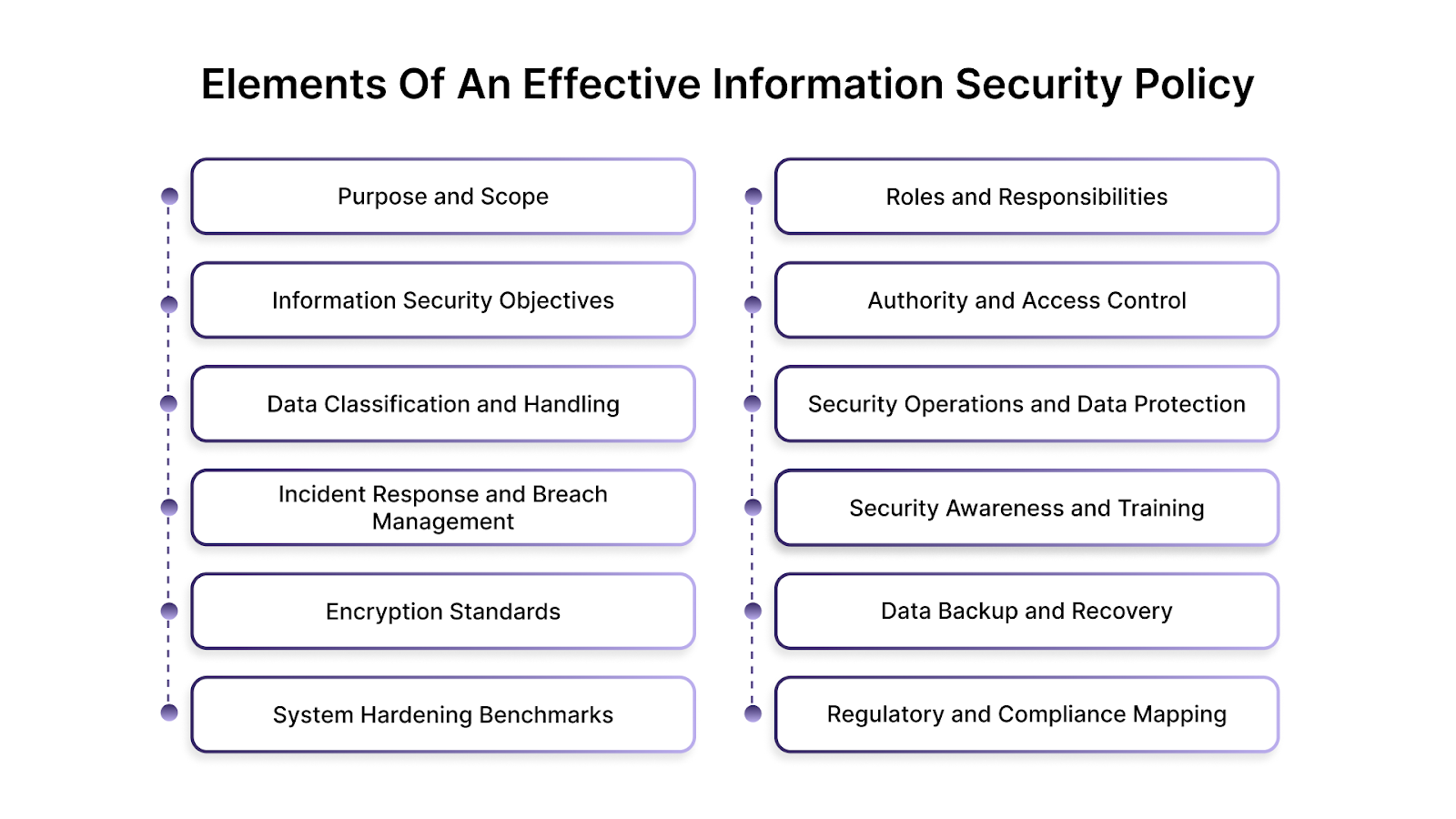
1. Purpose and Scope
Defines why the policy exists and precisely what assets, systems, entities, and activities fall under its authority.
- What It Covers: Specifies in-scope systems, data types, environments, users, and third parties subject to security controls.
- What It Excludes: Documents explicit exclusions to prevent misinterpretation during audits or regulatory reviews.
- Regulatory Alignment: Ties scope directly to licensing, contractual, and supervisory obligations.
2. Roles and Responsibilities
Establishes clear ownership for security decisions, control execution, and escalation authority.
- Executive Ownership: Names accountable executives responsible for accepting residual information security risk.
- Operational Duties: Assigns responsibility for access reviews, monitoring, incident response, and control maintenance.
- Escalation Authority: Defines who approves exceptions and emergency actions.
3. Information Security Objectives
Defines measurable security outcomes aligned to confidentiality, integrity, and availability requirements.
- Confidentiality Targets: Specifies access restrictions and protection thresholds for sensitive data.
- Integrity Controls: Defines mechanisms preventing unauthorized modification of systems or records.
- Availability Standards: Sets uptime, recovery, and resilience expectations.
4. Authority and Access Control
Governs how access is granted, reviewed, modified, and revoked across systems.
- Role-Based Access: Maps permissions to job functions and risk exposure.
- Privileged Access Management: Defines controls for administrative and elevated accounts.
- Authentication Standards: Specifies MFA, credential rotation, and identity proofing requirements.
5. Data Classification and Handling
Categorizes data based on sensitivity and defines handling requirements for each class.
- Classification Levels: Establishes clear tiers such as public, internal, confidential, and restricted.
- Handling Requirements: Defines storage, transmission, and retention rules per classification.
- Labeling Standards: Requires consistent tagging across systems and documents.
6. Security Operations and Data Protection
Defines baseline technical and procedural controls protecting information assets.
- Data Protection Controls: Specifies encryption, logging, and monitoring requirements.
- Backup and Recovery: Defines backup frequency, storage security, and restoration testing.
- Operational Safeguards: Covers patching, vulnerability management, and malware protection.
7. Incident Response and Breach Management
Establishes structured response processes for security incidents and data breaches.
- Detection and Reporting: Defines how incidents are identified, logged, and escalated.
- Response Procedures: Specifies containment, investigation, and remediation steps.
- Notification Obligations: Maps regulatory and contractual reporting timelines.
8. Security Awareness and Training
Guarantees personnel understand security responsibilities and threat vectors.
- Training Requirements: Defines onboarding and recurring security training cadence.
- Threat Awareness: Covers phishing, social engineering, and insider risk scenarios.
- Policy Acknowledgment: Requires documented employee acceptance of security obligations.
9. Encryption Standards
Defines mandatory encryption requirements protecting data confidentiality.
- Data at Rest: Specifies encryption requirements for databases, storage, and backups.
- Data in Transit: Requires secure protocols for internal and external transmissions.
- Key Management: Defines ownership, rotation, and storage of encryption keys.
10. Data Backup and Recovery
Governs how data is preserved and restored following disruptions.
- Backup Scope: Identifies systems and data requiring backup coverage.
- Retention Rules: Defines backup retention periods and disposal requirements.
- Recovery Testing: Requires periodic restoration testing and documentation.
11. System Hardening Benchmarks
Establishes baseline security configurations for critical systems.
- Benchmark References: Aligns configurations with CIS or equivalent standards.
- Configuration Management: Requires documented approval for deviations.
- Monitoring Compliance: Defines how baseline adherence is verified.
12. Regulatory and Compliance Mapping
Connects policy requirements directly to legal and regulatory obligations.
- Regulatory Coverage: Identifies applicable laws, standards, and supervisory guidance.
- Control Mapping: Links policy sections to compliance frameworks such as SOC 2 or GDPR.
- Update Triggers: Defines when regulatory changes require policy updates.
A complete information security policy integrates governance, controls, and accountability into a single enforceable framework that reflects real operations and withstands regulatory, banking, and audit scrutiny.
For organizations preparing for audits, bank onboarding, or regulatory review, Fraxtional offers structured support to identify gaps and strengthen information security policy execution. Get in touch with us!
How Information Security Policies Are Evaluated by Banks, Auditors, and Investors

Banks, auditors, and investors assess information security policies as evidence of control maturity, risk ownership, and execution discipline, not as standalone documentation.
- Policy-to-Control Traceability: Reviewers validate direct mapping between written requirements, implemented controls, and observable operational evidence.
- Named Executive Accountability: Policies are checked for explicitly assigned owners with authority to approve exceptions and accept residual risk.
- Operational Consistency Testing: Stated procedures are compared against system configurations, logs, access rights, and incident records.
- Regulatory Alignment Verification: Language is assessed for accuracy against applicable standards such as SOC 2, GDPR, PCI DSS, and bank-specific requirements.
- Exception and Escalation Handling: Evaluators examine how deviations are documented, approved, time-bound, and reviewed for risk acceptance.
Strong information security policies withstand scrutiny because they mirror real operations, assign ownership, and produce verifiable evidence, not because they read well.
Questions to Ask When Building an Information Security Policy
Before drafting controls or language, organizations must validate that the policy reflects real operations, risk exposure, and accountability, not theoretical security models.
- Have all data types, systems, and repositories been identified, classified, and mapped to owners and sensitivity levels?
- Are legal, regulatory, contractual, and industry requirements clearly identified and mapped to policy obligations?
- Are named executives accountable for approving access, accepting risk, and authorizing policy exceptions?
- Are authentication, authorization, privileged access, and review processes explicitly defined and enforceable?
- Does the policy define detection methods, response authority, regulatory notification timelines, and communication responsibilities?
- Are vendor access, data handling obligations, and breach responsibilities clearly governed?
- Does the policy define monitoring methods, audit evidence, disciplinary actions, and remediation workflows?
- Are review triggers tied to system changes, regulatory updates, incidents, or business expansion?
A strong information security policy begins with the right questions, guaranteeing governance, accountability, and controls reflect actual risk rather than assumed security posture.
For finance teams seeking defensible controls, clearer risk visibility, and audit-ready documentation, this guide explains how to align internal review findings with governance, compliance, and execution through the Internal Audit Checklist for Effective Financial Assessment & Control.
How Internal and External Organizational Contexts Shape a Strong Security Policy

Organizational context forms the foundation of an effective security policy by guaranteeing controls reflect actual operations, risk exposure, and strategic objectives, rather than generic best practices. Defining context improves accurate risk identification and alignment between the Information Security Management System (ISMS) and business priorities.
Internal Contextual Influences
Internal factors determine how security policies can be realistically implemented and enforced.
- Business Objectives and Culture: Security requirements must support operational goals and organizational structure without introducing friction or misalignment.
- Resource Constraints: Budget, staffing, and technical capacity determine whether policy controls are achievable and sustainable.
- Operational Weaknesses: Gaps such as inconsistent data handling, insufficient training, or legacy infrastructure drive targeted control design.
- Incident History: Past breaches and near misses identify control failures requiring prioritization.
External Contextual Influences
External factors make sure that the policy remains compliant, defensible, and responsive to growing risk.
- Regulatory Environment: Applicable laws and standards shape mandatory control requirements and reporting obligations.
- Threat Landscape: Industry-specific attack patterns and emerging technologies inform proactive risk mitigation.
- Third-Party Exposure: Vendor access and outsourcing relationships require defined accountability and oversight mechanisms.
- PESTLE Analysis: Political, economic, technological, legal, and environmental factors influence policy durability.
Integrating Context Into Policy Design
A strong policy results from documented contextual analysis translated into enforceable governance.
- Defined Scope: Context determines which systems, data, users, and vendors fall under policy control.
- Risk-Based Controls: Assets are protected based on sensitivity and impact, not uniform treatment.
- Strategic Alignment: Security objectives directly support business operations and regulatory commitments.
- Ongoing Review: Policies are updated as organizational and external conditions change.
A security policy is strong only when it is grounded in organizational context and updated as risk, regulation, and operations change.
Best Practices for Maintaining an Effective Information Security Policy
Maintaining an effective information security policy requires continuous operational alignment, cross-functional enforcement, and control discipline, not periodic document refreshes.
- Risk-Based Data Classification: Continuously reclassify data assets as products, integrations, and customer exposure changes.
- DevSecOps Policy Enforcement: Embed security policy requirements into development pipelines, configuration standards, and release approvals.
- Incident Response Integration: Align policy escalation paths with live incident playbooks, regulatory timelines, and breach notification thresholds.
- Cloud and SaaS Governance: Enforce standardized security baselines for cloud services, identity federation, logging, and vendor onboarding.
- Access and Usage Controls: Tie acceptable use, IAM rules, and device policies to real authentication systems and endpoint enforcement.
An information security policy remains effective only when it grows alongside systems, teams, and regulatory exposure, producing enforceable controls rather than static guidance.
For compliance and risk teams interpreting national risk findings, this guide explains how supervisory assessments translate into operational controls, enforcement priorities, and regulatory expectations through National Risk Assessments on Money Laundering Explained
When to Revisit or Rewrite Your Information Security Policy

Information security policies must be revisited when risk exposure, regulatory scope, or system architecture changes, not on arbitrary review cycles.
- New Regulatory Obligations: Licensing changes, cross-border operations, or new customer geographies introduce enforceable security requirements.
- Infrastructure Architecture Shifts: Cloud migrations, identity provider changes, or data residency updates invalidate prior control assumptions.
- Material Product Changes: New payment flows, custody models, or data processing logic alter threat models and access boundaries.
- Third-Party Risk Expansion: Onboarding critical vendors or outsourcing core functions changes security accountability and breach exposure.
- Audit or Incident Findings: Examination results or security events expose policy-control gaps requiring immediate remediation.
Rewriting an information security policy is necessary when reality outpaces documentation, creating regulatory and operational risk under scrutiny.
How Fraxtional Supports Audit-Ready Information Security Policies
Fraxtional supports organizations by providing experienced fractional compliance leadership and structured policy development, helping teams design information security programs that meet sponsor bank, audit, and regulatory expectations without requiring a full-time executive hire.
- Director-Led Oversight: Each engagement includes direct involvement from experienced Directors who guide policy structure, review controls, and advise on regulatory alignment.
- Embedded Collaboration Model: Fraxtional works alongside internal teams, integrating with existing processes to strengthen governance rather than replacing in-house ownership.
- Sponsor Bank–Aware Policy Design: Policies and procedures are developed with sponsor bank review standards, onboarding expectations, and ongoing oversight requirements in mind.
- Audit and Readiness Support: Fraxtional assists with SOC 2 preparation, independent audits, and documentation refinement to reduce review friction and remediation cycles.
- Flexible Fractional Engagements: Support is delivered through advisory, subscription, or fractional leadership models, scaling with business stage and regulatory complexity.
If your information security policies must withstand sponsor bank scrutiny, audit review, or regulatory examination, Fraxtional provides experienced compliance support to help you identify gaps and strengthen documentation without unnecessary complexity.
Schedule a policy review to assess readiness and next steps.
Conclusion
Information security policies rarely fail because documentation is missing. They fail when control, ownership, enforcement, evidence, and escalation authority cannot be demonstrated under the sponsor bank, audit, or regulatory review. Reviewers test execution, not intent.
A defensible information security policy closes that gap by linking governance, technical controls, third-party access, incident response, and change management into a single, traceable framework. When those elements align, security oversight becomes verifiable rather than reactive.
For teams preparing for audits, sponsor bank onboarding, or regulatory examinations, Fraxtional helps translate information security requirements into policies and supporting controls that withstand scrutiny. Our compliance teams work alongside yours to build review-ready documentation grounded in how systems and teams actually operate.
If your information security policies are approaching external review, speak with Fraxtional to make sure that they are built for real-world examination, not post-review remediation.
FAQs
Yes. Auditors assess control design and consistency, while banks and regulators test operational enforcement, ownership clarity, and whether policies reflect actual system behavior.
Yes. Programs fail when policies lag system changes, omit third-party dependencies, or cannot show evidence that controls are enforced as written.
Policies should change when systems, vendors, data flows, or access models change, not on a fixed annual cycle. Static policies create audit exposure.
Yes. Reviewers expect explicit coverage of cloud responsibility models, identity controls, logging ownership, and vendor security assumptions, not separate undocumented practices.
Most rejections stem from missing ownership, unclear escalation paths, weak third-party access controls, or policies that describe ideal states rather than current operations.
blogs
Don’t miss these
.jpg)


Let’s Get Started
Ready to Strengthen Your Compliance Program?
Take the next step towards expert compliance solutions. Connect with us today.