%201%20(1).svg)

Jan 8, 2026
What Is an Interim Executive? Roles, Value, and When to Use One

By Fraxtional LLC

Summarize the blog with AI
Leadership transitions are more than a human-resources issue. They're a major risk vector. In regulated sectors, delays or leadership vacuums can trigger audit failures, licensing postponements, or sponsor bank rejections.
For example, U.S. companies in the S&P 500 have seen the fastest rate of CEO turnover in two decades, with 41 exits so far in 2025, a figure higher than all of 2024. While those are public-company numbers, the message carries into fintech, crypto, and banking: turnover means instability.
Interim executive leadership fills that gap.
It stabilizes governance, maintains regulatory momentum, and keeps teams moving while long-term hiring decisions take shape. This guide explains what interim executive leadership is, how it maintains continuity, and how companies in regulated sectors can protect momentum while preparing for long-term decisions.
At A Glance:
- Interim executive leadership helps companies stay stable during leadership gaps, restructuring, and rapid growth.
- Fintech, crypto, banking, and PE-backed firms face higher risk during transitions because regulatory deadlines and audits cannot pause.
- Interim leaders provide direction, maintain governance, and ensure continuity across compliance and risk functions.
- A structured plan helps companies avoid disruptions, protect operations, and keep investors and partner banks confident.
- Fraxtional strengthens business continuity by combining interim leadership with deep regulatory and operational expertise.
What Is an Interim Executive?
In fast-moving industries like fintech, crypto, and banking, leadership transitions create major operational and regulatory risks. An interim executive is a high-level leader hired for a short-term assignment, typically to fill an urgent leadership gap, stabilize operations, or lead a strategic change.
Interim executives are often confused with consultants or fractional leaders, but they play different roles:
- Consultants typically offer specialized advice or project-based support without authority to lead day-to-day operations.
- Fractional leaders provide ongoing, part-time leadership, often as a long-term solution for scaling companies, without the full-time commitment.
- Interim executives, on the other hand, step in full-time to make critical decisions, manage teams, and ensure operational continuity until a permanent hire is made.
This distinction is crucial for companies making leadership changes in regulated environments, where stability and continuity are critical to success.
Now that we've defined interim executives, let's explore what they bring to a company.
What Interim Executive Leadership Brings to a Company: Key Benefits

What Interim Executive Leadership Brings to a Company
Interim executive leadership fills the gap between a leadership change and the hiring of a permanent executive. It's crucial in fintech, crypto, and banking, where regulatory deadlines, sponsor bank reviews, and audits cannot pause.
Here's how it works in practice:
1) Rapid Stability and Direction During Transitions
Interim leaders step in with immediate authority, so teams do not lose momentum.
- For instance, let's say a fintech lost its CCO during the lead-up to a major sponsor bank review. The company faced a tight deadline to submit compliance documents, including AML policies and control frameworks.
- An interim CCO was deployed within days to oversee the submission, address gaps in internal procedures, and respond to the sponsor bank's requests for additional documentation.
The result? The company met the deadline and secured the bank's partnership.
2) Regulatory and Audit Continuity
Regulators and sponsor banks expect uninterrupted oversight. Interim CCOs, CROs, and MLROs ensure filings stay on schedule, findings get addressed, and governance routines continue.
Take an example.
- A crypto startup preparing to file for a license in a new state faced the sudden departure of its MLRO. The company needs immediate leadership to ensure that its compliance systems are aligned with state-specific regulations and to manage the ongoing audit process.
- An interim MLRO is brought in to review the startup's internal AML framework, update transaction monitoring procedures, and provide direct responses to state regulators.
This allowed the company to keep the licensing process on track without interruption.
3) Expertise Without Full-Time Commitment
Interim executives bring decades of experience without the long-term financial commitment of a permanent hire.
- For instance, when a payments platform needs urgent guidance to meet new international compliance requirements, an interim compliance expert with extensive global experience can be brought in.
- The interim leader will guide the team through regulatory filings and vendor management, allowing the company to scale without a permanent hire.
You gain the senior judgment needed to manage complexity while preserving budget flexibility.
4) Alignment With Investor and Board Expectations
Boards and PE sponsors often prefer interim leadership during high-risk phases because it provides visible oversight and faster, cleaner reporting. It supports investor confidence when delayed decisions could affect valuation or market positioning.
Also Read: Role and Value of an Interim MLRO in Financial Firms
With the value defined, the next step is understanding where interim leadership outperforms a traditional hiring process.
How Interim Leadership Outperforms Permanent Hiring

Interim leaders are not a fallback option. In many cases, they outperform permanent hires because they solve urgent problems without the lengthy timelines and uncertainty of executive searches. This matters most in regulated industries where pauses, delays, or unclear ownership can create real exposure.
- Executive Departures or Sudden Leadership Vacancies
When a C-suite leader exits, teams often lose strategic direction within days, not weeks. Traditional hiring cycles can take three to six months. During that window, sponsor banks still expect updates, audits continue, and licensing deadlines remain fixed.
Interim executives prevent governance drift and keep operational decisions moving.
- New Product Launches or Market Expansion
Fintechs launching payment products or crypto features face rapid regulatory changes. Interim leaders help structure policies, risk assessments, and readiness plans to ensure launches remain compliant.
They also provide internal teams with the tools to avoid overlooking obligations tied to multi-state expansion or new licensing requirements.
- M&A, Restructuring or PE Integration
During transactions, leadership gaps can slow integration and dilute accountability. PE sponsors often deploy interim leaders to stabilize operations, align reporting, and oversee risk while the permanent structure takes shape.
This reduces the friction that usually slows down post-acquisition execution.
- Audit Cycles, Licensing Reviews or Sponsor Bank Oversight
These events introduce strict timelines and a zero-tolerance policy for incomplete responses. Interim CCOs, CROs, or MLROs maintain audit readiness, manage remediations, and ensure reviewer expectations are met.
Sponsor banks often prefer an interim leader over an unfilled role because it demonstrates continuity and ownership.
- High-Growth Periods With Talent Gaps
As risk exposure increases, scaling teams sometimes lacks senior leadership capacity. Interim executives fill these capability gaps immediately, allowing internal teams to execute without being stretched beyond their scope.
Also Read: Understanding Fractional vs. Interim Leadership Roles
Once you know where interim leadership adds the most value, the most important part is deciding whether you really need one right now.
Is Interim Executive Leadership Right for You? Key Decision Triggers
Many leaders ask a simple question before they decide: "Is this solution a fit for my situation right now?” Interim executives are most effective when specific business conditions are present, not in every scenario.
Below are the clear triggers that indicate you should seriously consider interim leadership:
1. You Face an Immediate Leadership Gap That Affects Continuity
If a C‑suite leader leaves suddenly, due to resignation, health, or unexpected departure, your business risks losing direction within days, not weeks. Interim executives can be deployed quickly (often within days), preventing slowdowns in critical functions like compliance, risk, product, or finance.
Ask yourself:
- Has a key leader left without a successor ready to step in?
- Are critical decisions stalled?
- Are compliance or audit cycles ongoing?
If yes, interim leadership helps maintain continuity.
2. You Are Entering a High‑Pressure or Time‑Sensitive Phase
Interim executives are especially valuable during time‑critical transitions such as:
- Audit cycles
- Licensing deadlines
- Sponsor bank reviews
- M&A or integration windows
In these situations, waiting for a permanent hire introduces risk and delay. Interim leaders step in with authority and experience, keeping these deadlines on track.
Ask yourself:
- Do you have high‑stakes milestones approaching?
- Are regulators or partners expecting responses soon?
If yes, interim leadership provides strategic stability.
3. You Need Specialized Expertise Now, Not Later
Unlike consultants or project advisors, interim executives lead teams and make decisions from day one. They are hired for leadership, not just advice.
Decision triggers here include:
- Short‑term transformation initiatives
- New regulatory frameworks to implement
- Strategic pivots requiring swift authority
- Scaling into new products, markets, or compliance frameworks
When your team needs experience now, not after hiring cycles, interim leadership is appropriate.
4. You Want to Preserve Budget Flexibility Without Sacrificing Capability
Interim executives combine C‑suite experience with time‑limited, cost‑explicit engagements. This flexibility allows you to secure senior leadership without the long‑term salary, benefits, and earnings package of a permanent hire.
Ask yourself:
- Do you need experienced leadership but want to manage overhead?
- Are you in a hiring freeze or budget review?
If yes, interim leadership balances capability with cost control.
5. You Are Evaluating Long‑Term Leadership Decisions with Care
In many cases, interim leadership buys valuable time for reflection and evaluation. Interim leaders help you:
- Assess internal talent pipelines
- Understand leadership requirements before committing
- Build a stronger, eventual, permanent hire profile
This is especially important when boards or investors want a thorough evaluation before long‑term commitments.
Ask yourself:
- Are you uncertain about your long‑term leadership needs?
- Do you want support as you build your permanent hiring strategy?
If yes, an interim leader can fill the gap while providing clarity.
If you answered yes to one or more of these, interim leadership is likely worth considering.
Suggested Read: The Rise of Fractional C-Suite Executives in Crypto
Now, the next step is building a strategy to maintain continuity throughout the transition.
Strategies for Maintaining Business Continuity With Interim Leaders
For companies in fintech, crypto, banking, and private-equity-backed portfolios, a leadership gap is not a pause but a risk vector. In the current changing environment, interim executives are increasingly used not just to fill vacancies but also to steer transformation and sustain momentum.
Below are practical, high-impact strategies for deliberately deploying interim executive leadership to keep your business moving forward with clarity and control.
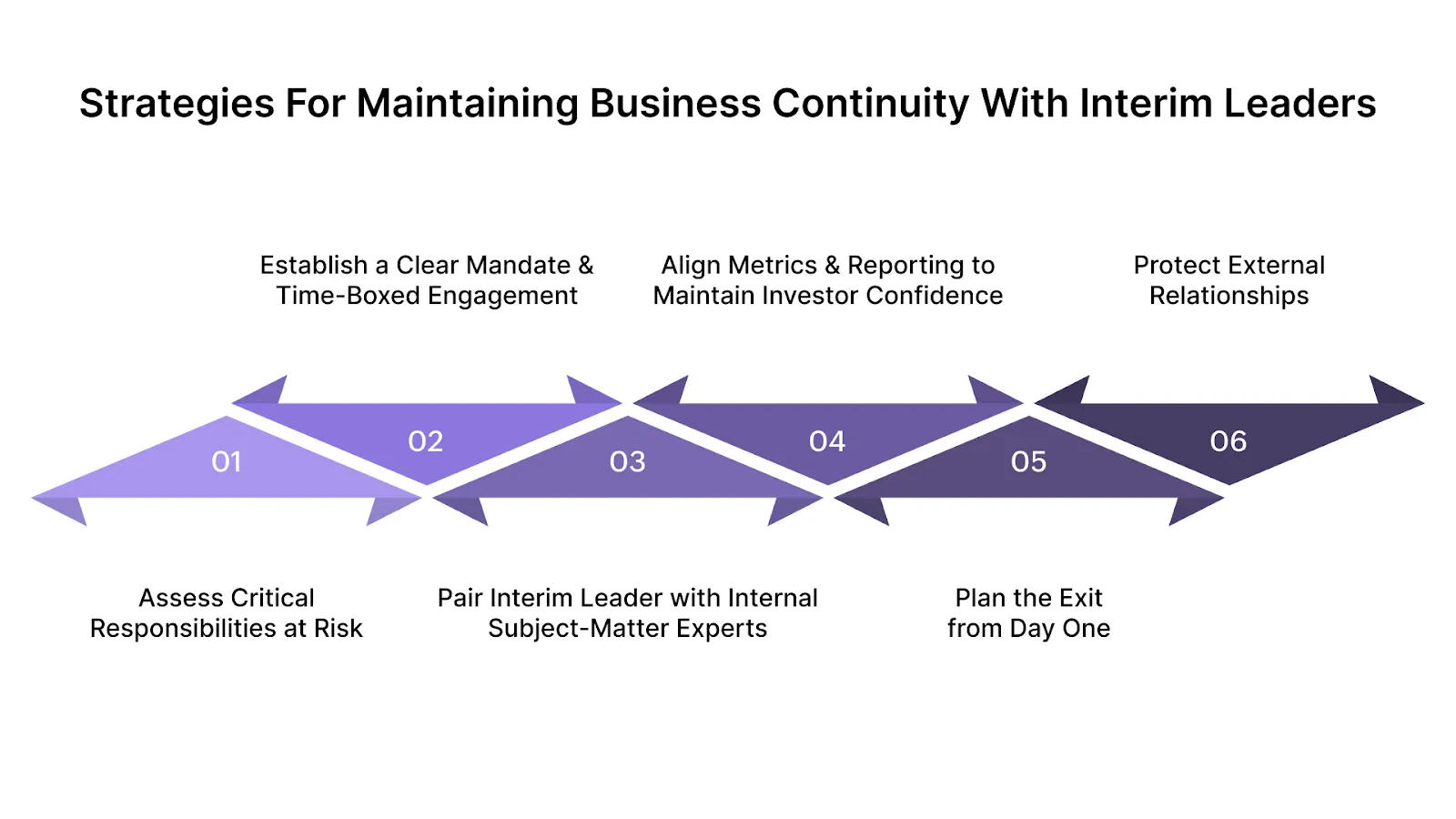
1. Assess Critical Responsibilities at Risk Immediately
When a key executive leaves, the first hour matters. Effective leaders work through a “preparation → entry → delivery → exit” cycle to manage those gaps.
For a regulated fintech, critical responsibilities often include:
- AML program oversight, including escalation of suspicious activity
- Sponsor bank reporting and review readiness
- Multi-state licensing processes or crypto-custody compliance
- Internal governance boards, audit routines, and vendor risk management
2. Establish a Clear Mandate and Time-Boxed Engagement
For interim leadership to work, role clarity and time boundaries are essential. Without them, ambiguity slows decisions and team morale drops.
Key elements of the mandate:
- Authority levels defined (budget, hiring, vendor approval)
- Scope clarified (which products, jurisdictions, frameworks)
- Key milestones aligned (audit date, licensing target, Q-board report)
- Exit or handoff plan established from day one
3. Pair the Interim Leader with Internal Subject-Matter Experts
While the interim brings strategic oversight, internal teams bring institutional knowledge. This combination prevents the common “reset syndrome,” in which new leadership redefines everything from scratch, wasting time and causing drift. Practical interim assignments must involve collaboration and quick integration into existing teams.
4. Align Metrics and Reporting
During transition periods, stakeholders need evidence, not just promises. Interim leaders should define KPIs tied to business continuity and regulatory milestones:
- Percentage of controls tested on time
- Number of outstanding audit findings and remediation status
- Time to vendor onboarding and compliance approval
- License applications submitted vs approved
A shift in interim leadership usage data shows that nearly 70 % of organizations deploying interim executives cite improved readiness for audits or regulatory reviews.
These metrics translate into investor and bank partner confidence, which is essential in a high-growth, highly regulated environment.
5. Plan the Exit from Day One
Many companies treat an interim appointment as temporary chaos management. The smarter approach: treat it as a strategic deployment with a defined end game. Planning the exit ensures the corporate memory, process improvements, and leadership foundation are retained.
Performance in the “exit” stage is as important as the entry and delivery phases. Here's a tactical checklist for exit planning:
- Document all decisions, policies, and controls established during the interim
- Develop hand-off sessions with the incoming permanent hire or internal team
- Ensure vendor/sponsor bank relationships are transferred smoothly
- Lock in governance routines so new leadership has continuity
6. Protect External Relationships and Brand Stability
In regulated industries, external stakeholders - regulators, sponsor banks, venture investors - notice leadership gaps. They evaluate not just what you do, but who leads it. Interim leadership reassures stakeholders that you have accountability.
Cost shapes almost every leadership decision. Understanding how interim leadership investment delivers strategic and regulatory return is essential.
If your next phase requires stability through audits, licensing milestones, or organizational change, Fraxtional’s interim leaders can help you maintain momentum with clarity. Connect with us to review your continuity needs and build a plan that protects performance.
But even with clear strategies, companies can fall into avoidable traps when filling leadership gaps. Understanding those mistakes helps prevent the risks that derail continuity.
Common Mistakes When Filling Leadership Gaps

Companies often underestimate the disruptive impact of a leadership vacancy. In regulated industries, those mistakes compound quickly. A mismanaged transition can slow audits, delay licensing, weaken sponsor bank confidence, or create operational drift.
Below are the mistakes that create the most risk and how to avoid them:
1. Waiting Too Long to Fill the Leadership Void
Many teams assume they can “pause” executive responsibilities until a permanent hire is found. In practice, regulated firms rarely have that luxury.
- This is why interim executives are used heavily during transition cycles to avoid drift and missed deadlines.
2. Assuming Internal Teams Can Absorb Executive Work
Internal staff can maintain operations, but cannot absorb C-suite responsibilities. Teams stretched thin often make inconsistent decisions, leading to findings or weaker audit outcomes.
- Oversight duties, such as escalation decisions, audit responses, or sponsor bank communications, require senior authority.
3. Bringing in an Interim Leader Without a Clear Mandate
One of the most common failures is hiring an interim executive but giving them no apparent authority. Without defined decision rights, the interim becomes a consultant rather than a leader.
- This can lead to stalled projects, blurred accountability, and confusion across teams.
4. Treating Interim Leadership as a Temporary Patch
Interim leadership must be strategic, not reactive. Companies that treat it as a short-term “fix” often fail to capture the continuity benefits.
- A structured entry plan, defined deliverables, and a well-planned exit are necessary to preserve operational stability.
5. Failing to Maintain External Confidence
Leadership gaps can unsettle regulators, sponsor banks, and investors if communication lapses. A fintech preparing for a bank review, for example, risks losing momentum if reviewers are unsure who owns the compliance program.
- Interim leaders maintain that confidence by providing a clear point of contact and consistent oversight.
6. Leaving Documentation and Governance in Disarray
During transitions, documentation often becomes fragmented. Policies stall in draft. Audit trackers go stale. Governance routines lose consistency.
- Interim leaders prevent this by enforcing discipline: updated controls, defined meeting cadences, and complete audit trails.
7. Not Planning the Transition From Day One
When companies wait until the end of the engagement to plan the handoff, institutional knowledge is lost.
- Defining the exit plan early, whether to a permanent hire, internal promotion, or fractional model, ensures continuity and avoids another gap.
Avoiding these mistakes requires judgment, structure, and experience - primarily when automation alone cannot support continuity. This is where a partner who understands leadership, risk, and regulatory pressure becomes essential.
How Fraxtional Strengthens Business Continuity Through Interim Leadership

Interim leadership is most effective when it protects operations, preserves governance, and keeps regulatory expectations on track. Fraxtional steps in at exactly this point: where leadership gaps intersect with compliance, risk, and audit obligations that cannot pause.
Instead of treating interim leadership as “coverage,” Fraxtional treats it as strategic continuity.
- Stabilizing Leadership
Fintechs, crypto firms, banks, and PE-backed companies often operate with tight regulatory timelines. Sponsor bank reviews, SOC 2 audits, AML obligations, and licensing submissions continue regardless of internal turnover. Fraxtional's interim executives maintain oversight to ensure these cycles remain uninterrupted. - Keeping Regulatory Momentum
When leadership gaps threaten multi-state licensing, audit remediation, or crypto oversight, key initiatives stall and compliance suffers. Fraxtional’s interim CCOs, CROs, and MLROs keep filings moving, address findings, and maintain essential governance routines. This protects relationships with regulators, auditors, and bank partners. - Strengthening Decision-Making
Interim leaders at Fraxtional do more than manage the day-to-day. They make the decisions that keep product launches, compliance frameworks, and risk strategies aligned with your growth plan. This prevents delays that typically stall fintech and crypto operations during transitions. - Translating Operational Complexity
Boards and investors need visibility, not noise. Fraxtional's interim executives simplify reporting, clarify risk posture, and provide clean, structured updates. This builds confidence during periods when leadership shifts could otherwise erode trust. - Driving Continuity
Fraxtional's model gives companies access to senior leadership calibrated to the moment: strategic, accountable, and immediately operational without the cost or delay of a full-time executive search.
Partner with Fraxtional to maintain leadership continuity, protecting your operations, accelerating execution, and standing up to regulatory and investor scrutiny.
Conclusion
Interim executive leadership is not a temporary fix. It is a stability mechanism that keeps strategy, governance, and regulatory expectations intact as your organization moves through change. Automation and internal coverage can support operations, but they cannot replace accountable leadership during moments that shape audits, licensing outcomes, or investor confidence.
Interim leaders protect momentum while permanent hiring decisions take shape. They safeguard compliance, maintain external trust, and keep teams focused on execution instead of uncertainty.
For organizations in regulated industries, that balance is not optional. It is the difference between a controlled transition and a period of risk.
Fraxtional helps companies hold that line by providing interim leaders who bring clarity, continuity, and disciplined oversight from day one. Contact us now to ensure your transition remains compliant, stable, and investor-ready.
FAQs
Most interim engagements last three to nine months, depending on audit cycles, licensing timelines, or restructuring phases. The duration should align with clear deliverables rather than a fixed calendar date.
Interim executives step in full-time for a defined period to maintain continuity. Fractional executives provide ongoing leadership part-time, often supporting stability after the interim phase or when full-time hiring is not required.
Interim leadership is more effective when a company faces urgent timelines, such as audits, sponsor bank reviews, licensing deadlines, restructures, or leadership exits. It removes the months-long delay of executive search and stabilizes operations immediately.
Yes. Regulators and sponsor banks prioritize accountability, not job titles. As long as the interim leader has the authority, experience, and oversight to make their own decisions, external stakeholders view the role as credible.
Experienced interims often begin delivering within days. They work from a structured entry plan, meet key stakeholders early, and align decisions to active risk, compliance, and operational priorities.
They can support, but they cannot make decisions that require senior authority. Executive duties such as AML escalation, audit response, and governance oversight require a leader who can take accountability and defend their judgment.
blogs
Don’t miss these



Let’s Get Started
Ready to Strengthen Your Compliance Program?
Take the next step towards expert compliance solutions. Connect with us today.
Now Accepting:
BTC

ETH

USDC
USDP