

Mar 27, 2026
Risk Acceptance Strategy Explained for Business Leaders (2026)

By Fraxtional LLC

Summarize the blog with AI
How do you decide which risks your business should address and which ones you can live with? For fintech founders, compliance leaders, and executives, this question often appears when operational or regulatory exposure begins to scale.
In many cases, risk acceptance involves accepting the consequences should a risk occur when preventing the risk would cost more than the damage it might cause. The challenge is deciding when accepting a risk is strategic and when it creates unnecessary exposure.
Understanding how risk acceptance works within a structured risk management framework helps you balance operational efficiency, governance, and resilience. To begin, it helps to clarify what risk acceptance actually means in business risk management.
Quick look
- Risk acceptance involves acknowledging a risk and choosing not to implement mitigation when the likelihood and impact remain within defined tolerance levels.
- Organizations typically accept risks after evaluating probability, financial exposure, operational impact, and regulatory implications.
- Common strategies include passive acceptance, active acceptance with contingency plans, and threshold-based acceptance within predefined limits.
- Accepted risks must still be documented in risk registers, assigned to owners, and reviewed through governance processes.
- Fintech companies often require structured compliance and risk leadership, where firms like Fraxtional support the development of formal risk management frameworks.
What Risk Acceptance Means in Risk Management
Risk acceptance occurs when you identify a potential threat but decide not to implement preventive controls immediately. This decision usually follows a cost-benefit evaluation showing mitigation would require more resources than the potential loss.
In practice, risk acceptance involves accepting the consequences should a risk occur while ensuring the exposure remains within acceptable limits. You still document the risk, monitor it, and review it through governance processes.
For example, you may accept the risk of short service delays during scheduled platform updates if eliminating that risk requires costly infrastructure upgrades that provide limited operational benefit.
Risk acceptance rarely exists on its own. It is one option among several risk response strategies you can apply.
To see how acceptance fits into the broader framework, it helps to compare it with other risk response strategies.
Where Risk Acceptance Fits Among Risk Response Strategies
When you evaluate a risk, you typically consider several response strategies before deciding what action to take. Each approach manages uncertainty in a different way.
The most common responses include avoidance, mitigation, transfer, and acceptance. These strategies help you balance operational exposure with available resources.
You typically choose risk acceptance when mitigation is unnecessary, impractical, or disproportionately expensive relative to the risk itself.
Once you understand where acceptance fits within the broader framework, the next step is understanding the different strategies you can use when accepting risk.
Risk Acceptance Strategies Businesses Use
Organizations rarely rely on a single method when accepting risk. Instead, you apply different strategies depending on how much exposure your business can tolerate.
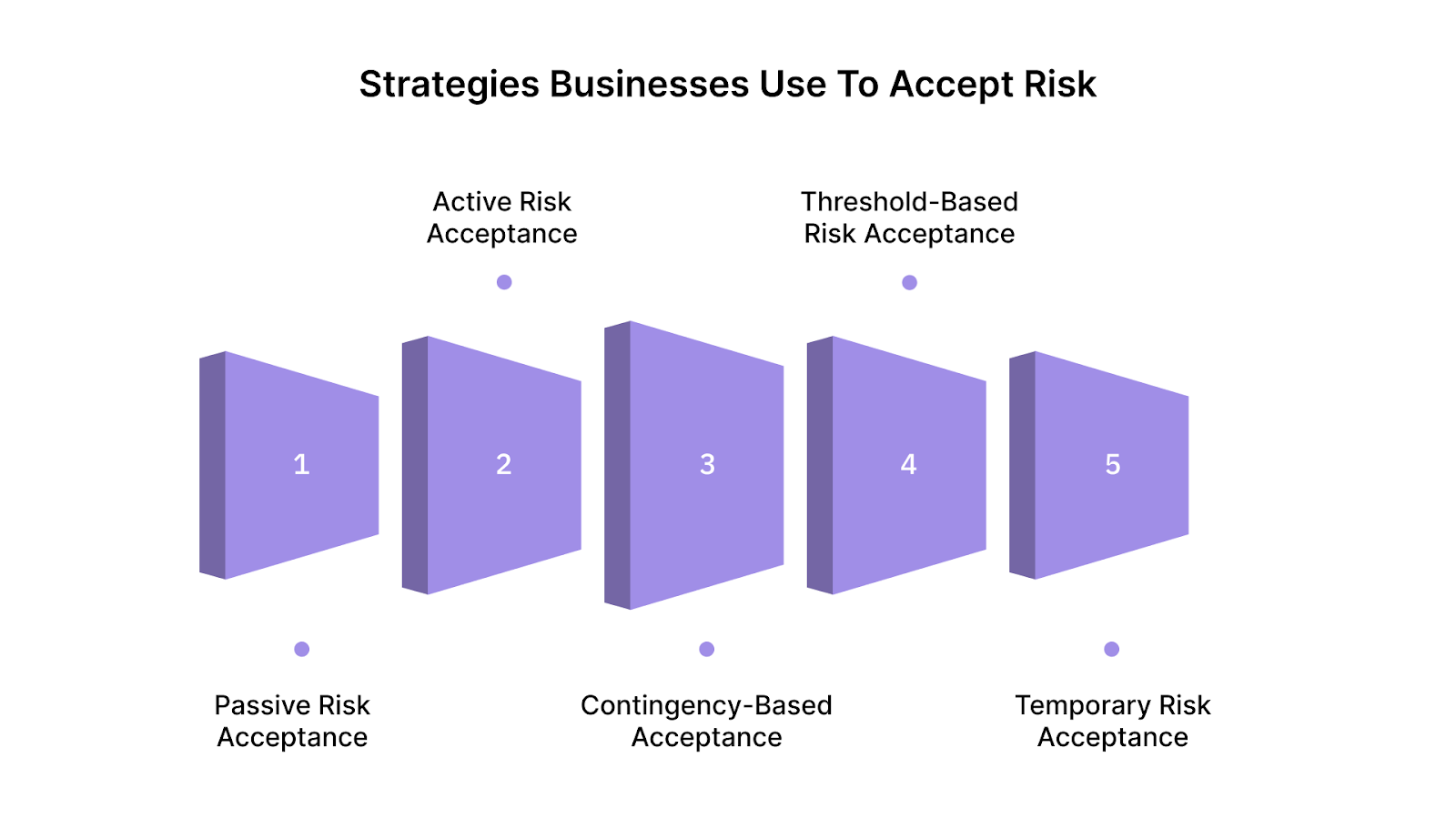
1. Passive Risk Acceptance
Passive acceptance means you acknowledge the risk and record it in your risk management system without implementing immediate controls.
You monitor the risk and reassess it periodically, but you take no proactive action unless the situation changes.
This strategy is typically used when risks are low probability and low impact.
2. Active Risk Acceptance
Active acceptance means you accept the risk but prepare a response plan in case it occurs.
You might develop contingency procedures, escalation protocols, or incident response playbooks.
This approach allows you to maintain operational readiness without investing in full mitigation.
3. Contingency-Based Acceptance
In contingency-based acceptance, you accept the risk because fallback options already exist.
Examples include backup suppliers, redundant systems, or temporary operational workarounds.
These safeguards allow you to absorb disruptions if the risk materializes.
4. Threshold-Based Risk Acceptance
Some organizations define measurable thresholds for acceptable exposure.
For example, you may accept risks that result in less than a specific financial loss, operational delay, or system downtime.
As long as the exposure stays within these limits, you formally accept the risk.
5. Temporary Risk Acceptance
Temporary acceptance occurs when you accept a risk for a limited time while implementing improvements.
You may apply this strategy during system upgrades, compliance program expansion, or infrastructure scaling.
Once conditions change, you reassess whether the risk should remain accepted.
Understanding these strategies helps you evaluate whether acceptance is appropriate in your situation. The next step is recognizing when risk acceptance makes strategic sense.
When Risk Acceptance Makes Strategic Sense
You should not accept risks randomly. Risk acceptance works when the exposure is clearly understood, measurable, and aligned with your organization’s risk tolerance. Leaders typically use this approach after evaluating probability, impact, mitigation cost, and operational priorities.
The following situations commonly justify risk acceptance:
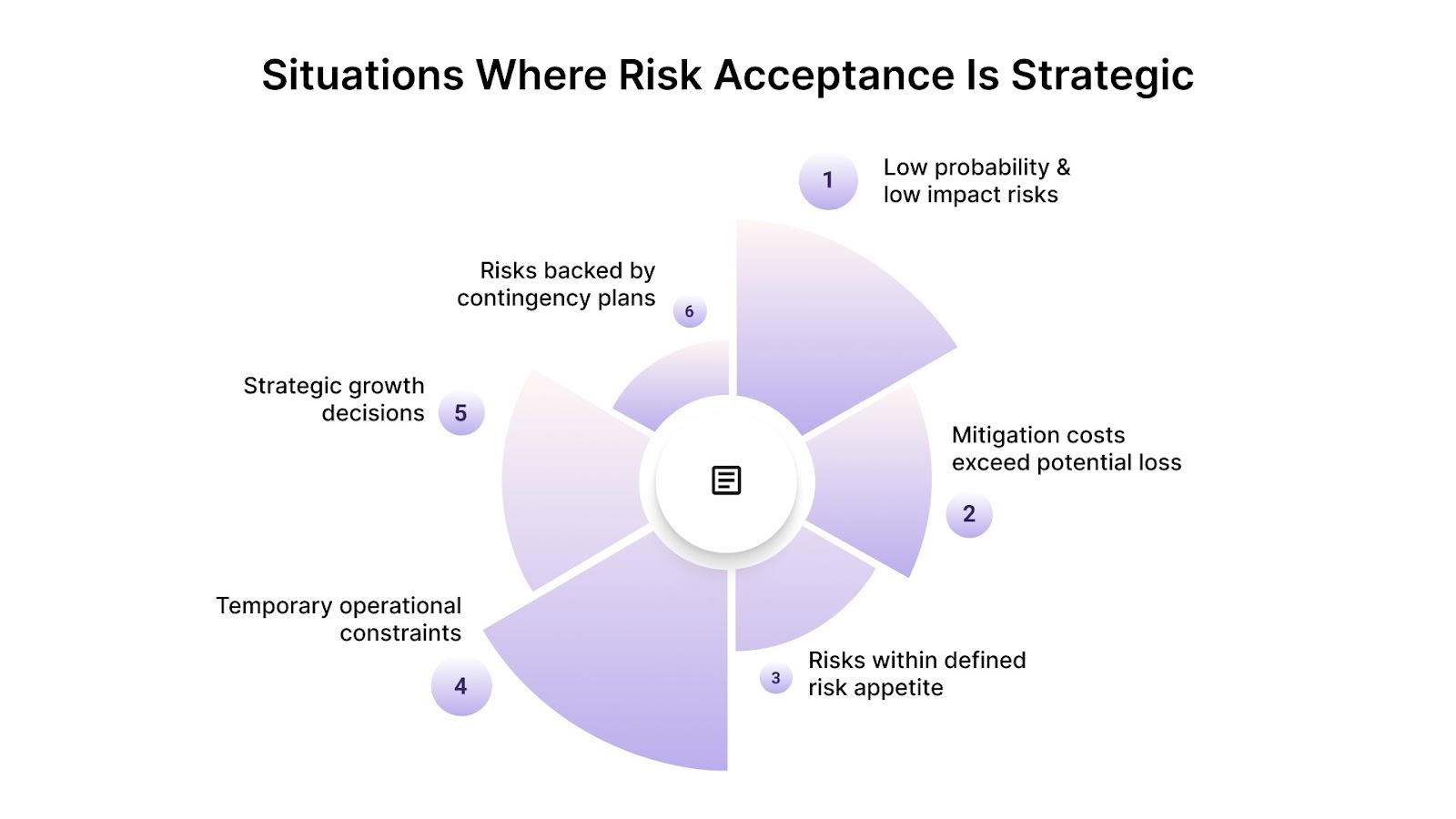
- Low probability and low impact risks: You may accept risks that are unlikely to occur and would cause minimal operational or financial disruption. For example, occasional short platform latency during scheduled maintenance.
- Mitigation costs exceed potential loss: If eliminating the risk requires expensive controls while the potential damage is small, accepting the risk may be the more efficient decision.
- Risks within defined risk appetite: Organizations often define acceptable exposure levels. If a risk falls within approved tolerance thresholds, monitoring it may be sufficient.
- Temporary operational constraints: You may accept certain risks temporarily while upgrading systems, expanding compliance teams, or implementing new controls.
- Strategic growth decisions: Companies sometimes accept operational or market risks when entering new markets or launching new financial products.
- Risks already supported by contingency mechanisms: If backup vendors, incident response plans, or operational buffers exist, accepting the risk may be reasonable.
These scenarios help you determine when risk acceptance supports operational efficiency rather than creating unnecessary exposure.
Once you recognize when acceptance is appropriate, the next step is understanding how leaders decide which risks should actually be accepted.
How Leaders Decide Which Risks to Accept
Accepting a risk should always follow a structured evaluation process. Business leaders typically assess several factors to determine whether a risk can be tolerated or whether mitigation is necessary.
Before making a decision, you evaluate both the potential consequences and the operational effort required to control the exposure.
The following criteria commonly guide this decision.
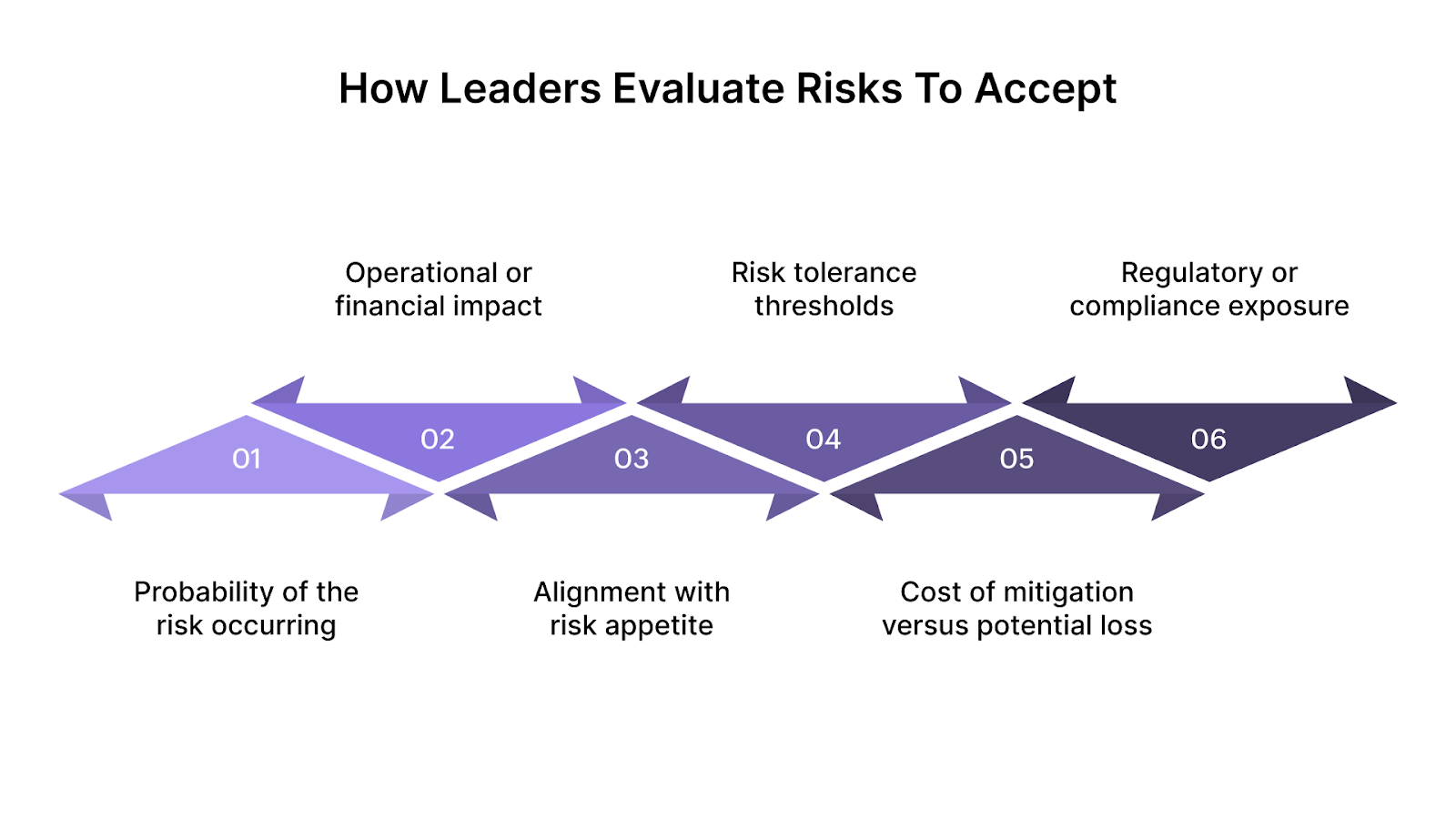
- Probability of the risk occurring: You first assess how likely the event is to happen. Risks with very low probability often do not justify extensive mitigation efforts.
- Operational or financial impact: Even if a risk is unlikely, you must evaluate the potential damage if it occurs. Leaders typically analyze operational disruption, financial loss, reputational harm, or regulatory consequences.
- Alignment with risk appetite: Every organization defines a risk appetite that reflects how much uncertainty it is willing to tolerate. If the exposure falls within these limits, acceptance may be reasonable.
- Risk tolerance thresholds: Risk tolerance defines the maximum acceptable level of disruption or loss. Leaders compare the risk exposure against these thresholds before deciding to accept it.
- Cost of mitigation versus potential loss: If implementing controls costs significantly more than the expected loss from the risk, accepting the risk may be the more practical choice.
- Regulatory or compliance exposure: In regulated industries such as fintech and banking, leaders must evaluate whether accepting the risk could create compliance concerns or regulatory scrutiny.
These criteria help ensure that risk acceptance decisions are deliberate and supported by structured analysis rather than intuition.
If you are looking for experienced guidance when evaluating complex operational or regulatory risks, firms like Fraxtional provide fractional compliance and risk leadership to help organizations structure these decisions within broader risk management frameworks.
Once you determine that a risk can be accepted, the next step is implementing that decision within a clear governance and monitoring process.
How Organizations Implement Risk Acceptance
Once you determine that a risk can be tolerated, you need a structured process to document the decision, assign ownership, and monitor the exposure over time.
The following steps outline how this process usually works.
- Identify and clearly document the risk: You begin by recording the risk in a risk register or governance system. This documentation typically includes a description of the risk, potential triggers, and the operational area affected.
- Assess probability and potential impact: You evaluate how likely the risk is to occur and what consequences it may have on operations, finances, or compliance obligations. Risk matrices or scenario analysis are often used to support this assessment.
- Determine whether acceptance aligns with risk appetite: You compare the risk exposure against your organization’s defined risk appetite and tolerance thresholds to confirm the exposure remains acceptable.
- Assign a responsible risk owner: A specific individual or team must be accountable for monitoring the risk. The risk owner tracks changes in probability, impact, or operational conditions.
- Establish monitoring and review triggers: Even accepted risks require oversight. You define review intervals or triggers that prompt reassessment if conditions change or exposure increases.
Following these steps ensures risk acceptance remains a controlled and transparent decision rather than an overlooked vulnerability.
However, implementing risk acceptance effectively requires strong governance structures that ensure accepted risks remain visible and properly managed.
Why Risk Acceptance Requires Strong Governance

Strong governance frameworks help you maintain visibility into accepted risks and confirm they remain within your organization’s tolerance limits. Several governance practices support this process.
- Documented approval processes: Risk acceptance decisions should be formally recorded and approved by relevant leadership or risk committees. This ensures the decision is deliberate and traceable.
- Executive or committee oversight: Many organizations review accepted risks through risk committees, executive leadership meetings, or board-level reporting structures.
- Periodic risk reassessment: Conditions surrounding a risk can change. Regular reviews ensure previously accepted risks remain within acceptable exposure levels.
- Clear escalation procedures: If a risk increases in probability or impact, governance frameworks ensure it is escalated quickly for reevaluation.
- Integration with enterprise risk management programs: Accepted risks should remain part of the broader risk management system, allowing organizations to track trends and identify emerging exposures.
Governance structures ensure that accepting risk remains a strategic choice supported by oversight and accountability.
For organizations operating in regulated environments, experienced risk leadership often plays a key role in guiding these governance processes and risk decisions.
How Fraxtional Helps Organizations Manage Risk Decisions?
Fintech companies and financial institutions often face complex operational and regulatory risks as they grow. Making informed decisions about which risks to mitigate, transfer, or accept requires experienced compliance and risk leadership.

Fraxtional provides fractional compliance and risk executives who support organizations in building structured risk management programs.
Fraxtional offers:
- Fractional Chief Compliance Officer (CCO): Senior compliance leadership on a fractional basis to oversee compliance frameworks, regulatory obligations, and internal governance programs.
- Fractional Chief Risk Officer (CRO): Executive-level risk oversight to evaluate operational exposure, define risk appetite, and guide enterprise risk management programs.
- AML and Financial Crime Compliance Support: Development and oversight of AML programs, transaction monitoring frameworks, and financial crime compliance processes.
- BSA Compliance Leadership: Expertise in building and managing Bank Secrecy Act compliance programs, reporting requirements, and internal controls.
- Compliance Framework Development: Support in building policies, procedures, and internal risk frameworks aligned with regulatory expectations.
- SOC 2 Readiness and Audit Support: Guidance on preparing for SOC 2 audits, implementing controls, and coordinating with auditors during certification processes.
By combining regulatory expertise with flexible executive leadership, Fraxtional helps organizations strengthen their risk management and compliance programs.
Wrapping Up
Risk acceptance allows you to tolerate certain risks when mitigation is unnecessary or too costly. The key is evaluating probability, impact, and tolerance levels while ensuring accepted risks remain documented and monitored.
Fraxtional provides fractional compliance and risk leadership to help fintech companies build structured risk management frameworks and maintain regulatory oversight.
Contact today to learn how fractional compliance leadership can support your organization’s risk management strategy.
FAQs
Yes. Many organizations include risk acceptance within their enterprise risk management framework. Accepted risks are typically documented, assigned to owners, and reviewed periodically through governance processes.
Regulators generally expect organizations to document and justify risk acceptance decisions. Businesses must demonstrate that the exposure falls within defined risk tolerance and is actively monitored.
Yes. Companies sometimes accept certain cybersecurity risks when mitigation costs are disproportionate to potential impact. However, these risks must still be monitored and included in security governance reviews.
A risk register records identified risks, acceptance decisions, and assigned owners. It helps organizations track accepted risks and ensures they remain visible for periodic reassessment.
Accepted risks are usually reviewed during regular risk committee meetings or governance reviews. The frequency depends on the organization’s risk management program and the nature of the exposure.
blogs
Don’t miss these
.jpg)


Let’s Get Started
Ready to Strengthen Your Compliance Program?
Take the next step towards expert compliance solutions. Connect with us today.