

Mar 20, 2026
What Is a Compliance Committee? 5 Key Roles and Responsibilities

By Fraxtional LLC

As regulatory pressure increases across fintech, banking, and crypto markets, many executives face a difficult question: who inside the organization is responsible for overseeing compliance risk? When compliance responsibilities are scattered across departments, critical risks can easily go unnoticed.
This is where a compliance committee becomes essential. Instead of leaving compliance oversight to a single officer, organizations create a structured leadership group responsible for reviewing regulatory exposure, monitoring controls, and guiding risk decisions.
For founders, compliance leaders, and financial executives, understanding what a compliance committee is and how it functions is critical for building a governance structure that can support regulatory expectations and business growth.
Overview
- A compliance committee is a cross-functional leadership group that oversees regulatory obligations, internal controls, and ethical standards within an organization.
- Typical members include executives from compliance, legal, finance, IT security, HR, and internal audit, ensuring regulatory risks are reviewed across departments.
- The committee monitors compliance program performance, regulatory updates, and operational risk indicators to guide governance decisions.
- In regulated sectors like fintech and banking, committees often review areas such as AML monitoring, regulatory reporting, and third-party risk exposure.
- Some organizations strengthen governance by engaging fractional compliance leadership from firms like Fraxtional to support oversight and regulatory readiness.
What Is a Compliance Committee?
A compliance committee is an internal leadership group responsible for overseeing how an organization manages regulatory obligations, ethical standards, and internal compliance programs. It brings together executives from multiple departments to ensure compliance risks are monitored at the organizational level.
The committee acts as a governance layer between operational teams and executive leadership. Its purpose is to review compliance issues, assess emerging risks, and guide how the company responds to regulatory requirements.
In regulated industries such as financial services, fintech, and crypto platforms, compliance committees often support oversight for areas like AML compliance, data protection, licensing requirements, and internal controls.
Understanding the committee’s role becomes clearer once you look at why organizations rely on this structure in the first place.
Why Organizations Need a Compliance Committee

Regulatory obligations rarely sit within a single department. Legal interprets regulations, finance manages reporting requirements, and technology teams oversee data security and operational controls. Without coordination, compliance risks can easily become fragmented across the organization.
Key reasons organizations establish a compliance committee include:
- Centralized compliance oversight: Brings leadership from multiple departments together to monitor regulatory obligations.
- Early risk detection: Identifies operational and regulatory risks before they escalate into violations or investigations.
- Cross-department coordination: Ensures legal, finance, technology, and operations teams address compliance issues collectively.
- Regulatory readiness: Helps organizations respond quickly to regulatory updates, audits, or enforcement actions.
- Executive visibility: Keeps senior leadership informed about compliance performance and risk exposure.
Once the need for centralized oversight is clear, the next step is understanding who typically participates in a compliance committee and the roles they play.
5 Key Roles Within a Compliance Committee
A compliance committee usually includes senior leaders who oversee departments directly connected to regulatory exposure. These individuals represent operational areas where compliance risks can arise.
1. Compliance Leadership
The Chief Compliance Officer (CCO) or head of compliance typically leads the committee. This role is responsible for coordinating compliance strategy, presenting risk assessments, and guiding the organization’s response to regulatory developments.
The compliance leader also ensures the committee receives accurate information about compliance program performance and regulatory expectations.
2. Legal and Regulatory Leadership
The General Counsel or legal leadership plays a central role in interpreting regulatory requirements and advising the committee on legal implications of business decisions.
Legal representatives help translate complex regulations into operational policies and provide guidance when regulatory investigations or enforcement actions arise.
3. Financial and Operational Leadership
Financial executives such as the Chief Financial Officer or finance leadership provide oversight into financial reporting controls, regulatory filings, and financial risk management.
Operational leaders may also participate when their departments are closely tied to regulatory exposure, particularly in industries where product design or operational practices affect compliance obligations.
4. Technology and Security Leadership
Regulatory compliance increasingly intersects with technology. Leaders responsible for information security, cybersecurity, and data privacy help the committee monitor risks related to data protection, system security, and digital infrastructure.
In fintech environments, technology leaders are often responsible for implementing systems that support transaction monitoring and compliance reporting.
5. Internal Audit Representation
Internal audit provides an independent view of compliance program effectiveness. Audit leaders often present findings related to control weaknesses, operational risks, or policy violations that require leadership attention.
These roles form the backbone of most compliance committees, but their real impact becomes clearer when examining the responsibilities they collectively manage.
5 Core Responsibilities of a Compliance Committee
The responsibilities of a compliance committee extend beyond reviewing policies. The group plays a strategic role in overseeing how the organization manages regulatory exposure and ethical conduct.
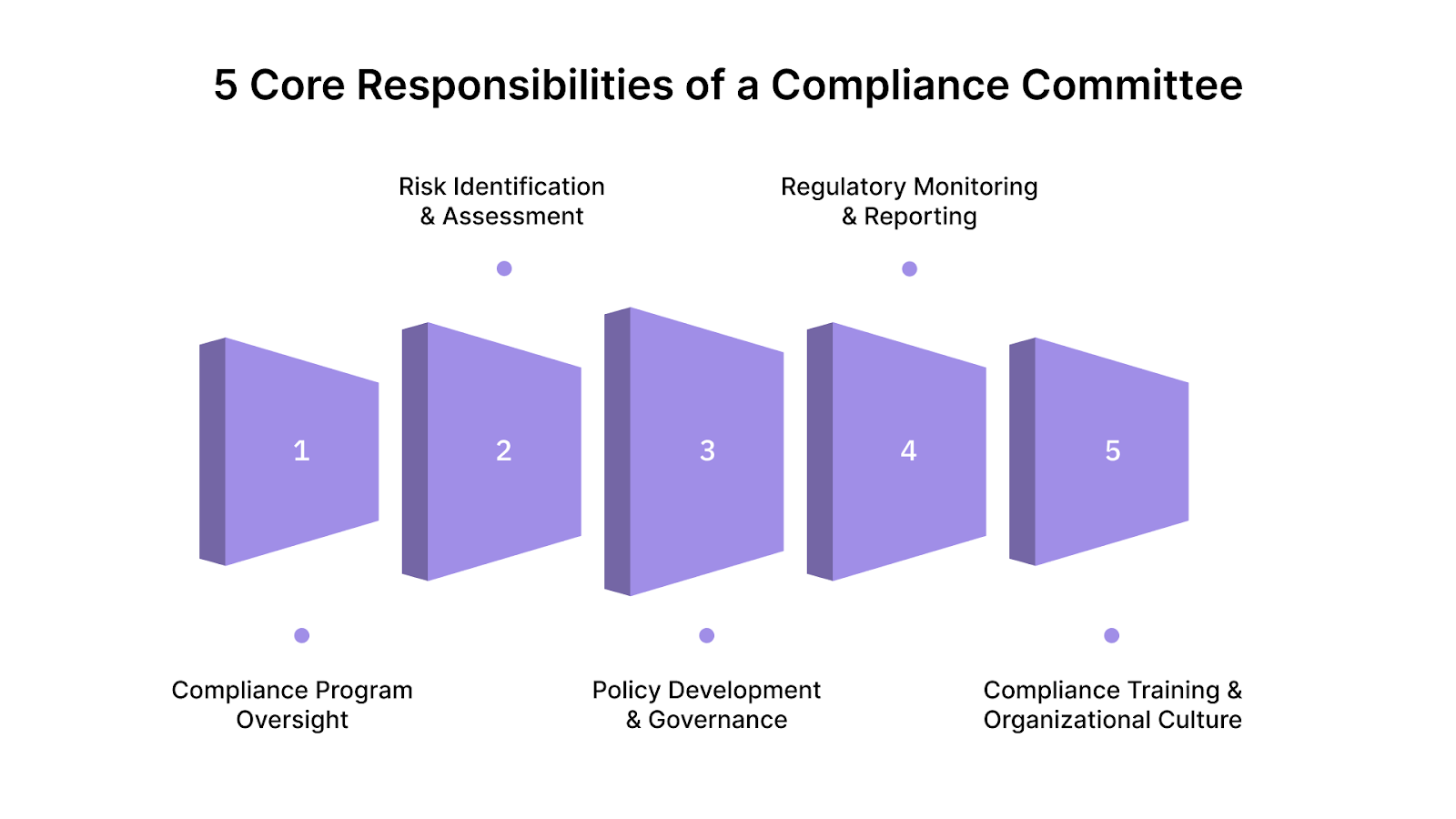
1. Compliance Program Oversight
The committee evaluates whether the organization’s compliance program is functioning effectively. This includes reviewing policies, internal controls, reporting mechanisms, and investigation procedures.
Members may review compliance metrics such as policy violations, regulatory inquiries, or audit findings to assess whether improvements are needed.
2. Risk Identification and Assessment
A major responsibility of the committee is identifying emerging regulatory risks. Leaders from different departments provide insights into operational activities that may create compliance exposure.
For example, fintech companies may review risks related to anti-money laundering monitoring, cross-border transactions, or digital identity verification processes.
3. Policy Development and Governance
Compliance committees help guide the development and approval of internal policies. These policies establish how employees handle regulatory obligations, data protection, financial reporting, and ethical conduct.
The committee ensures policies remain aligned with evolving regulations and operational realities.
4. Regulatory Monitoring and Reporting
Regulatory expectations change frequently. The committee monitors updates from regulators, assesses how those changes affect the organization, and determines what actions are required.
Members may also oversee regulatory reporting processes, ensuring required filings or disclosures are completed accurately and on time.
5. Compliance Training and Organizational Culture
Beyond policy oversight, committees promote a culture of accountability. They often review training programs, evaluate employee awareness of compliance obligations, and ensure departments follow ethical standards.
Organizations looking to strengthen compliance governance often work with providers like Fraxtional, who offer fractional compliance leadership to support oversight, risk management, and regulatory readiness.
Fraxtional partners with fintech companies, financial institutions, and regulated organizations to build robust, regulator-ready compliance frameworks backed by experienced leadership.
A strong compliance culture reduces the likelihood of regulatory violations and strengthens organizational credibility.
To manage these responsibilities effectively, compliance committees must operate within a structured governance framework.
How a Compliance Committee Typically Operates
Compliance committees usually follow a structured governance process that allows leadership to review risks consistently and make informed decisions.
1. Meeting Structure
Most organizations schedule compliance committee meetings on a quarterly or monthly basis, depending on the complexity of their regulatory obligations. Meetings often follow a structured agenda designed to review risk updates and compliance program performance.
Regular meetings ensure that growing issues are discussed promptly and that leadership maintains continuous oversight of compliance activities.
2. Agenda Topics
Typical committee agendas include regulatory updates, internal audit findings, compliance incident reports, and updates on risk mitigation initiatives.
Committee members may also review performance metrics related to compliance programs, such as training completion rates, investigation outcomes, or regulatory reporting accuracy.
3. Reporting and Governance Relationships
The compliance committee often reports findings and recommendations to executive leadership or board-level governance bodies such as the audit committee or risk committee.
This reporting structure ensures that senior leadership and board members remain informed about compliance risks and the effectiveness of internal controls.
Understanding how compliance committees operate becomes even more important when examining their role in highly regulated financial sectors.
How Fintech and Financial Institutions Use Compliance Committees

Fintech companies, payment platforms, and digital banks operate in heavily regulated environments where compliance risks evolve quickly. Regulatory expectations often span multiple jurisdictions, licensing frameworks, and financial crime regulations, making centralized oversight essential.
A compliance committee helps leadership maintain visibility across regulatory areas that affect financial operations. In financial services organizations, the committee often reviews and oversees:
- Anti-Money Laundering (AML) oversight: Monitoring suspicious activity reporting, transaction monitoring systems, and customer risk scoring frameworks.
- Financial crime controls: Reviewing internal controls related to fraud detection, sanctions screening, and transaction monitoring programs.
- Customer due diligence processes: Ensuring Know Your Customer (KYC) procedures and onboarding controls align with regulatory expectations.
- Regulatory licensing obligations: Monitoring compliance with money transmitter licenses, payment institution regulations, or banking supervisory requirements.
- Third-party and partner oversight: Reviewing compliance risks related to fintech partnerships, vendor integrations, and service providers.
Compliance committees also play an important role in sponsor bank relationships. Many fintech platforms rely on banking partners to provide regulated financial infrastructure, and sponsor banks expect strong governance around AML controls, operational risk management, and regulatory reporting.
As fintech companies scale transaction volume, expand internationally, or introduce new financial products, compliance committees help leadership review regulatory implications before operational decisions are implemented.
Understanding how these committees operate in regulated financial environments makes it easier to see how organizations can build an effective compliance committee from the ground up.
How to Build an Effective Compliance Committee
Creating a compliance committee requires more than selecting a group of executives. The committee must operate with a clear mission, defined responsibilities, and consistent governance practices.
1. Define the Committee’s Mission
The organization should clearly define the committee’s purpose. Most committees exist to support the compliance officer, oversee compliance program performance, and provide leadership guidance on regulatory risk.
This mission should be documented within governance policies or committee charters.
2. Select Cross-Functional Leadership
Members should represent departments where compliance risks originate. Typical representation includes legal, compliance, finance, technology, internal audit, and operations leadership.
The goal is to ensure that regulatory issues affecting different areas of the business are addressed collaboratively.
3. Establish Governance Structure
The committee should have a defined chairperson, reporting process, and meeting schedule. Governance structures often specify how issues are escalated to executive leadership or board committees.
Clear governance improves accountability and ensures compliance concerns receive leadership attention.
4. Implement Monitoring and Reporting Processes
Committees should review compliance metrics regularly, including policy violations, audit findings, and regulatory developments. Monitoring systems allow leadership to track how effectively compliance programs operate.
These practices help organizations maintain visibility into regulatory risks while strengthening internal accountability.
Even with a well-structured governance model, some organizations still need experienced leadership to guide compliance strategy.
How Fraxtional Helps Organizations Strengthen Compliance Governance?
Rather than relying on fragmented advisory or overextending internal teams, organizations work with Fraxtional to embed senior compliance expertise directly into their operations. This ensures that governance structures are not only designed correctly but also actively managed, tested, and aligned with evolving regulatory expectations.
Fraxtional’s fractional model gives companies access to seasoned compliance and risk executives, without the cost and delay of hiring full-time leadership, while maintaining the depth required to operate in highly regulated environments.
Fraxtional supports organizations through services such as:
- Fractional Chief Compliance Officer (CCO): Provides executive-level compliance leadership to guide regulatory strategy, oversee compliance programs, and support governance structures like compliance committees.
- Fractional Chief Risk Officer (CRO): Helps organizations identify operational and regulatory risks while developing risk management frameworks that align with regulatory expectations.
- AML and Financial Crime Compliance Support: Assists companies in building anti-money laundering programs, transaction monitoring frameworks, and regulatory reporting processes.
- Compliance Framework Development: Supports the creation of policies, procedures, and internal controls that help organizations meet regulatory and operational compliance requirements.
- Regulatory Licensing and Readiness Support: Helps fintech companies prepare for licensing processes, regulatory reviews, and compliance audits.
- SOC 2 Compliance and Audit Preparation: Assists organizations in building controls and documentation required for SOC 2 Type I and Type II readiness.
Strong compliance governance requires both structured oversight and experienced leadership. With the right governance model and expert guidance, organizations can manage regulatory obligations while continuing to grow.
Wrapping Up
A compliance committee brings structure to regulatory oversight by involving leaders from legal, finance, technology, and operations. This governance model helps organizations identify compliance risks early, monitor regulatory obligations, and maintain accountability across departments.
Fraxtional provides fractional compliance and risk leadership to fintech companies and financial institutions that need experienced oversight without hiring full-time executives. Their experts help organizations strengthen compliance frameworks and governance structures.
If your organization needs experienced compliance leadership to support regulatory oversight, contact today to explore how Fraxtional can help.
FAQs
Not every organization is legally required to establish a compliance committee. However, regulators often recommend governance structures that support compliance oversight. In regulated sectors like financial services or healthcare, committees are commonly used to demonstrate strong compliance governance.
The size of a compliance committee depends on the organization’s structure and regulatory exposure. Most companies keep committees between 3 and 7 members to maintain effective discussions while ensuring key departments are represented.
A compliance committee focuses on regulatory obligations, ethics programs, and policy oversight. An audit committee primarily oversees financial reporting, internal controls, and external audits. In many organizations, the two committees coordinate closely but serve different governance functions.
Members should have decision-making authority and operational insight within the departments they represent. Leaders with experience in legal, finance, risk management, technology, or internal controls are commonly selected to ensure informed compliance discussions.
Most committees operate under a committee charter that defines responsibilities, reporting structure, and meeting frequency. The committee may also rely on risk assessments, compliance program reports, and internal audit findings to guide discussions.
blogs
Don’t miss these



Let’s Get Started
Ready to Strengthen Your Compliance Program?
Take the next step towards expert compliance solutions. Connect with us today.