

Feb 13, 2026
High-Risk Customers in 2026: Managing Risk Without Losing Growth

By Fraxtional LLC

Summarize the blog with AI
Every compliance leader, fintech founder, or sponsor bank executive knows this moment: a customer clears onboarding, and weeks later, risk alerts, bank questions, or regulatory scrutiny surface. What looked like a routine approval suddenly becomes a governance problem.
This is a daily reality for growth-stage fintechs and crypto firms. You are expected to scale quickly while applying bank-grade risk controls, often without large compliance teams or mature monitoring infrastructure. When high-risk customers are identified too late, the consequences are immediate, strained sponsor bank relationships, audit pressure, and stalled growth.
Managing high-risk customers in 2026 is about early identification, clear documentation, and applying controls that regulators and bank partners trust, without slowing growth. In this blog, we will explore how you can identify and manage high-risk customers with clarity and confidence.
Key Takeaways
- High-risk customers pose operational, regulatory, and reputational challenges that can stall growth if not proactively identified.
- Categorizing customers by geography, ownership, transactions, industry, and political exposure enables targeted monitoring and escalation.
- Risk signals appear both at onboarding and during ongoing activity, making continuous reassessment essential.
- Strategic controls, tiered due diligence, and governance frameworks ensure scalable, compliant risk management.
- Fraxtional provides senior compliance leadership and regulator credibility, helping companies manage high-risk customers confidently without full-time overhead.
What Defines a High-Risk Customer

Think of a high-risk customer as someone whose profile and behavior raise red flags long before a regulator, bank partner, or investor does. These are real people or entities whose characteristics make your risk-based controls trigger deeper scrutiny, slower scaling, and harder sponsor bank approvals.
In everyday operations, a “high-risk” tag means you can’t just onboard and forget. You must apply enhanced scrutiny, constant monitoring, and defensible documentation that stands up to regulator exams and investor due diligence.
High-risk customers typically share one or more of the following traits:
- A customer profile that is likely to be involved in money laundering, terrorist financing, or fraud
- Opaque ownership structures that make beneficial owners hard to verify
- Geographic exposure to jurisdictions with weak enforcement or high regulatory scrutiny
- Parties with political influence or public office connections that imply corruption risk
Also Read: Top Risk Assessment Methodologies and Practices Guide
Understanding who qualifies as high-risk is only the starting point; the downstream impact is where the real exposure lies.
Why High-Risk Customers Create Disproportionate Business Risk
High-risk customers test the strength of your governance, strain sponsor bank relationships, and become focal points in regulatory reviews that can slow or stall growth. When leadership misclassifies or under-manages these customers, the consequences ripple through operations, partnerships, and investor confidence.
Below are the major ways this disproportionate risk shows up in your business and strategic outcomes:
- Regulatory Enforcement Exposure: Poor handling of high-risk customer profiles can prompt intense regulatory scrutiny, enforcement actions, and corrective mandates that consume executive attention and resources.
- Sponsor Bank Relationship Strain: Sponsor banks facing heightened regulatory oversight or historical compliance lapses may restrict, reprice, or terminate partnerships with fintech or integrated partners due to high-risk customer exposures.
- Escalating Compliance Burden: High-risk customer profiles drive enhanced due diligence, monitoring, and documentation requirements that scale non-linearly with risk, increasing operational cost and structural complexity.
- Reputational Risk for Leadership: Associations with poorly managed high-risk clients can quickly erode trust among investors, partners, and regulators, weakening strategic credibility and long-term valuations.
The impact of high-risk customers follows clear patterns. Those patterns map directly to the customer categories most likely to trigger enhanced scrutiny.
The 5 Most Common High-Risk Customer Categories
In high-risk customer management, categorization matters because it determines the level of scrutiny, escalation, and strategic judgment required before you onboard or continue a relationship.
Below are the key categories that consistently require heightened risk ownership and management:
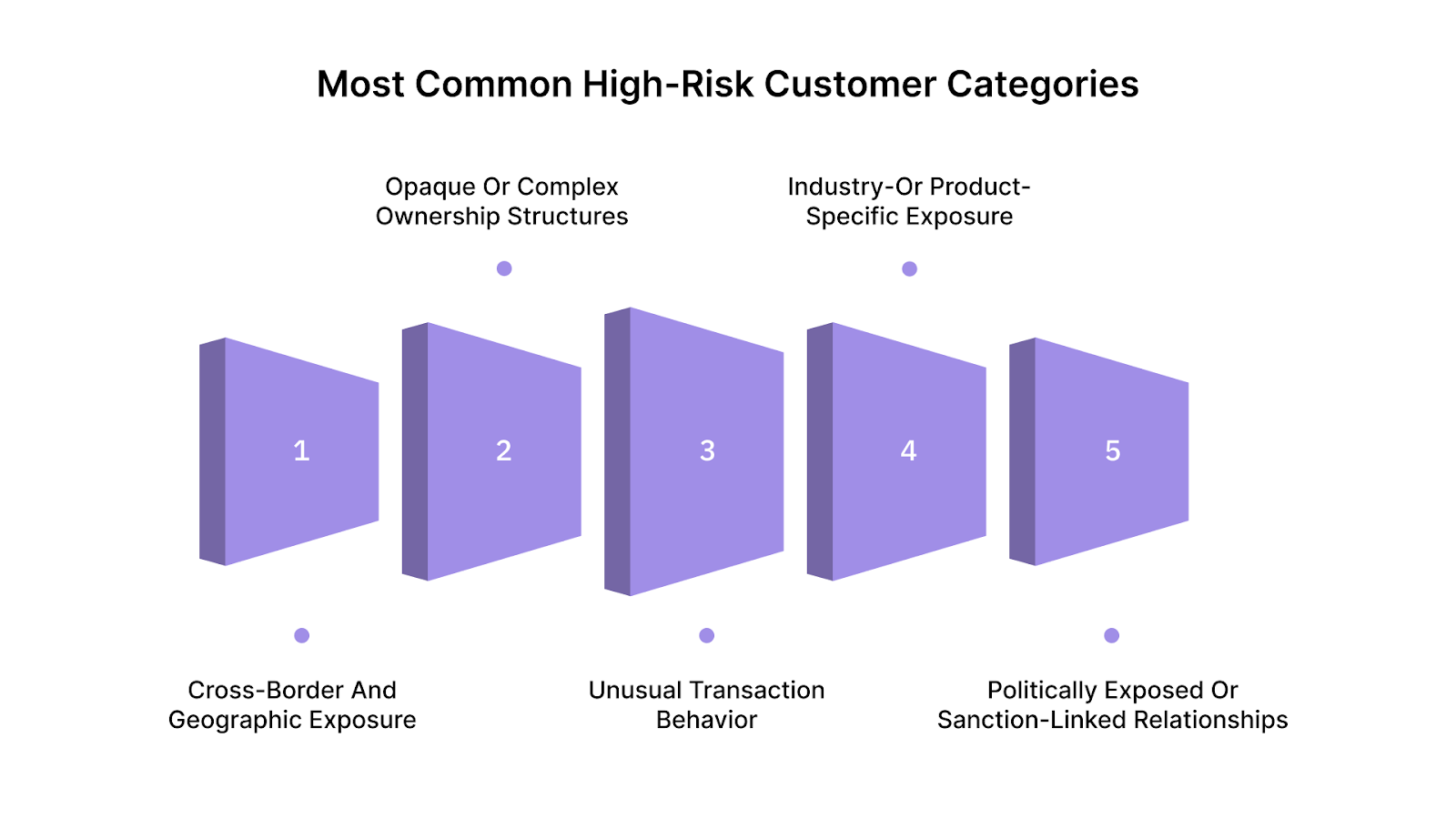
- Cross-Border and Geographic Exposure: Customers operating or residing in jurisdictions with weak enforcement, sanctions concerns, or regulatory opacity create added compliance complexity and oversight burdens from partners and regulators.
- Opaque or Complex Ownership Structures: Entities with layered ownership, nominee shareholders, or unclear beneficial owners increase risk because they challenge your ability to verify identities and monitor ongoing behavior.
- Unusual Transaction Behavior: Patterns such as rapid spikes in activity, atypical volumes, or inconsistent transaction types indicate increased risk requiring elevated monitoring and verification.
- Industry-or Product-Specific Exposure: Certain industries and emerging products, including virtual asset services and cash-intensive segments, inherently pose greater compliance and operational scrutiny demands.
- Politically Exposed or Sanction-Linked Relationships: Individuals or entities with significant political influence, public office history, or connections to sanctioned parties trigger both regulatory and partner bank risk thresholds.
Knowing the categories is only the first step. The real challenge is identifying these customers early and consistently.
How Do Companies Identify High-Risk Customers in Practice

Effective high-risk customer management starts with actionable signals, not checklists. Across regulated businesses and banks, risk teams understand a mix of structured criteria and behavioral patterns to catch risk early, whether at onboarding or throughout the customer lifecycle.
Below are the practical indicators decision makers actually use to flag customers for higher scrutiny:
1. Risk Signals Identified During Onboarding
Below are the key signals flagged before a relationship begins:
- Inconsistent or Incomplete Identity Verification: Gaps in verifying identity, beneficial ownership, or legal status during onboarding are major early warning signs.
- Sanctions, Watchlist, or PEP Match Alerts: Matches against global sanctions lists, political exposure, or adverse media increase risk classification before account activation.
- Unverified Source of Funds or Wealth Narratives: Customers unable (or unwilling) to provide credible documentation about the origins of funds or wealth often require Enhanced Due Diligence before approval.
- Discrepancies in Business Information: Conflict between registration data, operational history, and stated business purpose signals elevated review requirements.
2. Risk Signals Identified Through Ongoing Activity
Below are indicators that emerge after onboarding:
- Sudden or Unusual Transaction Patterns: Persistently atypical transaction behavior compared to the customer’s profile can trigger escalated monitoring and reassessment.
- Changes in Beneficial Ownership or Control Structure: Significant corporate or ownership shifts warrant renewed risk classification and deeper investigation.
- Repeated External Alerts and Screening Matches: Regular hits on updated sanctions, watchlists, or adverse media during monitoring cycles indicate rising risk that must be actioned.
These signals guide companies in allocating enhanced scrutiny, governance escalation, and periodic re-evaluation of risk profiles rather than treating compliance as static paperwork.
High-risk customers can quietly strain your sponsor bank relationships and operational resources. Fraxtional integrates senior compliance leadership to guide risk decisions confidently. Partner with us today to strengthen your controls and reduce exposure.
Even strong identification frameworks miss subtle signals that later surface as serious risk, especially during audits or bank reviews.
The 5 Most Overlooked Red Flags Risk Teams Miss
Even the most well-structured risk programs can fail if operational teams overlook subtle indicators hidden in customer data and behavior. Below are the red flags that frequently escape attention but have real consequences for regulated businesses and risk leaders:
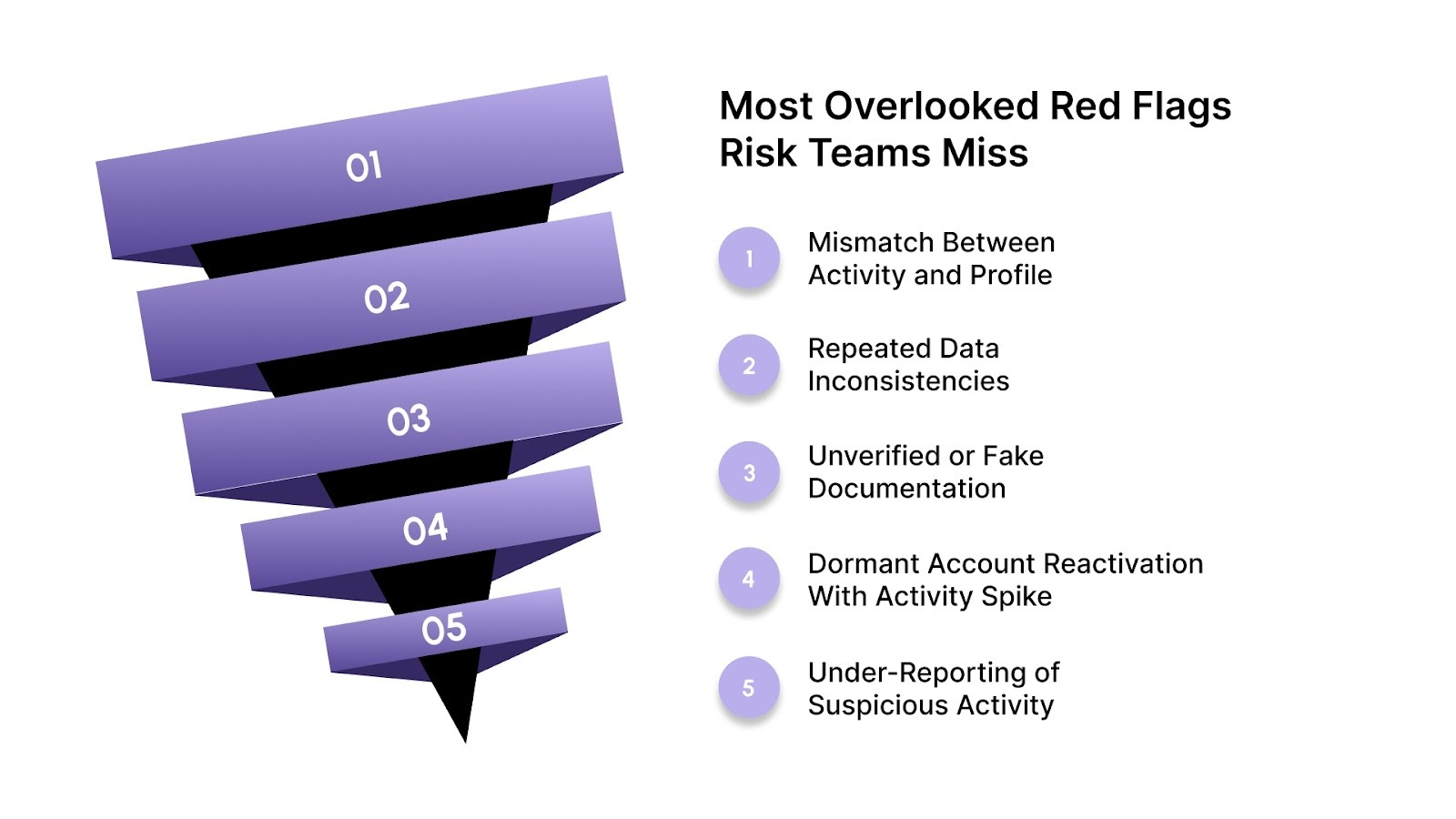
- Mismatch Between Activity and Profile: Customers whose transactional activity diverges sharply from their stated business model or risk score often slip past static rule sets, masking emerging risk exposure.
- Repeated Data Inconsistencies: Small discrepancies in identity information that recur across systems or documents signal deeper verification gaps and can undermine onboarding defensibility.
- Unverified or Fake Documentation: Clients who provide unverifiable, inconsistent, or clearly altered documents sometimes bypass early checks yet represent a foundational compliance risk.
- Dormant Account Reactivation With Activity Spike: Accounts that have been dormant for long periods and suddenly show unusual activity often indicate layering tactics rather than legitimate engagement.
- Under-Reporting of Suspicious Activity: When internal Suspicious Activity Reports (SARs) are unusually low relative to the volume or type of flagged behavior, it often reflects detection gaps rather than a lack of risk.
Also Read: Top ERM Frameworks to Strengthen Risk Management in 2026
Identifying red flags is ineffective unless customer risk ratings directly drive due diligence depth and escalation decisions.
How Customer Risk Rating and Due Diligence Should Work Together
Customer risk rating is the foundation that shapes how due diligence is applied, escalated, and documented over the course of a relationship. When risk scoring and due diligence are integrated consistently, the result is a defensible, transparent, and audit-ready compliance posture that regulators and investors can trust.
Below are the essential ways these elements must connect:
- Consistent Risk Classification Framework: A repeatable, documented methodology ensures every customer receives a risk score based on defined risk factors (e.g., geography, entity type, behavior) that directly determines the level of due diligence applied throughout the customer lifecycle.
- Due Diligence Proportional to Assigned Risk: Risk ratings guide which due diligence tier applies, simplified for low risk, standard for moderate, and enhanced for high-risk, ensuring effort and scrutiny match the profile rather than arbitrary checklists.
- Escalation and Monitoring Triggers: Changes in customer activity or new information should prompt automatic reassessment of risk scores and corresponding due diligence actions, maintaining accuracy over time.
- Defensible Documentation and Audit Trails: Every risk score, corresponding due diligence decision, and review action must be recorded with clear rationale and approvals, creating a comprehensive audit trail for exams or investment due diligence.
When risk ratings and due diligence align, organizations can apply scalable strategies that manage high-risk customers without stalling growth.
Key Strategies for Managing High-Risk Customers at Scale

Managing high-risk customers at scale isn’t about ticking compliance boxes; it’s about building defensible, repeatable, and governance-aligned risk controls that keep your business agile and regulator-ready.
Below are the key strategic approaches that operators integrate in their risk management frameworks:
- Establish a Risk-Based Governance Framework: Define clear roles, escalation pathways, and accountability at executive and board levels for decisions involving high-risk customers.
- Apply Proportionate Enhanced Due Diligence: Use tiered due diligence that scales with assessed risk. High-risk profiles require documented, deeper investigation, senior approval, and stricter ongoing monitoring to align controls with exposure.
- Implement Continuous Monitoring and Reassessment: Treat risk scoring and monitoring as dynamic, not static. Regularly re-evaluate risk profiles based on activity patterns, changes in business fundamentals, or new external data.
- Document Decisions and Controls Thoroughly: Maintain comprehensive records of risk ratings, escalation decisions, due diligence steps, and periodic reviews. Audit trails are central to demonstrating defensibility under regulatory or investor scrutiny.
- Set Strategic Transaction and Access Controls: For customers that are retained, deploy structured guardrails like transaction limits, enhanced alerts, and event-triggered reviews to contain exposure without disrupting legitimate activities.
Scalable management strategies also define when risk exceeds tolerance and a controlled customer exit becomes necessary.
When and How to Exit High-Risk Customers Safely
Exiting a high-risk customer relationship is one of the toughest decisions for leadership, and often the most scrutinized by regulators, sponsor banks, and investors.
Below are the structured considerations and steps necessary to exit high-risk customers responsibly:
- Establish Clear Exit Criteria: Define in policy the specific risk thresholds and behaviors that can trigger relationship termination. This ensures objectivity and consistency in decision-making.
- Document Risk Assessment and Rationale: Maintain comprehensive documentation of the customer’s risk profile, reviews, alerts, and justification for exit. This audit trail is crucial for regulatory reviews, sponsor bank calls, and investor due diligence.
- Follow Regulatory and Contractual Requirements: Ensure exit procedures comply with applicable laws and any contractual obligations, including required notice periods or reporting, to avoid legal disputes or regulator pushback.
- Communicate with Transparency and Control: Provide clear, factual communication to the customer while protecting the institution’s risk posture. Avoid ambiguous language that can lead to challenges or misinterpretation.
- Prevent Re-Entry Without Re-Assessment: Put in place controls to prevent automatic re-onboarding of exited entities without a fresh risk assessment process and senior approval.
Exiting or managing high-risk customers without clear oversight creates regulatory and reputational risk. Fraxtional provides experienced leaders to implement defensible escalation and monitoring strategies. Reach out to us to secure governance and make high-stakes customer decisions with confidence.
Also Read: The Ultimate Guide to UBO Compliance for Investors in 2026
Knowing how to exit safely starts with recognizing which types of customers are most likely to fall into high-risk categories.
Who Typically Falls Into the High-Risk Customer Category

Risk teams and compliance leaders must distinguish high-risk customers from ordinary client profiles to ensure appropriate due diligence, monitoring, and escalation.
Below are the key types of customers and entities that commonly fall into high-risk categories:
- Politically Exposed Persons (PEPs) and Associates: Individuals with prominent public roles, their immediate family members, and known close associates often require enhanced review due to corruption and bribery exposure.
- Non-Resident or Cross-Border Customers: Customers domiciled in or operating from jurisdictions with weak enforcement, elevated corruption metrics, or complex regulatory scenes increase risk and monitoring requirements.
- Non-Face-To-Face or Remote Onboarding Profiles: Customers onboarded without in-person verification or enhanced identity checks pose increased verification challenges and require stricter controls.
- Complex Ownership or Shell Structures: Entities with opaque beneficial ownership, layered corporate hierarchies, or shell company characteristics demand deeper due diligence to establish transparency.
- Cash-Intensive or High-Transaction Sectors: Businesses such as money services, precious metal dealers, and high-volume remittances commonly carry elevated transaction risk, requiring enhanced oversight.
- Sanctioned or Adverse-Media Linked Entities: Parties linked to sanctions lists, adverse press, or regulatory watchlists attract elevated risk assessments and compliance actions.
Once high-risk profiles are clear, KYC requirements define how regulators expect institutions to verify, monitor, and manage them.
How KYC Requirements Align With Regulatory Expectations
In the United States, KYC is a legal requirement integrated in foundational AML frameworks like the Bank Secrecy Act (BSA) and FinCEN’s Customer Due Diligence (CDD) Rule. This together mandates rigorous identity verification, beneficial ownership checks, and ongoing customer monitoring as core compliance duties for regulated entities.
Below are the key ways U.S. KYC expectations connect with national and global regulatory standards:
- U.S. AML Frameworks Require Structured KYC: Institutions must implement CIPs, verify beneficial ownership, and conduct ongoing monitoring aligned to evolving risk.
- Risk-Based Due Diligence Is Embedded in U.S. Law: Regulators expect proportionate KYC based on risk, aligning U.S. practices with FATF principles.
- U.S. Ownership Transparency Strengthens KYC: FinCEN’s beneficial ownership registry increases visibility into entity ownership and reinforces high-risk customer controls.
- UK KYC Rules Mirror Risk-Based Standards: UK regulations mandate ongoing, risk-based due diligence enforced by the FCA, with post-Brexit divergence from EU law.
- EU AMLR and AMLA Drive Harmonized KYC: The EU is moving toward centralized supervision and unified KYC, sanctions, and ownership requirements across member states.
Meeting KYC expectations is necessary, but strong risk decisions depend on experienced compliance leadership overseeing how those requirements are applied.
How Fraxtional Compliance Leadership Improves Risk Decisions

Without named leadership strengthened to make defensible risk calls, companies often face prolonged audits, sponsor bank hesitation, and investor concerns that stall growth.
Fraxtional integrates experienced fractional C-suite risk and compliance leaders directly into your organization, giving you the strategic oversight needed to manage this complexity without committing to full-time executive overhead.
Below are the core ways Fraxtional helps you manage high-risk customer decisions with confidence:
- Escalation Authority and Governance Ownership: Fraxtional’s leaders act as named compliance executives, such as CCOs, CROs, and CAMLOs, with documented responsibility and escalation rights that regulators and partners expect.
- Regulator Credibility Through Expertise: Directors with deep experience in risk and compliance guide decision-making and represent your position directly with regulators, strengthening your audit posture and reducing exam friction.
- Bank-Facing Confidence and Partnership Support: Fraxtional leaders support sponsor bank interactions by preparing risk profiles, responding to due diligence requests, and articulating defensible governance frameworks, improving partner trust.
- Strategic Oversight Without Full-Time Overhead: You receive senior decision leadership tailored to your stage, from onboarding high-risk customers through lifecycle management, without the cost and commitment of permanent executive hires.
Also Read: What Is an Interim Executive? Roles, Value, and When to Use One
Taken together, these elements show why high-risk customer management succeeds only when leadership, governance, and execution align.
Conclusion
High-risk customers are not an exception in regulated businesses; they are an inevitability as you scale into new markets, products, and customer segments. The real differentiator is how early you recognize risk, how consistently you rate it, and how decisively you act when exposure outweighs value.
This is where Fraxtional plays a critical role. Fraxtional integrates senior compliance and risk leadership into your organization, helping you make high-stakes customer decisions with regulator credibility, sponsor bank confidence, and executive-level accountability, without the burden of full-time overhead.
If you are evaluating how to strengthen your approach to high-risk customers, speak with Fraxtional to assess your current risk posture and define the right next steps for your business.
FAQs
High-risk customers require frequent reviews, often at least annually, with more frequent checks triggered by risk-relevant events like new adverse media, sanctions updates, or unusual transactions.
Yes. High-risk customers can be onboarded provided you perform enhanced due diligence, document decision rationale, and implement monitoring and controls proportional to risk. The goal is defensible risk acceptance, not blanket denial.
Dynamic risk rating updates a customer’s risk score based on real-time behavior and events, for example, updated sanctions lists or transaction anomalies, rather than a fixed periodic review. This makes risk assessments more current and actionable.
Onboarding risk checks establish a baseline profile, while ongoing monitoring continuously evaluates customer activity against behavior and risk thresholds. Significant deviations or new signals trigger reassessment, escalation, or action.
Regulators expect reporting of suspicious activity and escalation of high-risk profiles. Compliance functions must document escalation criteria, supporting evidence, and actions taken, ensuring transparency to regulators and auditors.
blogs
Don’t miss these



Let’s Get Started
Ready to Strengthen Your Compliance Program?
Take the next step towards expert compliance solutions. Connect with us today.