

Feb 13, 2026
ORM Process in 2026: How Leaders See Operational Risk

By Fraxtional LLC

Summarize the blog with AI
Most leaders only realize their operational risk gaps after a late-night wake-up call, a missed transaction, a vendor outage, or a regulatory escalation that could have been prevented. You’ve built systems to scale, yet it’s often the hidden everyday breakdowns in processes, people decisions, or technology handoffs that trip up growth plans, audits, and investor confidence.
For U.S. banks and fintechs alike, operational risk shows up in measurable financial impact and workday stress. A 2025 study of large U.S. bank holding companies finds that institutions with faster growth and heavier tech investment tend to see higher operational loss rates per dollar of assets. This highlights how innovation and speed can unintentionally elevate risk if not managed structurally.
In this blog, we will explain what the ORM process really is, why it matters, how it works, and how smart leaders operationalize it to strengthen resilience without slowing execution.
Key Takeaways
- The ORM process helps leaders identify and manage everyday operational risks that impact growth, audits, and regulatory outcomes.
- Fast-scaling FinTechs, banks, and crypto firms face heightened scrutiny from regulators, sponsor banks, and investors, making proactive ORM critical.
- Effective ORM is structured around seven stages: risk identification, assessment, prioritization, control design, monitoring, incident management, and continuous improvement.
- Common ORM pitfalls include over-engineering, fragmented ownership, manual processes, and focusing on audits over operations; these slow resilience and risk response.
- Fraxtional provides experienced risk leadership that integrates into organizations, strengthening ORM, regulatory readiness, and partner confidence without full-time executive costs.
What Is the ORM Process and Why It Matters Today

Operational risk shows up in small, unglamorous moments you deal with daily. A missed handoff. A vendor issue. A process no one owns. The ORM process exists to stop those moments from becoming headlines.
So what does “operational risk” actually mean in business terms? It is the risk of loss, disruption, or regulatory trouble caused by how your company actually runs. Not market swings. Not credit defaults. Day-to-day execution is failing under real pressure.
At its core, the ORM process includes:
- Identifying where your operations can realistically break
- Assessing which failures matter most to customers, regulators, and partners
- Designing controls that match your scale and risk appetite
- Monitoring issues before they turn into incidents
- Learning from failures and tightening the system continuously
Why ORM is now a board-level concern:
- Growth multiplies operational complexity faster than teams expect
- Sponsor banks demand evidence of mature risk ownership
- Regulators expect accountability, not reactive fixes
- Investors view weak ORM as a valuation and diligence risk
The ORM process is a leadership system that helps you make better decisions, set clearer ownership, and run a business that holds up under scrutiny.
Suggested Read: How Fractional Leadership Has Reshaped Private Equity Operations
Seeing why ORM is now critical makes it easier to appreciate how the process has changed across regulated industries over time.
A Brief History of the ORM Process in Regulated Industries

Operational risk wasn’t always a boardroom topic; it was once an undefined “other risk” that regulators and risk leaders gradually formalized as oversight became more sophisticated and financial systems more complex.
Here’s how ORM changed in regulated industries:
- From Residual Risk to Regulatory Focus: Operational risk began as a catch-all category for unquantified business risk, but regulators crystallized it into a formal category as part of the Basel II framework to reflect losses from failed processes, people, systems, or external events.
- Basel Frameworks Shaped ORM Precision: While the original Basel I Accord focused on capital adequacy for credit risk, Basel II elevated operational risk, requiring banks to explicitly measure and manage it.
- Post-Crisis Evolution: Major disruptions and crises exposed gaps in traditional risk models, prompting regulators to emphasize proactive risk governance and supervisory review beyond simple loss tracking.
- New Era For Fintech And Crypto: Operational risk today includes technology, third-party, and process dependencies unique to digital financial services, demanding continuous anticipation and control rather than reactive responses.
This evolution reflects how operational risk management has shifted from back-office housekeeping to a strategic leadership discipline.
Also Read: How to Use a Gap Assessment Template Reviewers Actually Expect
Now, let’s break down the core stages that structure this ongoing practice.
The 7 Core Stages of the ORM Process
The ORM process isn’t a checklist or annual review; it’s a structured sequence of leadership-driven activities that turn risk awareness into better business decisions and stronger resilience. Each stage exists to protect operations and support growth.
Here are the seven core stages and why they matter to your business:
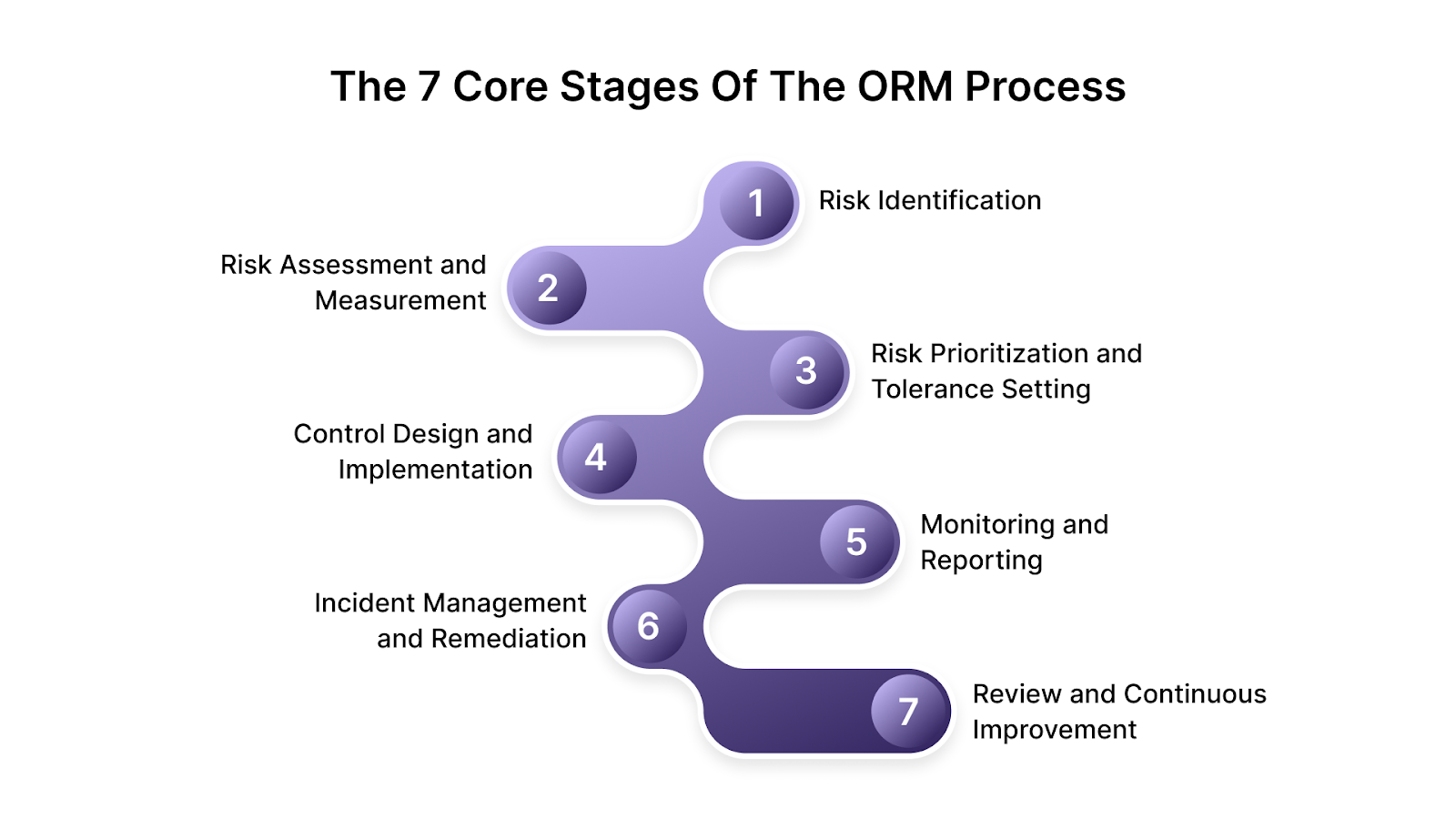
1. Risk Identification
Purpose: To know what keeps you awake at night before it becomes a headline.
This stage surfaces the real operational threats, from system failures and process gaps to people and third-party dependencies, so you can see what you’re truly exposed to instead of guessing. It shapes where your attention and resources must go first.
2. Risk Assessment and Measurement
Purpose: To distinguish the red flags from the noise.
Not all risks carry the same weight. Risk assessment and measurement help you understand how likely a risk is and how severe its impact could be, so decision-makers spend time where it counts.
3. Risk Prioritization and Tolerance Setting
Purpose: To decide what matters now and what can wait.
This stage lets leadership articulate risk tolerance, what losses are acceptable in pursuit of strategic goals, and focus engineering, process, and compliance efforts accordingly. It’s a business-driven filter.
4. Control Design and Implementation
Purpose: To reduce the likelihood or impact of bad outcomes.
Here you build the decision-enabling safeguards, from processes and policies to automated controls, that shape how teams act daily and prevent predictable failures.
5. Monitoring and Reporting
Purpose: To stay informed as risks change.
Risk isn’t static. Ongoing dashboards, key risk indicators (KRIs), and reporting up the chain give insight into trends and emerging threats so leadership isn’t blindsided.
6. Incident Management and Remediation
Purpose: To react purposefully when something goes wrong.
Good ORM accepts that failures happen. What matters is how quickly you detect, diagnose, and remediate issues so operations stay intact, and learning happens fast.
7. Review and Continuous Improvement
Purpose: To make your ORM process smarter with every cycle.
After controls are in place and incidents handled, leaders revisit assumptions, results, and controls to refine the system, not once, but continuously.
Also Read: What Is Risk and Control Self-Assessment? Framework and Execution
With these stages in mind, the next challenge is recognizing the practical hurdles that slow ORM progress and how best-in-class organizations overcome them.
Common ORM Process Challenges Leaders Face at Scale
When you’re sprinting to scale and win, ORM often becomes one of the first casualties, not because leaders don’t care, but because resource tension, unclear ownership, and manual habits get in the way of real resilience.
Here are the real ORM hurdles smart operators encounter:
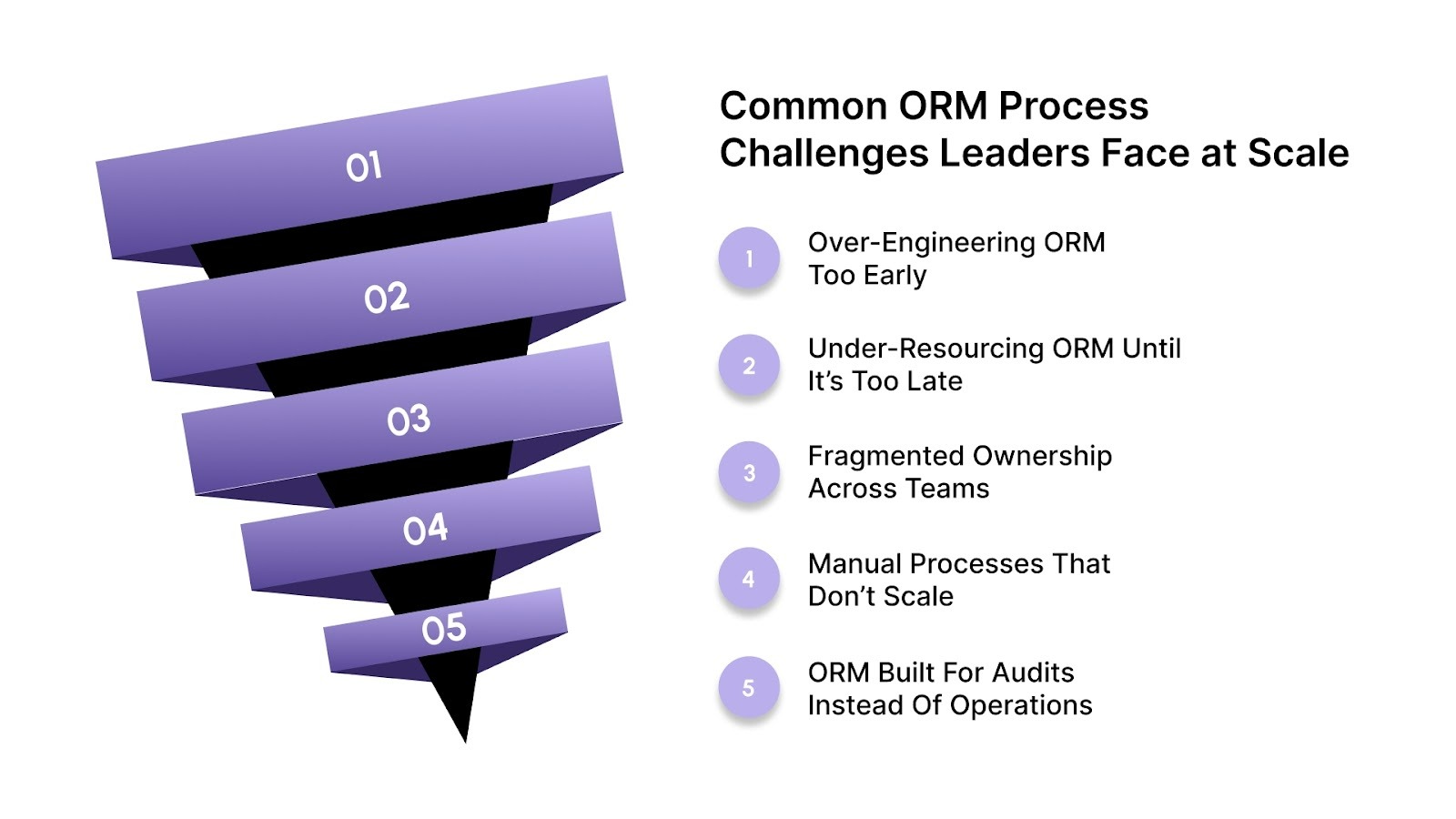
- Over-Engineering ORM Too Early: It’s tempting to build perfect frameworks before you’ve fully defined your risk scenario. But too much structure too soon slows execution and frames ORM as bureaucracy instead of a business enabler. Effective ORM should change with strategy and scale, not operate in isolation.
- Under-Resourcing ORM Until It’s Too Late: Risk management often gets minimal attention until an incident or audit fails. Waiting for failure means your team is responding, not preventing, and that reactive stance quickly erodes confidence from partners and investors.
- Fragmented Ownership Across Teams: When no one owns risk end-to-end, issues fall through the cracks. Risk becomes “someone else’s job,” and no one feels accountable for outcomes, a common problem in fast-growing fintechs where functions scale unevenly.
- Manual Processes That Don’t Scale: Spreadsheets and tribal knowledge work for early stages but break under volume and complexity. Manual ORM often means disconnected data, inconsistent practices, and slow or missed signals.
- ORM Built For Audits Instead Of Operations: Some teams focus ORM efforts on “looking good” for audits rather than strengthening daily execution. That disconnect turns ORM into a compliance exercise instead of a true operational control mechanism.
If your growth is outpacing your operational controls and partner scrutiny is increasing, Fraxtional’s risk leadership can help you stabilize ORM before audits, regulators, or sponsor banks force the issue. Reach out to us to assess where your risk posture stands today.
Next, we’ll explore the ORM frameworks used by regulated companies today.
ORM Frameworks Used by Regulated Companies Today

Regulated firms don’t wing operational risk; they adopt structured frameworks that help them manage risks with discipline and consistency. These frameworks guide judgment, not replace it, and are chosen with strategy and context in mind.
Here’s how ORM frameworks are used:
- Basel Operational Risk Framework: Banks often anchor ORM around Basel Committee guidelines that define how risk is measured, monitored, and capitalized for operational disruptions. These methods range from standardized formulas to advanced internal models approved by regulators, giving structure to measurement and accountability.
- Principles-Based Risk Standards (like ISO 31000): Many firms layer in principles such as those from ISO 31000 to align risk leadership and culture, integrating governance and continuous improvement into operations instead of just ticking boxes.
- Tailored ORM Frameworks: Leading organizations don’t adopt frameworks blindly; they adapt them to fit size, complexity, and risk profile, ensuring that risk activities truly support their business model and regulatory expectations rather than just piling on documentation.
With these frameworks in mind, let’s look at real examples that show how ORM plays out day to day.
Practical Examples of the ORM Process in Action
Operational risk becomes clear when you see it in motion. These real scenarios show how ORM plays out inside regulated businesses, quietly shaping outcomes long before issues reach regulators or boards.
Here’s what ORM looks like:
- Fintech Onboarding and Transaction Risk: ORM flags weak KYC handoffs, manual reviews, or vendor gaps early, preventing transaction backlogs, monitoring failures, and sponsor bank escalations.
- Crypto Custody and Operational Controls: ORM governs access controls, wallet operations, and incident response so custody failures don’t turn into regulatory or reputational crises.
- Sponsor Bank Oversight Expectations: Banks use ORM evidence to assess whether fintech partners can manage outages, fraud spikes, and third-party risk without constant intervention.
- Portfolio Company Risk Reviews For PE Firms: ORM helps investors spot operational fragility during diligence, beyond financials, before it impacts valuation or exit readiness.
Now, let’s have a look at some benefits of a well-designed ORM process.
Benefits of a Well-Designed ORM Process
A strong operational risk management (ORM) process doesn’t just protect you, it enhances confidence in your leadership and unlocks smoother relationships with partners, regulators, and investors.
Here’s how ORM creates real business value:
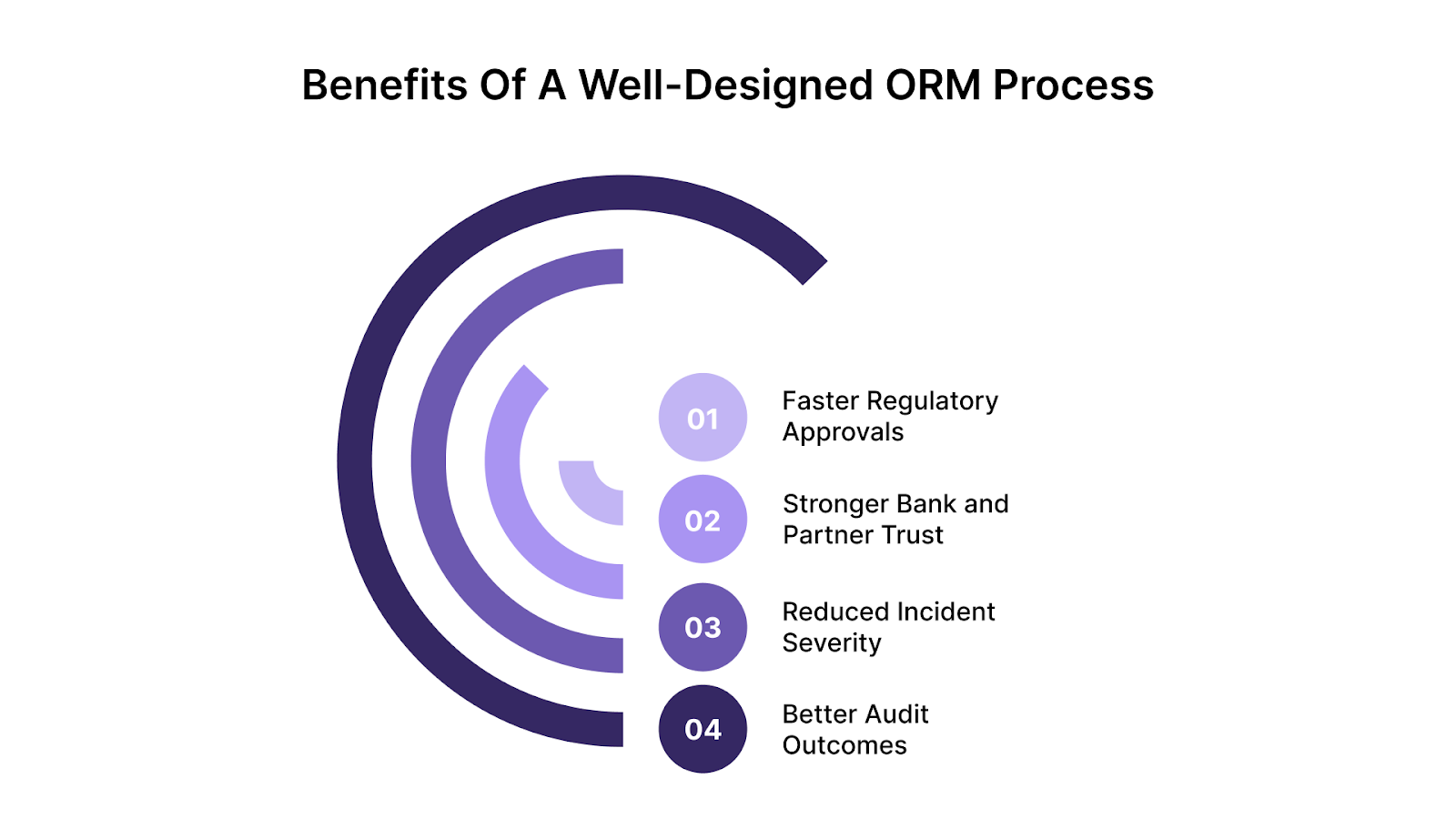
- Faster Regulatory Approvals: When regulators see structured ORM evidence, reviews accelerate because risk controls are documented, monitored, and demonstrably effective. This reduces scope questions and back-and-forth during examinations.
- Stronger Bank and Partner Trust: Effective ORM signals discipline and predictability. Sponsor banks and ecosystem partners prefer working with firms that can show proactive risk governance and consistent operational performance.
- Reduced Incident Severity: ORM identifies weak points before they turn into crises, minimizing outages, compliance slips, and costly remediation, which protects both operations and reputation.
- Better Audit Outcomes: With ORM in place, audits become smoother because controls, monitoring, and reporting align with expectations, and the evidence exists before auditors ask.
Also Read: What Is a Data Governance Policy? A Practical Guide for Regulated Teams
With benefits clear, understanding how to build and scale an effective ORM process becomes the next leadership priority.
How to Develop an ORM Process That Actually Scales: Step by Step
Scaling ORM isn’t about more paperwork; it’s about aligning risk discipline with your business reality. The right process grows with you, enabling leadership to make better decisions, not just check boxes.
Here’s a practical, leadership-friendly guide to building ORM that scales:
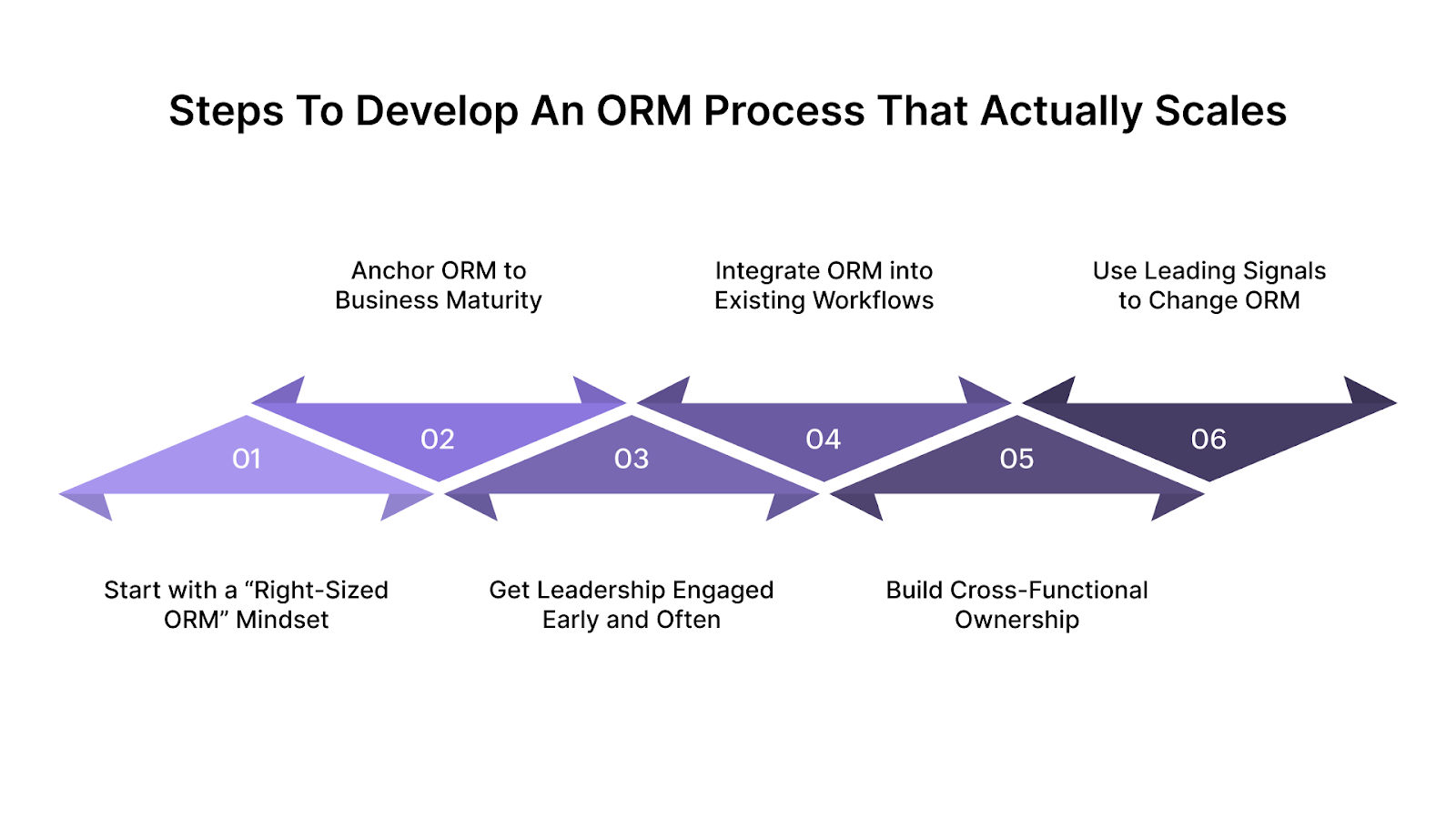
- Start with a “Right-Sized ORM” Mindset: Design ORM to match your stage and complexity, not a giant framework built for bigger firms. Too much too soon creates resistance and delays value. Good ORM supports daily decisions and strategic choices.
- Anchor ORM to Business Maturity: Define risk appetite and processes that reflect how you operate today, and adapt over time. Early stages focus on key processes and controls; later stages add more automation, metrics, and governance loops.
- Get Leadership Engaged Early and Often: ORM succeeds when leaders set tone, allocate resources, and connect risk discussions to strategic trade-offs. Leadership involvement signals operational discipline to partners, regulators, and investors.
- Integrate ORM into Existing Workflows: Rather than siloing risk, integrate identification, assessment, and reporting into product launches, vendor onboarding, and key operational reviews so it becomes part of how you execute.
- Build Cross-Functional Ownership: Assign clear roles across teams so risk doesn’t hide in handoffs. When risk owners exist in operations, engineering, compliance, and finance, visibility and accountability improve.
- Use Leading Signals to Change ORM: Monitor risk indicators, near misses, and industry signals to refine controls and priorities. If incidents rise, controls lag, or partners flag gaps, it’s time to adjust your ORM approach.
When ORM starts breaking under scale, and internal teams lack senior ownership, Fraxtional provides executives who step in with clarity and structure. Partner with us to build an ORM process that scales with your business, not against it.
Now that you have a scalable ORM development path, the next priority is recognizing when ORM must change, not just grow, to stay ahead of emerging risks and external expectations.
When the ORM Process Breaks and What Leaders Miss
Even strong teams hit operational risk blind spots. When ORM breaks, it’s often not a single failure; it’s a pattern of missed signals that leadership could’ve caught earlier with the right governance and visibility.
Here are the breakdowns that often hide in plain sight:
- Early Warning Signs of ORM Failure: Small controlling issues, inconsistent reporting, untracked exceptions, and weak escalation paths are classic early alarms. Left unchecked, these gaps widen until they become operational losses or regulatory scrutiny.
- Why Incidents Often Trace Back to Governance Gaps: Weak governance means unclear ownership, inconsistent decision-making, and delayed corrective action. History shows that when governance fails, controls falter, and teams lack clarity on who is accountable for risk response.
- How Reporting Blind Spots Hide Real Risk: If reporting only shows “issues closed” without context on severity, trends, and root causes, leadership gets a false sense of safety. This disconnect hides escalation triggers and blocks proactive management until an incident forces action.
Understanding these fault lines helps you tighten ORM before small gaps become expensive disruptions.
How Fraxtional Helps Leaders Build Effective ORM Without Overhead

Strong operational risk management needs seasoned leadership, not more tools or temporary consultants. Fraxtional integrates experienced executives into your team so you get strategic risk oversight without the full-time executive cost.
Here’s how Fraxtional supports leaders like you:
- Strategic ORM Leadership: Fraxtional places senior risk and compliance leaders directly within your organization, giving you proactive oversight of operational risk frameworks, governance, and decision-making, without hiring full-time executives.
- Executive Expertise When and How You Need It: Whether you need a Chief Risk Officer, CCO, MLRO, or CAMLO, Fraxtional provides leadership that scales with your business through flexible engagement models.
- Improve Risk Outcomes and Readiness: Experienced leadership helps clarify risk appetite, refine controls, prepare for audits and exams, and strengthen operational resilience, turning ORM into a growth enabler rather than a cost centre.
- Stronger Sponsor Bank and Investor Confidence: With named, proven leaders running your ORM and compliance programs, regulators, sponsor banks, and investors see discipline, accountability, and readiness rather than gaps or uncertainty.
Also Read: Information Security Policies: Importance, Elements, and Key Questions
With the process clear, it’s worth exploring how Fraxtional helps leaders implement ORM effectively without adding unnecessary overhead.
Final Thoughts
A well-designed ORM process is no longer optional for regulated, fast-growing companies. It’s how leaders gain visibility into everyday operational breakdowns, make smarter trade-offs, and prevent small failures from turning into regulatory, financial, or reputational damage as the business scales.
Fraxtional helps FinTechs, banks, crypto firms, and investors build and run ORM processes with senior-level judgment from day one. Through its leadership model, experienced risk and compliance executives can be integrated directly into your organization, bringing clarity, governance, and accountability without the cost or rigidity of full-time hires.
If you want to strengthen your ORM process with experienced leadership, reach out to Fraxtional to speak with a senior risk expert and discuss the right next step for your business.
FAQs
Ultimate responsibility for the ORM process sits with senior leadership and the board. While teams execute day to day, regulators and investors expect clear executive ownership to ensure risks are identified, prioritized, and addressed in line with business strategy.
A well-designed ORM process removes uncertainty from scaling decisions. By identifying operational weak points early, leaders can expand products, partnerships, and geographies with confidence instead of reacting to incidents that disrupt momentum.
The ORM process should be reviewed continuously, with formal reviews at least annually or after major business changes. Product launches, new partners, regulatory shifts, or incidents are signals that risk assumptions and controls need reassessment.
Regulators and banks usually expect risk assessments, control inventories, incident logs, governance records, and reporting summaries. The goal isn’t volume, but evidence that risks are actively managed, owned, and escalated when necessary.
Yes, but it must be right-sized. Early-stage companies should focus on core operational risks, clear ownership, and simple controls rather than complex frameworks. ORM should scale with the business, not overwhelm it.
blogs
Don’t miss these



Let’s Get Started
Ready to Strengthen Your Compliance Program?
Take the next step towards expert compliance solutions. Connect with us today.