

Feb 13, 2026
What Is Strategic Risk Management? How Leaders Use It to Win

By Fraxtional LLC

Summarize the blog with AI
You’ve built your business on intuition and execution, yet sudden regulatory shifts, partner failures, or market changes can still catch you off guard. What keeps founders, compliance leaders, banks, and investors awake isn’t risk itself, but the risks no one sees in time, leaving teams stuck in firefighting instead of planning ahead.
That’s where strategic risk management becomes your silent advantage: a discipline that doesn’t just protect, it clarifies decision space when stakes are highest. In fact, a recent survey of U.S. executives found that less than half say their risk processes help identify emerging strategic risks, even as the pace and complexity of risks accelerate.
In this blog, we will explain what strategic risk management is, why it matters, how to implement it, and how to measure its impact for your organization.
Key Takeaways
- Strategic risk management focuses on protecting long-term growth, valuation, and strategic objectives, not just day-to-day operational issues.
- Early identification of strategic risks helps leaders avoid costly surprises in market expansion, regulatory alignment, partnerships, and capital decisions.
- Effective strategic risk management requires clear executive ownership, defined risk appetite, governance, and ongoing monitoring tied to major decisions.
- Measuring effectiveness through risk trends, regulatory outcomes, and decision quality ensures risk management drives real business impact.
- Fraxtional strengthens strategic risk management by embedding experienced fractional C-suite risk and compliance leadership without the cost or rigidity of full-time hires.
What Is Strategic Risk Management and Why Does It Matter?
Strategic risk management ensures leadership decisions support growth, valuation, and regulatory confidence without creating hidden exposure. It connects strategy to risk ownership where critical trade-offs are made.
Here’s why strategic risk management matters:
- Long-Term Objective Protection: Identifies risks that could disrupt growth plans, market position, or exit outcomes.
- Funding and Partnership Confidence: Strengthens credibility with investors, sponsor banks, and regulators.
- Regulatory and Compliance Alignment: Anticipates regulatory shifts before they become exam or audit issues.
- Business Resilience Under Stress: Ensures the operating model remains viable during market or funding disruptions.
Suggested Read: How Fractional Leadership Has Reshaped Private Equity Operations
Once you understand what is strategic risk management and why it matters, the next step is seeing how it differs from other risk disciplines that focus more on execution than direction.
How Strategic Risk Management Differs from Other Risk Disciplines

Even seasoned leaders can mix up strategic risk with other types of risk, especially when vocabulary overlaps on the surface. Clarity matters because who owns the risk, how far ahead you look, and what decisions you make depend on the discipline you’re talking about.
Below, we break down key distinctions so you can make smarter decisions and assign ownership appropriately.
Strategic Risk vs Operational Risk
Strategic risk and operational risk both affect your business, but they do so in different ways and at different levels.
Below is a clear comparison of the two:
Beyond the distinction between strategic and operational risk, enterprise risk management shows how strategic risk is governed across the organization as a whole.
Strategic Risk vs Enterprise Risk Management
Once you place strategic risk next to operational risk, you might ask: “So where does enterprise risk management (ERM) fit?” ERM isn’t a separate type of risk; it’s a framework that brings all risk types, strategic, operational, financial, compliance, and reputational, into a single, governance-aligned view.
Here’s how they compare:
With the distinctions between strategic risk and other risk disciplines clear, the focus now shifts to the specific types of strategic risks organizations must anticipate and manage.
What Types of Strategic Risks Organizations Face
In your role as a founder, bank leader, compliance head, or investor, strategic risks are real forces that can alter your growth plans, regulatory trajectory, partner relationships, and valuation.
Below are the core types of strategic risk you should regularly assess and manage.
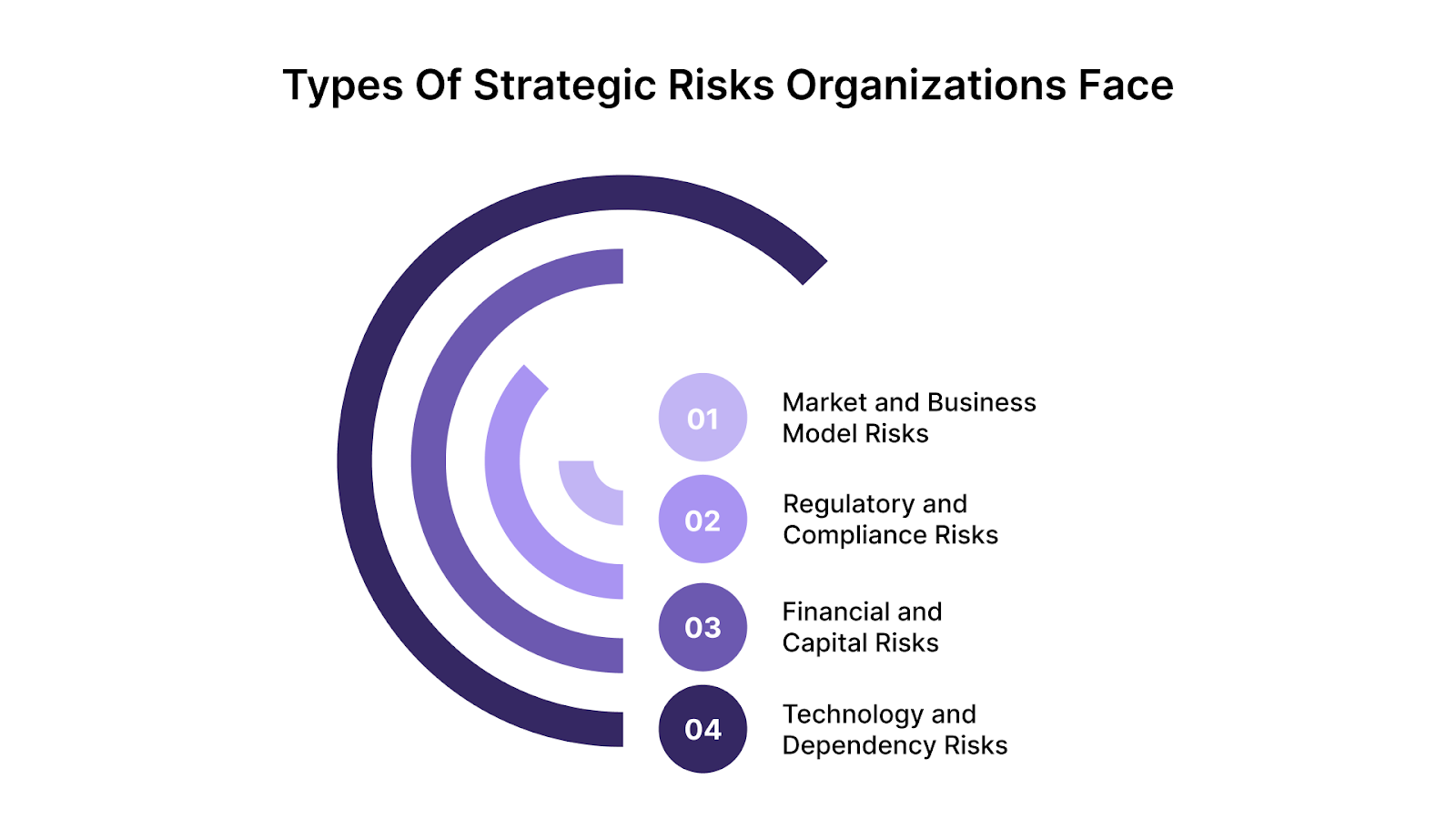
1. Market and Business Model Risks
These risks stem from changes in the environment where your business competes or from strategic choices about how you generate value.
Below are common examples:
- Competitive Shifts: New entrants or innovation from rivals can erode your market edge faster than expected, forcing you to rethink your value proposition.
- Demand Changes: Customer preferences or economic shifts can reduce demand for your products or services, requiring strategic pivots.
- Expansion Decisions: Entering new markets, launching new offerings, or scaling too quickly without validated demand can introduce strategic risk when execution outpaces product-market fit.
2. Regulatory and Compliance Risks
For financial services and fintech, regulatory change is not an afterthought; it shapes your business model and competitive positioning.
Here are key strategic risk types in this category:
- Licensing Exposure: Failing to secure or maintain critical licenses can limit your ability to operate in target markets or offer core services.
- Regulatory Change Risk: New rules, guidance, or enforcement priorities can quickly recalibrate what is allowable, profitable, or compliant.
- Sponsor Bank Dependencies: If your model relies on sponsor banks or intermediaries, shifts in their risk appetite or regulatory relationships can become strategic vulnerabilities.
3. Financial and Capital Risks
Strategic decision-making inevitably involves capital and financing, and missteps here can have long-lasting consequences.
Key financial strategic risks include:
- Funding Structure: Overreliance on a single investor class or short runway can leave you exposed when markets tighten.
- Liquidity Decisions: Strategic choices about deploying reserves, lines of credit, or capital buffers affect your ability to withstand downturns.
- Investor Expectations: Divergence between investor timelines and business performance can create strategic pressure that forces suboptimal decisions.
Feeling blindsided by sudden regulatory shifts or partner risks that disrupt your growth? Fraxtional risk leadership helps you spot these hidden threats early so you can make confident decisions. Partner with us to strengthen your strategic oversight.
4. Technology and Dependency Risks
Technology isn’t just an enabler; it shapes your business model, operational ecosystem, and risk exposure. Strategic risk here can be hidden or amplified by external forces.
Below are key considerations:
- Platform Reliance: Dependence on a single platform, API, or critical system can create concentrated risk if that platform fails or changes.
- Third-Party Vendors: Outsourced services or tools introduce strategic risk when vendor performance, stability, or compliance changes impact your capabilities.
- Cyber Risk as a Strategic Issue: Cyber threats, including data breaches, ransomware, or AI exploitation, can disrupt operations and undermine trust, both key strategic assets.
Also Read: How to Use a Gap Assessment Template Reviewers Actually Expect
Now, let's see how to identify strategic risks early.
How to Identify Strategic Risks Early

Early identification of strategic risks is the result of intentional oversight, structured planning, and proactive decision processes.
Below are practical ways to identify strategic risks before they become urgent problems.
- Strategic Planning Reviews: Reassess growth and expansion plans through a risk lens, challenging assumptions on demand, competition, regulation, and capacity before execution.
- Product and Market Entry Risk: Evaluate strategic risks tied to new products or markets using structured methods to surface potential failure points early.
- Environmental and Trend Scanning: Monitor regulatory, competitive, economic, and technology shifts to identify emerging risks ahead of impact.
- Cross-Functional Risk Input: Involve product, finance, and business teams in risk discussions to reduce blind spots beyond compliance.
- Scenario Testing and Early Signals: Test strategies against plausible scenarios and define indicators that trigger review or corrective action.
Once strategic risks are identified early, the next step is conducting a strategic risk assessment to evaluate their impact, likelihood, and relevance to long-term objectives.
How to Conduct a Strategic Risk Assessment
Conducting a strategic risk assessment turns risk from a vague concern into a structured understanding of threats that could undermine your long‑term goals. It’s a systematic process that connects your business strategy to the risks that could derail it.
Here's how to conduct a strategic risk assessment:
- Define Strategic Objectives Clearly: Document specific, measurable goals that leadership agrees on. Clear objectives are the baseline for identifying meaningful risk.
- Identify Risks That Threaten Those Objectives: Surface risks that could directly delay or derail goals by combining cross-functional input with external signals like regulatory or market changes.
- Assess Impact, Likelihood, and Velocity: Evaluate how severe each risk could be, how likely it is, and how quickly it could affect the business to separate critical risks from background noise.
- Prioritize at the Leadership Level: Rank risks based on their impact on key objectives and present the most significant ones through executive or board-level dashboards.
Also Read: What Is Risk and Control Self-Assessment? Framework and Execution
After completing a strategic risk assessment, the focus shifts from analysis to action, implementing strategic risk management across the organization.
How to Implement Strategic Risk Management Across the Organization
Implementing strategic risk management means moving from planning to doing. It requires structures, roles, and processes that connect risk insight directly to your biggest decisions, like growth, partnerships, and capital allocation.
Below are key actions leaders use to make strategic risk real:
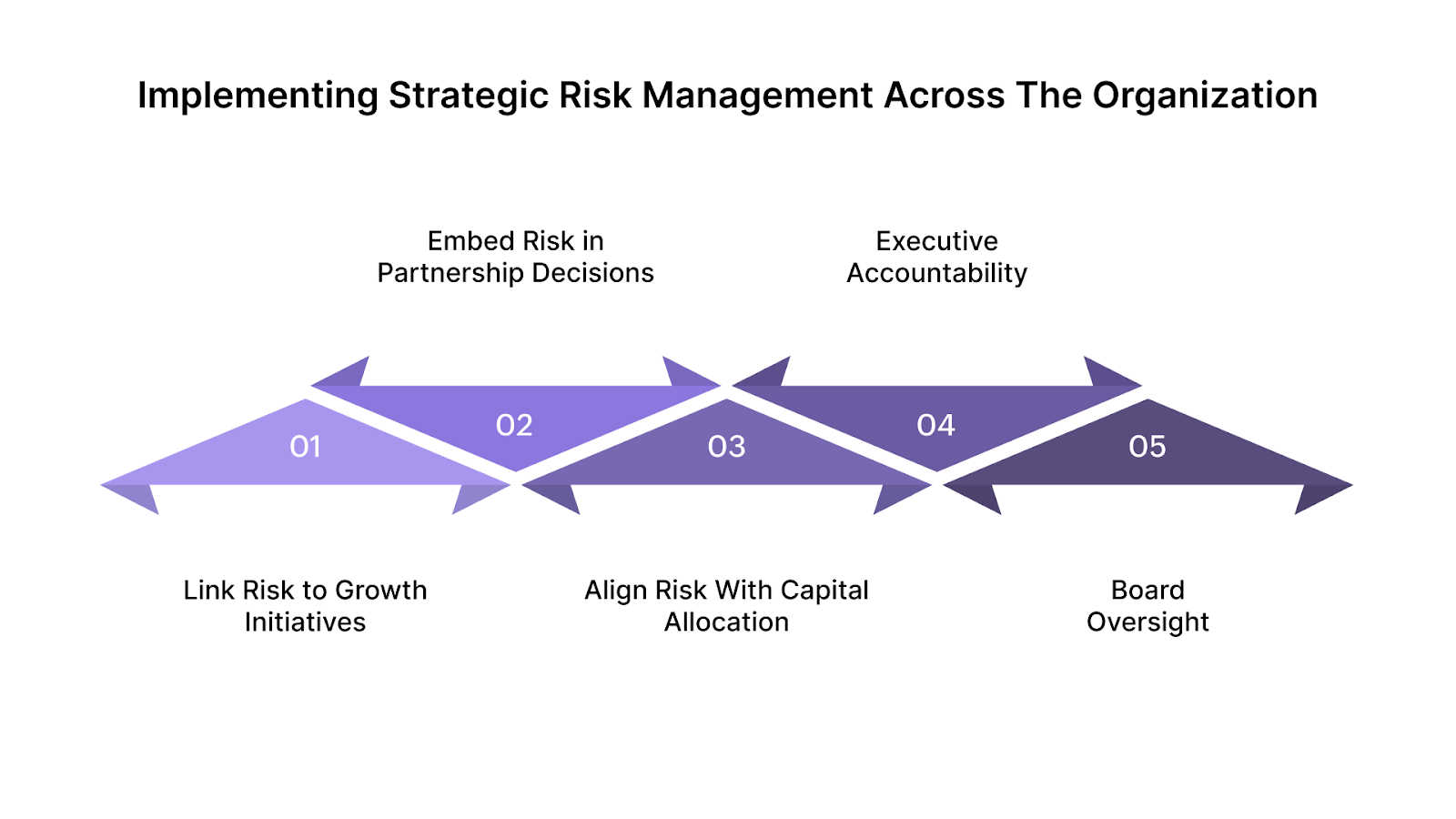
- Link Risk to Growth Initiatives: Integrate risk assessment into planning new products, markets, or scaling plans so risks are flagged and mitigated before launch.
- Embed Risk in Partnership Decisions: Assess strategic risks tied to joint ventures, sponsor banks, and key alliances to avoid surprises that impact operations or compliance.
- Align Risk With Capital Allocation: Tie risk insights to budgeting and funding choices so resources are directed to areas that support long‑term resilience.
- Executive Accountability: Assign clear ownership of strategic risks to executives who influence decisions, ensuring risk is part of leadership dialogues.
- Board Oversight: Regularly update the board on strategic risks with concise dashboards and scenario impacts, enabling governance that matches the pace of change.
Once strategic risk management is integrated across the organization, practical challenges often determine whether those frameworks actually work.
What Challenges Prevent Strategic Risk Management from Working
Even with the best intentions, strategic risk management can fail if the right structures and mindsets aren’t in place. Leaders often encounter practical obstacles that keep risk from being visible, actionable, and tied to business decisions.
Here are key challenges and how to fix them:
- Fragmented Ownership: When risk responsibility is scattered across teams, threats slip through the cracks.
- Fix: Assign clear ownership at the executive and board level, ensuring that each risk has a designated accountable leader.
- Reactive Compliance Mindset: Treating risk only after issues arise creates constant firefighting.
- Fix: Integrate proactive risk identification into strategy and decision-making cycles, making anticipation part of every leadership review.
- Static Risk Assessments: Annual or infrequent reviews fail to capture fast-moving market or regulatory changes
- Fix: Implement continuous monitoring, scenario planning, and early warning indicators to keep the risk picture up to date.
- Lack of Independent Challenge: Without outside perspectives, leadership can overlook blind spots or biases.
- Fix: Bring in independent audit, advisory boards, or fractional C-suite experts to provide an objective critique and validation.
Struggling to apply frameworks in fast-changing environments without slowing growth? Fraxtional risk leadership provides executive-level guidance to implement strategies efficiently. Reach out to us to make strategic risk management actionable today.
Now, let’s examine how to measure strategic risk management effectiveness and tie it back to leadership decisions.
How to Measure Strategic Risk Management Effectiveness

Measuring the effectiveness of your strategic risk management ensures you see real outcomes, not just activity. Without measurable signals, it’s impossible to know whether your risk efforts are reducing exposure, influencing decisions, or strengthening governance.
Below are key measurement approaches:
- Risk Exposure Trends: Monitor how key risk indicators (KRIs), such as frequency of tolerance breaches, residual risk levels, or control failure rates, move over time to show whether strategic risk exposure is increasing or decreasing.
- Regulatory Outcomes: Track audit findings, exam results, and compliance exceptions to see if your strategic risk practices are reducing regulatory friction and improving oversight outcomes.
- Strategic Decision Quality: Evaluate how often risk insight informs major decisions (e.g., market entry, partnerships, capital allocation) and whether those decisions result in fewer strategic reversals or unexpected setbacks.
Also Read: What Is a Data Governance Policy? A Practical Guide for Regulated Teams
Now, the focus turns to how organizations can resource and sustain strategic risk management effectively.
How Fraxtional Risk Leadership Supports Strategic Risk Management
Strategic risk doesn’t wait for “later”; it shows up in every growth initiative, bank relationship, and investor evaluation. But hiring full‑time executives early can be expensive, slow, and often premature.
Fraxtional offers a different path: expert strategic risk leadership integrated into your team without the full‑time overhead.
Below are the ways Fraxtional’s risk leadership model helps you turn strategic risk management into a real business advantage:
- Avoid Premature Full‑time Hires: Most startups and growth‑stage companies don’t need a full‑time chief risk/ compliance executive before the point where complexity demands leadership. Fraxtional places seasoned leaders into your organization on demand, saving headcount and cost while ensuring strategic accountability.
- Fractional C‑suite Leadership: Fraxtional integrates directors, such as Chief Compliance Officers (CCO), Chief Risk Officers (CRO), or BSA/AML leaders, directly into your leadership team.
- High ROI From Flexible Engagement: Because engagements are tailored, part‑time, project‑based, or interim, you pay only for the level of leadership your organization actually needs.
- Support Aligned With Regulatory And Investor Expectations: Fraxtional’s leaders bring deep experience with complex compliance regimes (e.g., AML/KYC, licensing, SOC 2), helping you build frameworks that satisfy regulators, sponsor banks, and investors, which strengthens trust and increases enterprise value.
Fraxtional helps you integrate expert risk and compliance leadership into critical strategic decisions, giving you governance, oversight, and execution capability when you need it most, without the burden of a full‑time hire.
Also Read: Information Security Policies: Importance, Elements, and Key Questions
Final Thoughts
Strategic risk management is a critical discipline for fintech founders, bank executives, crypto leaders, and private equity investors who want to safeguard growth, maintain regulatory alignment, and protect enterprise value. By focusing on what is strategic risk management, you can anticipate threats that impact long-term goals and build resilience into your organization’s planning and execution.
Fraxtional helps you turn this discipline into action. By integrating expert C-suite leadership directly into your team, you get seasoned guidance on risk identification, mitigation, and governance without the cost of full-time hires.
Ready to strengthen your strategic risk management? Reach out to Fraxtional to discuss how we can integrate fractional risk leadership into your organization.
FAQs
Strategic risk management gives leaders a structured way to anticipate threats and opportunities tied to long‑term goals. By integrating risk assessment into planning and evaluation cycles, you make decisions based on risk exposure, scenario impacts, and aligned priorities, not just intuition or short‑term performance.
Strategic risk frameworks provide structure, common language, and repeatable processes to guide leaders without replacing judgment. Commonly used tools include COSO ERM for enterprise-wide alignment, ISO 31000 for adaptable risk principles, and risk matrices or heat maps for quick visual assessment.
Strategic risks should be reviewed continuously, with trigger-based reviews after major events, regular monitoring through dashboards during the year, and a comprehensive annual assessment aligned with planning cycles to refresh risk priorities, update registers, and adjust tolerance as conditions change.
Scenario planning tests how different future conditions could impact long‑term objectives. It helps you evaluate strategies under varied risk scenarios, enabling proactive mitigation and contingency plans instead of reactive responses.
Tools like risk matrices, heat maps, SWOT analysis, and scenario models help you visualize risk likelihood and impact. They transform complex risk information into actionable insights for leadership.
blogs
Don’t miss these
.jpg)


Let’s Get Started
Ready to Strengthen Your Compliance Program?
Take the next step towards expert compliance solutions. Connect with us today.
Now Accepting:
BTC

ETH

USDC
USDP