

Feb 13, 2026
Risk Assessment Matrix: How to Build One for Strategic Decisions

By Fraxtional LLC

Running a startup or managing compliance means constant pressure as priorities shift and regulations change. Too often, risks arrive without warning, creeping into strategy and board discussions as gut-feel assumptions that slow decisions and execution. That’s where a risk assessment matrix becomes a strategic lens.
It helps CEOs, compliance leaders, sponsor bank directors, and private equity investors translate ambiguous risks into structured priorities you can act on. In fact, according to PwC’s Global Compliance Survey 2025, 76% of organizations now include formal risk assessment as part of their compliance workflows, ranking it among the top three activities driving risk-informed decisions at the executive level.
In this blog, we will explore what a risk assessment matrix is, how it works, and how to build one that truly elevates your strategic decision-making.
Key Takeaways
- A risk assessment matrix helps leaders prioritize risks using probability and impact, turning uncertainty into clear, defensible strategic decisions.
- The effectiveness of a matrix depends on fit: the right size and scale should match your business complexity, regulatory exposure, and growth stage.
- Strategic value comes from how the matrix is used, not just built, linking risks to risk appetite, capital allocation, product decisions, and board oversight.
- Consistent scoring, cross-functional input, clear ownership, and regular reviews are essential to keep the matrix decision-ready rather than static.
- With experienced, independent risk leadership like Fraxtional, a risk assessment matrix evolves from a compliance artifact into a practical governance and execution tool.
Why Do Strategic Leaders Need a Risk Assessment Matrix Today

If you are leading a fintech, bank, crypto firm, or advising a portfolio company, risk no longer sits quietly in compliance reviews. It shows up in funding conversations, product roadmaps, and board meetings.
Here’s what is changing on the ground and why informal approaches no longer hold up.
- Regulatory Pressure Is Unpredictable: Regulators now act faster and dig deeper, especially on AML, data security, third-party risk, and consumer protection. Leaders need clarity on which risks escalate first and why.
- Capital Decisions Require Downside Clarity: Investors expect risks ranked and controlled, not just potential upside. A risk matrix turns uncertainty into defensible priorities.
- Ad-Hoc Tracking Fails at Scale: Spreadsheets and informal reviews work early but break as teams, products, and regulatory scrutiny grow.
Also Read: How to Use a Gap Assessment Template Reviewers Actually Expect
Knowing the strategic value of a risk assessment matrix is one thing. Understanding what it looks like and how leaders actually use it, is what makes it useful.
What Is a Risk Assessment Matrix in Practical Terms

A risk assessment matrix is a structured, visual, and quantitative tool that leadership teams use to rank and compare risks based on how likely they are to occur and how serious their consequences would be.
Here’s what it is:
- A Visual Prioritization Tool: A grid or chart linking likelihood and impact to show risk severity.
- A Decision Support Framework: Helps leaders decide whether to accept, mitigate, transfer, or escalate a risk.
- A Comparative Lens: Turns subjective worries into ranked insights you can act on and communicate across teams.
Once a risk assessment matrix is clearly defined, let’s explore how to create one.
How to Create a Risk Assessment Matrix Step by Step
Building a risk assessment matrix isn’t about filling out a template; it’s about creating a decision-ready tool that leadership, boards, and investors can use with confidence.
Below is a practical, disciplined process that keeps you focused on what matters most.
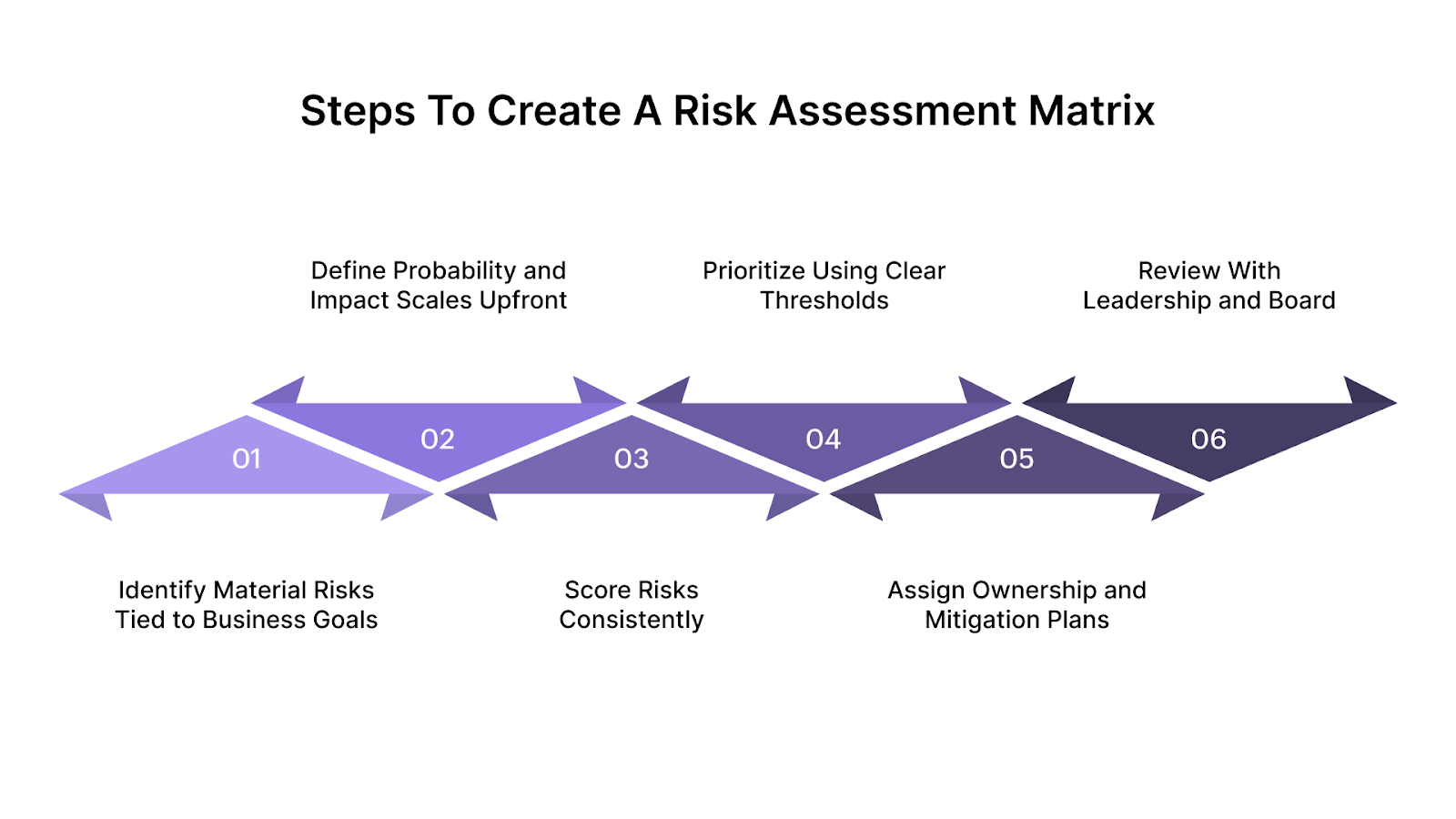
1. Identify Material Risks Tied to Business Goals
Start with a strategic risk inventory, not a laundry list of every possible problem.
- Ask Yourself: Which risks have the potential to derail our growth targets, regulatory milestones, or market entry plans?
- Example: A fintech planning a new payments feature might list risks like sponsor bank rejection, AML control gaps, and customer onboarding failures.
- Tip: Use cross-functional workshops to ensure you capture risks from operations, product, compliance, and finance.
2. Define Probability and Impact Scales Upfront
Before you score anything, agree on the scales you will use. Consistency is more important than complexity.
- Probability: Rare, Unlikely, Possible, Likely, Almost Certain
- Impact: Insignificant, Minor, Moderate, Major, Catastrophic
Agree on what each level means in business terms, e.g., “Major = $5M–$10M revenue impact or regulatory sanctions.”
3. Score Risks Consistently
With definitions in place, assign each risk a probability and impact score. Use documented criteria rather than intuition alone.
Example: Customer onboarding errors that regularly trigger manual fixes might be scored as:
- Probability: 4 (Likely)
- Impact: 3 (Moderate)
This yields a risk score that leadership can compare to others.
4. Prioritize Using Clear Thresholds
Define thresholds for what counts as high, medium, or low risk before you score anything. This avoids moving goalposts after scores are assigned.
Example:
- Scores 1–6 = Low Priority
- Scores 7–13 = Medium Priority
- Scores 14+ = High Priority
Place risks in your matrix using these thresholds so teams know which require immediate mitigation.
5. Assign Ownership and Mitigation Plans
Every high and medium-risk needs a clearly accountable owner and a specific action plan.
Example:
For a high risk of sponsor bank compliance gaps, assign the compliance lead to:
- Build a remediation plan
- Report progress weekly
- Escalate blockers to the executive team
6. Review With Leadership and Board
A risk matrix is not a one-and-done artifact; it should be part of ongoing governance.
Schedule recurring reviews:
- Quarterly leadership risk reviews
- Semi-annual board risk deeply enters
These sessions validate scores against new data and strategic shifts, ensuring your matrix reflects the current reality.
If your risk discussions feel reactive or hard to defend in leadership or board meetings, it is often a sign that risk prioritization lacks senior judgment. Fraxtional brings experienced, independent risk leadership to help you turn your risk assessment matrix into a decision-ready framework. Reach out to us today!
Now, let’s see how a risk assessment matrix supports decision-making.
How a Risk Assessment Matrix Supports Strategic Decision-Making

A risk assessment matrix doesn’t just visualize risks; it becomes a strategic tool that directly influences growth, resilience, and governance across high-stakes decisions.
Here’s how it helps leaders like you turn uncertainty into decision clarity:
- Product Launch Prioritization: Quantify regulatory, operational, and market risks upfront to sequence features, allocate compliance resources, and address high-impact risks before rollout.
- Market Expansion Decisions: Score expansion risks to identify compliance gaps or infrastructure weaknesses, guiding market choices aligned with risk appetite.
- Sponsor Bank Relationship Management: Provide concise, repeatable risk visibility to strengthen partnerships and demonstrate structured governance.
- Regulatory Exam Readiness: Use the matrix to assess risk severity and mitigation, improving audit narratives and reducing back-and-forth with regulators.
Also Read: What Is Risk and Control Self-Assessment? Framework and Execution
Now, the next step is understanding how probability and impact are actually assessed.
How Probability and Impact Are Calculated?

In a risk assessment matrix, probability and impact are the two axes that determine whether a risk is low, moderate, or high priority.
Here’s a step-by-step logic to score probability and impact:
- Define Your Scales: Decide whether you’re using a simple 3-point (Low/Medium/High), 4-point, or 5-point scale for both probability and impact.
- Assign Probability Scores
- For Qualitative: “Unlikely”, “Possible”, “Likely.”
- For Quantitative: use historical frequency or statistical estimates (e.g., 0.2 = 20% chance). For strategic teams, a 5-point scale works well:
- 1 = Rare
- 2 = Unlikely
- 3 = Possible
- 4 = Likely
- 5 = Almost Certain
- Assign Impact Scores: Impact should be measured in business terms such as revenue loss, regulatory penalties, or operational disruption. Translate these into consistent categories:
- 1 = Insignificant
- 2 = Minor
- 3 = Moderate
- 4 = Major
- 5 = Catastrophic
- Plot and Interpret: Once both probability and impact are scored, place the risk on your matrix. In a quantitative version, multiplying probability × impact gives you a risk score (e.g., 4 × 4 = 16, a high-risk area).
Example: A fintech leader identifies the risk of failing a compliance audit. Based on internal data and regulatory history, you judge:
- Probability: 4 (Likely)
- Impact: 5 (Catastrophic)
Multiplying these in a 5×5 scale gives a risk score of 20, placing this risk in the high-priority quadrant of your matrix.
Also Read: What Is a Data Governance Policy? A Practical Guide for Regulated Teams
Once probability and impact are assessed, the next step is translating them into consistent scores using the appropriate risk matrix scale.
What Risk Assessment Matrix Scales Are Most Common

Choosing the right matrix size isn’t about tradition; it’s about fit for complexity and decision clarity. The number of rows and columns (e.g., 3×3, 4×4, 5×5) determines how finely you separate likelihood and impact categories.
Below is a practical guide on when to use each, what trade-offs they involve, and examples to help you decide.
When a 3×3 Risk Matrix Makes Sense
A 3×3 matrix has three levels of likelihood and three of impact, creating nine risk cells total. It’s simple, quick, and easy to explain to leadership without training.
Best Fit When:
- Early-stage startups where risk categories are still being discovered, and controls are nascent
- Limited regulatory exposure, you’re not juggling dozens of compliance obligations
Why It Works Here
- Low Complexity: Fewer categories reduce decision friction in early lifecycle stages.
- High Clarity, Low Noise: Teams can quickly identify high vs low concerns.
Trade-offs
- Too Blunt For Nuanced Differences: Many risks may end up clustered in the “medium” box, reducing differentiation.
- Not Stable For Governance Scale: Boards and investors may push for more granularity as risk processes mature.
After understanding the basics of a 3×3 matrix, it’s helpful to see when a 4×4 matrix provides more nuanced risk prioritization.
When a 4×4 Risk Matrix Is More Effective
A 4×4 risk matrix offers four levels on each axis, 16 total cells, adding a layer of nuance without exploding complexity.
Best Fit When:
- Scaling fintechs or financial services firms with burgeoning product lines
- Multi-product environments where more categories help isolate priority areas
Why It Works Here
- Balanced Granularity: More cells help distinguish between risks that are moderately different in likelihood or impact.
- Better Prioritization: Leadership can make clearer judgments about where to invest risk mitigation efforts.
Trade-offs
- Requires Clearer Definitions: Teams must agree on what distinguishes each level, e.g., “likely” versus “very likely.”
- Still Interpretable: Not so granular that it overwhelms stakeholders, but enough to make differentiation meaningful.
As complexity grows, large organizations often adopt a 5×5 matrix for finer risk differentiation.
Why Large Organizations Use 5×5 Risk Matrices
A 5×5 matrix has five levels of likelihood and impact, 25 total cells, and is the most commonly recommended format for detailed risk profiling.
Best Fit When:
- Banks are subject to multiple regulatory regimes and exams
- Crypto platforms managing complex cross-border, technology, and liquidity risks
- Private-equity-backed companies where investors require deep risk decomposition
Why It Works Here
- High Detail: Allows fine distinctions between risk intensities, critical in regulatory and financial reporting contexts.
- Investor Confidence: Boards and investors expect this level of detail when evaluating governance.
Trade-offs:
- Requires Disciplined Input: Without strong scoring definitions, the matrix can become inconsistent.
- More Effort to Maintain: Teams must invest in governance and training to keep scores comparable across cycles.
Choosing the right scale helps leaders balance clarity with precision so risk matrices become tools for actionable decision-making, not just dashboards of colors.
Also Read: Vendor Management Policy Guide: From Risk Questions to Audit-Ready Execution
While scale selection matters, the structure of the matrix itself also varies. Leaders choose different types of risk assessment matrices based on decision-making needs, regulatory expectations, and organizational maturity.
What Types of Risk Assessment Matrices Leaders Use
As your risk program matures, one risk assessment matrix isn’t enough to capture all dimensions of what could go wrong.
Below are the common matrix types you’ll encounter in a risk assessment matrix:
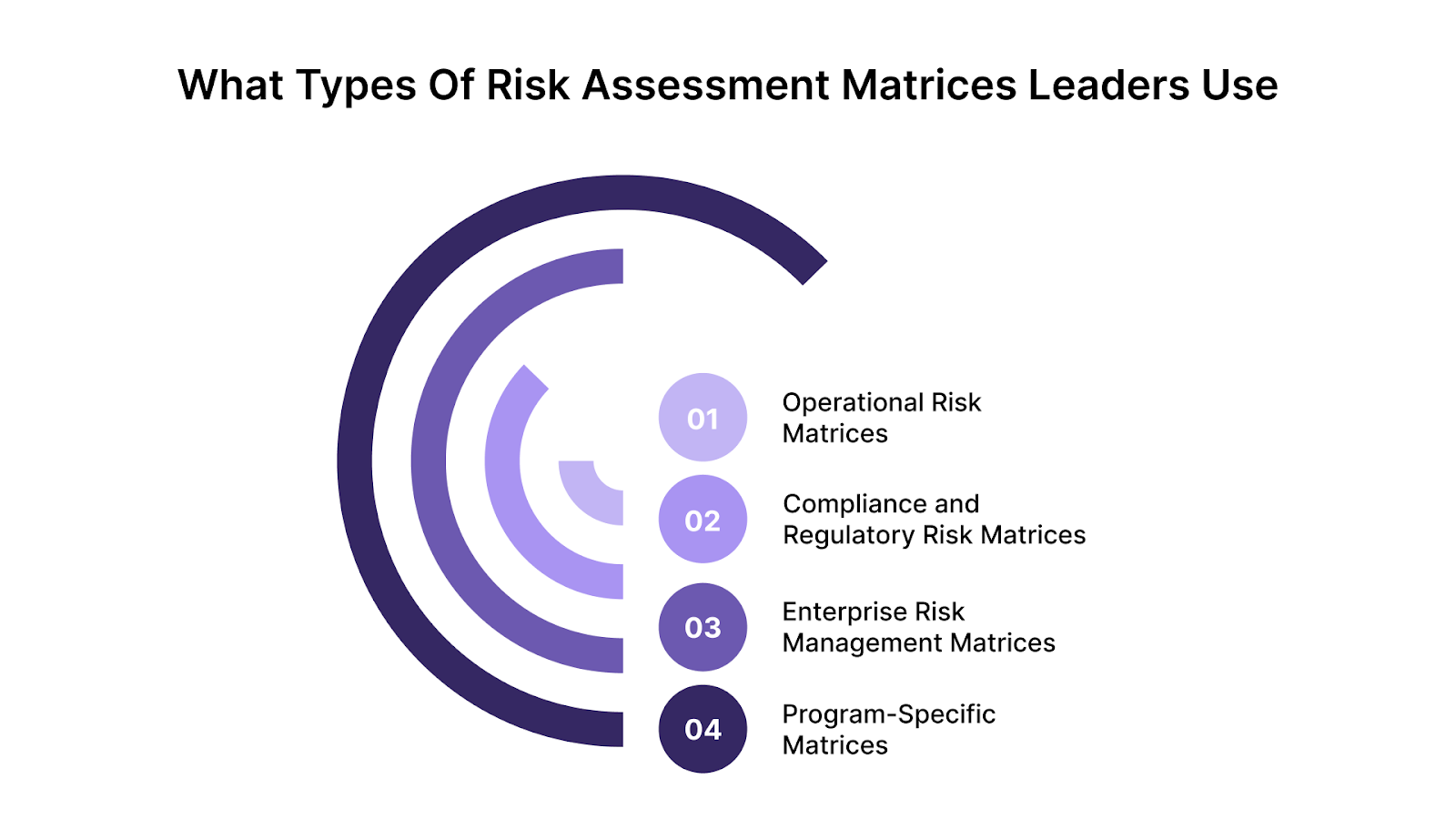
- Operational Risk Matrices: Focused on internal processes, systems, and execution risks that affect day-to-day operations.
- Compliance and Regulatory Risk Matrices: Tailored to risks tied to laws, rules, exams, and regulatory penalties.
- Enterprise Risk Management (ERM) Matrices: High-level matrices that encompass strategic, financial, reputational, and systemic risks across the organization.
- Program-Specific Matrices: Used for targeted initiatives like vendor risk, product launches, or technology rollouts where the risk profile is unique.
Often, mature organizations maintain more than one matrix simultaneously, using each for its intended audience and decision context, e.g., compliance leadership uses a regulatory matrix for exam readiness, while the board reviews an ERM view for oversight.
Many organizations document risks well but struggle to decide which ones to accept, escalate, or invest in. Fraxtional helps leadership teams define risk appetite, decision thresholds, and trade-offs using practical, regulator-aware frameworks. Contact us to align your risk assessment matrix with real strategic leadership.
Now, let’s explore the most common challenges leaders encounter.
What Are the Most Common Challenges When Building a Risk Assessment Matrix
On paper, building a risk assessment matrix looks straightforward. Many matrices fail not because the framework is wrong, but because leadership decisions around ownership, judgment, and governance are unclear.
Below are the most common challenges leaders run into, along with practical fixes.
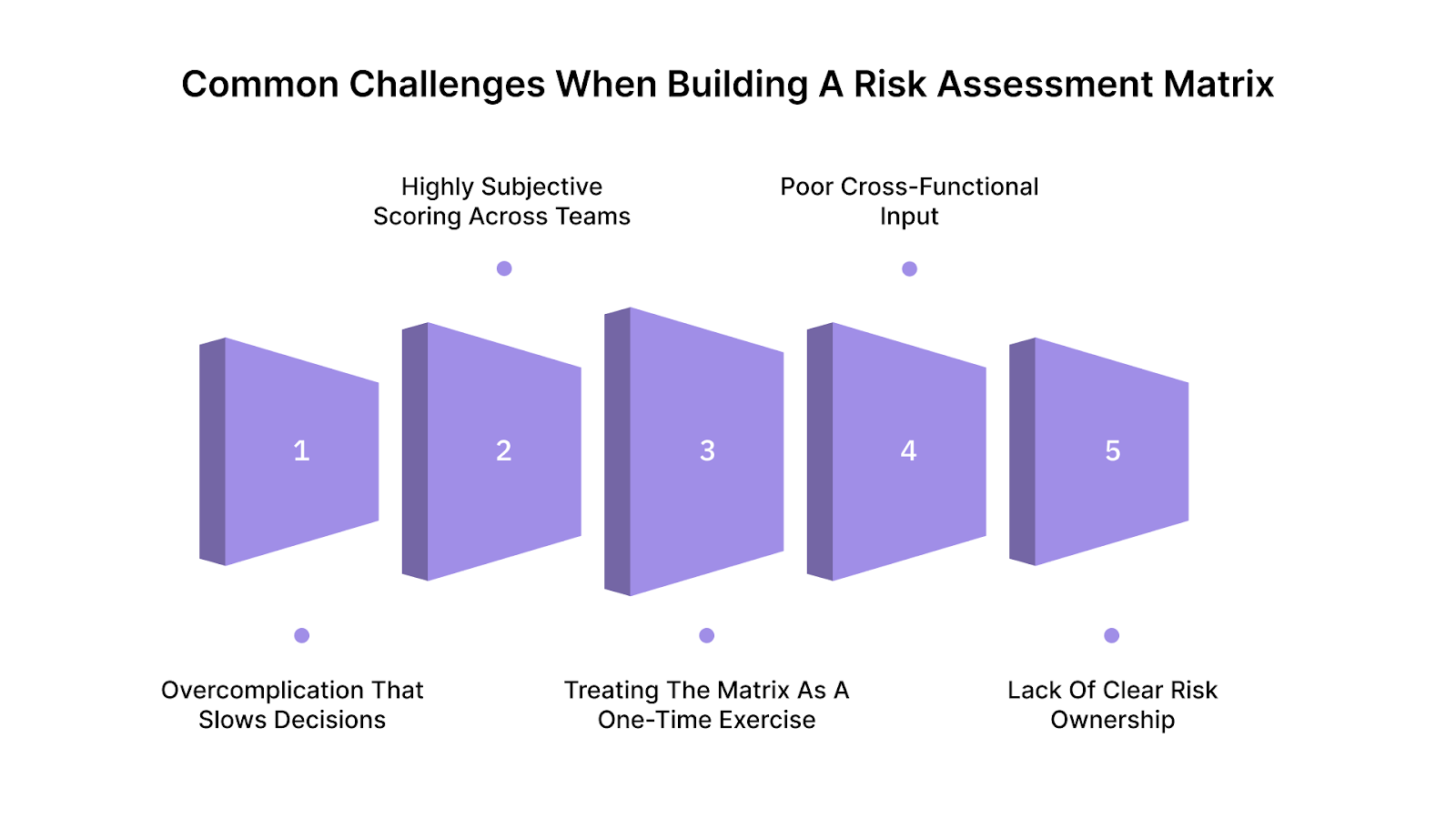
- Overcomplication that Slows Decisions: Leaders sometimes add too many scales, formulas, or risk categories in an attempt to be precise. The result is a matrix no one can interpret quickly.
- Fix: Match complexity to decision needs. If the matrix does not change priorities or actions, simplify it.
- Highly Subjective Scoring Across Teams: Different leaders score the same risk differently based on experience, incentives, or risk tolerance. This erodes trust in the output.
- Fix: Define scoring criteria clearly and review scores cross-functionally to normalize judgment.
- Treating the Matrix as a One-Time Exercise: Many organizations build a matrix for audits or board decks and never revisit it. Risks change, but scores don’t.
- Fix: Tie updates to business events, regulatory changes, and quarterly leadership reviews.
- Poor Cross-Functional Input: When risk scoring is owned by one function, blind spots emerge. Operational or product risks are often underestimated.
- Fix: Involve compliance, operations, product, and leadership in scoring discussions.
- Lack of Clear Risk Ownership: Risks without owners become discussion points, not action items.
- Fix: Assign accountable owners and require documented mitigation plans.
Also Read: Information Security Policies: Importance, Elements, and Key Questions
Now, let’s explore why experienced risk leadership, like Fraxtional, can turn a matrix from a static tool into a strategic decision-making asset.
How Fraxtional Risk Leadership Strengthens Risk Assessment Matrices

Risk assessment matrices only become strategic when they are backed by experienced, independent leadership, not just static documents. That’s where Fraxtional elevates the process for fintechs, banks, crypto firms, and private equity teams by integrating seasoned risk and compliance leaders into your strategic workflow.
Here’s how Fraxtional enhances the value of your risk matrices in ways that matter to decision-makers:
- Independent Risk Perspective: Fraxtional’s directors bring objective judgment that’s outside internal biases, helping you assess and prioritize risks based on market reality, not internal politics or wishful thinking.
- Experience Across Regulators and Business Models: With decades of combined experience in banking, fintech, crypto, and investor compliance, Fraxtional leaders know what examiners and boards focus on, making your risk scores more defensible and actionable in high-stakes conversations.
- Avoiding Internal Bias: In-house teams can unintentionally under- or over-score risks tied to their own domains. Fraxtional provides leadership that challenges assumptions and brings disciplined frameworks to scoring and prioritization.
- Scaling Risk Governance Without Full-Time Hires: Rather than locking down expensive full-time executives, Fraxtional integrates part-time leaders (e.g., CCOs, CROs, MLROs) who own outcomes and scale governance as your business grows.
Fraxtional’s approach ensures your risk assessment matrix isn’t just a spreadsheet; it’s a governance asset that supports confident decisions, clear accountability, and investor-ready reporting across your organization.
Also Read: Drata vs Human Compliance Leadership
Final Thoughts
A risk assessment matrix is most powerful when it moves beyond documentation and becomes a repeatable decision framework. When probability and impact are assessed consistently and tied to business objectives, the matrix helps leaders prioritize trade-offs, allocate capital with intent, and make risk-aware decisions quarter after quarter.
This is where Fraxtional adds real value. Fraxtional brings experienced, independent risk and compliance leadership that strengthens how risk matrices are built, reviewed, and used, helping fintechs, banks, crypto firms, and investors scale governance without the cost or rigidity of full-time executive hires.
If you want to turn your risk assessment matrix into a tool that supports confident strategic decisions, reach out to Fraxtional to speak with a fractional risk leader and understand the right next steps for your business.
FAQs
The risk assessment matrix should be jointly owned by senior leadership, with day-to-day stewardship by risk or compliance leads. Ownership works best when accountability is clear, but scoring and prioritization involve cross-functional input to avoid blind spots and internal bias
Yes. Risk matrices are widely used in board and investor reporting because they provide a clear, visual summary of risk exposure. When aligned with risk appetite and thresholds, they help boards understand where leadership is accepting risk and where action is required.
A risk assessment matrix must reflect current conditions to guide decisions. Leaders update it quarterly or after triggers like new products, market entry, control changes, regulatory guidance, or incidents such as outages or audit findings to ensure emerging threats are captured accurately.
A risk register lists risks and related details. A risk assessment matrix prioritizes those risks by likelihood and impact. Most mature organizations use both: the register for documentation and tracking, and the matrix for leadership decisions and governance discussions.
Yes. Emerging risks such as regulatory changes, new technologies, or market shifts should be included even when data is limited. These risks may be scored with higher uncertainty, but excluding them can leave leadership unprepared for issues that escalate quickly.
blogs
Don’t miss these



Let’s Get Started
Ready to Strengthen Your Compliance Program?
Take the next step towards expert compliance solutions. Connect with us today.